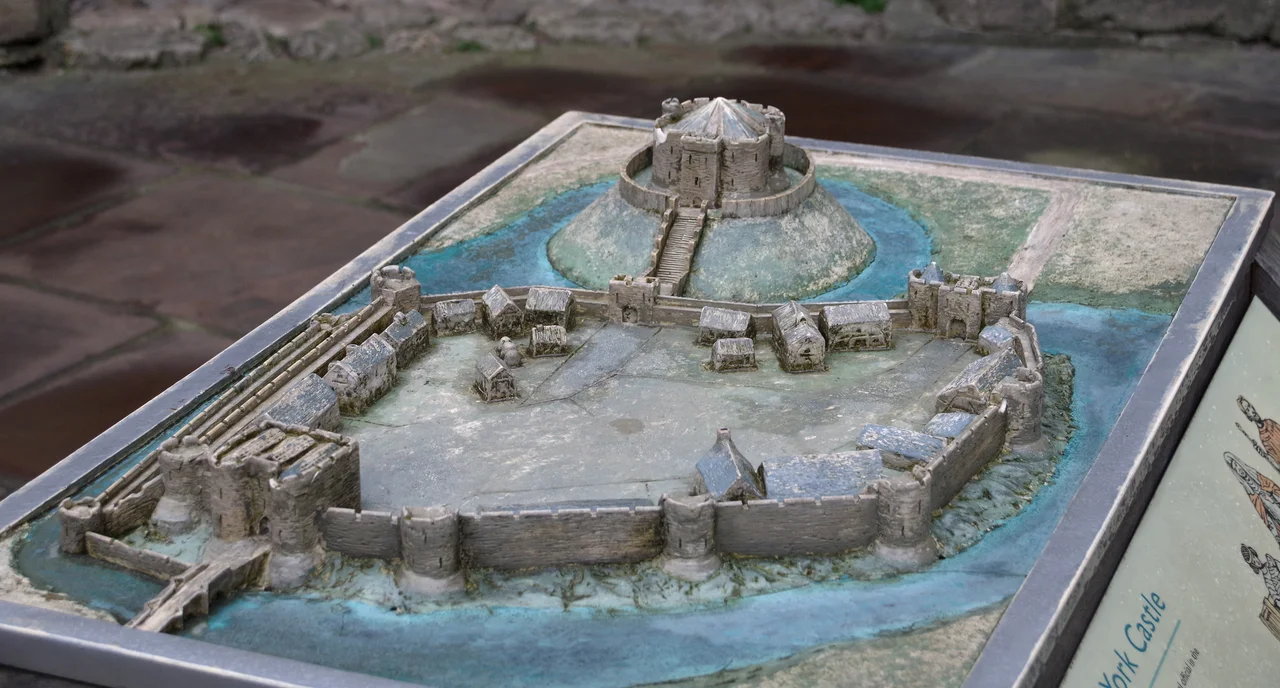

York Castle
On the night of Friday 16 March 1190, the Jewish community of York took shelter in the wooden keep of William the Conqueror's castle. A mob of townspeople surrounded them. The constable had left the keep to negotiate and was refused re-entry by terrified Jews who feared he meant to hand them over. Through the long Sabbath that followed, surrounded and out of options, perhaps 150 men, women and children died - most by their own hand and the hands of fathers and husbands acting under a Jewish legal tradition that preferred death to forced conversion. A handful surrendered with promises of mercy. They were killed by the crowd anyway.
Norman Hammer
William the Conqueror built the first castle here in 1068. York had been a Viking capital - Jórvík - for over a century, and an Anglo-Scandinavian city before that. William wanted it tamed. He destroyed hundreds of houses to clear ground for a motte and bailey castle, placed his sheriff William Malet in command, and rode away. The local population rose up immediately. Malet held the castle. The following year, William came back and built a second castle on Baile Hill across the Ouse to give himself a paired stronghold over the river crossing. Then a Danish Viking fleet sailed up from the Humber, joined by the Northumbrian rebel Cospatrick, and the Normans burned much of the city trying to repel them. Both castles fell, and Malet was taken hostage. William's response was the Harrying of the North - a punitive winter campaign that broke the back of Anglo-Scandinavian resistance and left whole districts depopulated. The water defences of York Castle were built up around an artificial lake called the King's Pool, fed by damming the River Foss. By the Domesday Book of 1086, the castle was a serious fortification.
The Massacre
Richard I was crowned in 1189 and declared his intention to join the Crusades. Anti-Jewish violence flared across England. In York, on 16 March 1190, a man named Richard de Malbis - who owed money to the Jewish financier Aaron of Lincoln - used a house fire as a pretext to incite a mob against the family of one of Aaron's recently deceased agents. The Jewish community fled to the castle keep, where royal protection was supposed to apply. The constable left to negotiate. The Jews inside, fearing the mob would be allowed in or that they would be handed over to the sheriff, refused him re-entry. Through the night and Sabbath that followed, the mob laid siege. When it became clear that no help was coming and the keep would be breached, Rabbi Yom Tov of Joigny led the community in following a Jewish tradition - originating in the mass suicide at Masada in 73 CE - of choosing death over forced conversion. Husbands killed wives. Parents killed children. The men killed each other and themselves last. Around 150 people died. A few who surrendered, promised baptism, were killed by the crowd as they emerged. The leaders of the mob then marched to York Minster and destroyed the records of debts owed to Jewish moneylenders. The massacre was one of the worst in medieval European Jewish history. The names of most of the dead are lost. A plaque at the foot of Clifford's Tower today commemorates them and quotes the verse from the Hebrew Bible: 'These I will remember.'
Stone, Quatrefoil, and a King's Visit
The wooden keep that burned during the massacre was rebuilt - in wood again - at a cost of £207. Then in 1228 a gale knocked it down. Henry III rebuilt the castle in white limestone in 1244, designing the keep in a unique four-lobed quatrefoil plan that you can still walk on top of today. The Scottish wars between 1298 and 1338 turned York Castle into the temporary administrative capital of England - the central seat of royal government when the king was campaigning against the Scots. The castle hosted Parliament and the Exchequer. By the 15th century its military importance was fading, and it slid into a long career as a county jail and debtors' prison.
The Explosion of 1684
York Castle was refortified during the English Civil War and played its part in the 1644 Royalist defence of the city against Parliamentarian and Scottish armies. It continued as a garrison after the war. In 1684 something - probably a powder magazine accident - blew up inside Clifford's Tower. The interior burned and was never restored. What you see today is the shell: outer walls of Henry III's white limestone with empty sockets where the floors and roof used to be. The military life of York Castle ended there. The legal and penal life carried on. A neoclassical Crown Court and debtors' prison were built in the 18th century, and a Tudor Gothic county prison was added in 1825. The prison closed in 1929. The Tudor Gothic block was demolished in 1935.
What Stands Today
Clifford's Tower sits on its motte, owned by English Heritage and open to the public. The 18th-century buildings around its foot now house the York Castle Museum and the working Crown Court. The motte itself has had to be reinforced with concrete underpinnings to stop the artificial mound from spreading - a 20th-century engineering intervention preserving an 11th-century earthwork. Stand on the parapet today and you look out across the Ouse, the Foss, and the medieval city - the same view a Norman garrison had, the same view those trapped inside the wooden keep had on the morning of 17 March 1190. The plaque at the base names what happened there. It is impossible to climb Clifford's Tower without thinking about it.
From the Air
Clifford's Tower stands at 53.956°N, 1.080°W in central York, on the south bank of the Foss just before it joins the Ouse. From the air, look for the white stone keep on its grass mound, surrounded by the Crown Court buildings and a large open carpark - the old castle bailey, now a controversial planning question for the city. Leeds Bradford (EGNM) is about 22 nm southwest. The tower's quatrefoil footprint is distinctive enough to recognise from altitude if visibility allows.
Nearby Stories
- Scampston Hall 3.5 km away
- Salts Mill 4.7 km away
- Newburgh Priory 6 km away
- Brodsworth Hall 6.2 km away
- Coverham Abbey 16 km away
- RAF Leconfield 17 km away
- Macclesfield Canal 27 km away
- RAF Scampton 35 km away