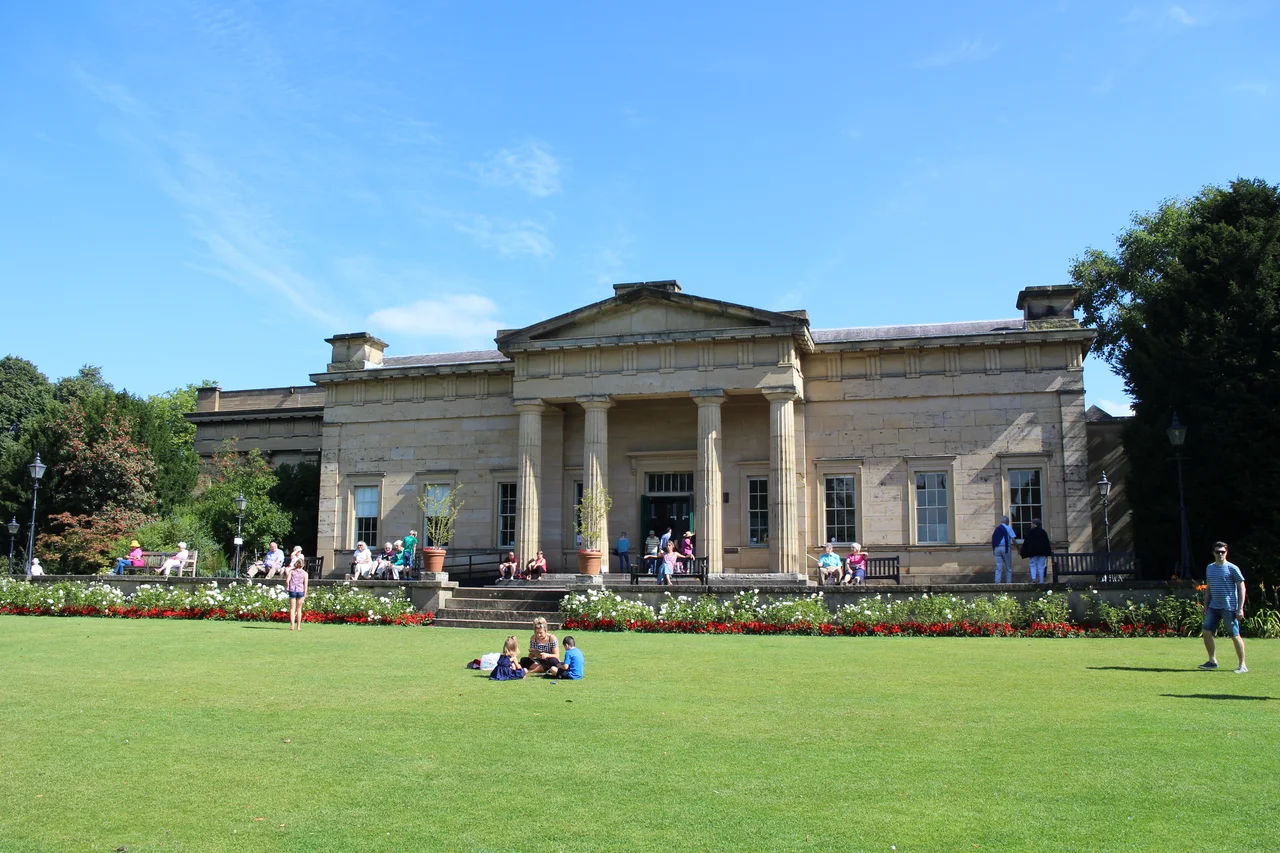

Yorkshire Museum
On 21 April 2020, deep into the first COVID lockdown, the Yorkshire Museum's curator launched a Twitter contest asking other museums to share the creepiest object in their collection. The thread exploded. The Yorkshire Museum's own entry, the bun of hair from a fourth-century Romano-British woman, complete with the original jet pins still in place, drew international attention. More than six million people saw the museum's collections online before the campaign ended. It was a strangely modern moment for an institution founded in 1830 to house geological specimens dug up by Victorian gentlemen with cabinets full of fossils.
Built for Science
The Yorkshire Philosophical Society started collecting in the 1820s, beginning with animal bones and fossils from Kirkdale Cave in North Yorkshire. The collection quickly outgrew its Ousegate premises. In 1828, the British royal family granted the society ten acres of land that had once belonged to St Mary's Abbey. William Wilkins, the architect later known for the National Gallery in London, designed the new museum in Greek Revival style. It opened in February 1830 as one of the first purpose-built museums in Britain. The royal grant came with a condition: botanical gardens had to surround the building. Those gardens, planted in the 1830s, became the Museum Gardens that still encircle the place today. On 26 September 1831, the inaugural meeting of the British Association for the Advancement of Science took place inside, marking the museum's emergence as a serious scientific institution.
The Bones in the Basement
The biology collection contains 200,000 specimens, weighted heavily toward insects. There are two stuffed great auks, a species hunted to extinction by 1844. A nearly complete skeleton of a moa, the giant flightless bird of New Zealand, stands assembled. Passenger pigeons rest in drawers. From Kirkdale Cave come elephants, cave bears, and hyenas, all roughly 125,000 years old. The geology collection runs to 112,500 specimens, with fossils dominating. In 1866-67, the museum received some of the bones the explorer Harry Higginson dug up of the dodo of Mauritius, the bird that became shorthand for human-caused extinction. The Higginson dodo bones still anchor the collection. A few cases over, there is the Middlesbrough Meteorite, which fell to Yorkshire in 1881 and was promptly collected.
Constantine's Head
The archaeology collection holds close to a million objects spanning half a million years. The showpieces come from York's own dirt: the Coppergate Helmet, an eighth-century Anglo-Saxon helmet found in 1982 during the dig that also revealed Viking Jorvik; the Ormside Bowl, a silver-gilt vessel from Cumbria; the Middleham Jewel, a fifteenth-century gold pendant set with sapphire and engraved with the Trinity on one face and the Nativity on the other. From Roman York there is the marble head of Constantine the Great, a fragment from the statue of an emperor first proclaimed at York in 306. There is the Statue of Mars, the fourth-century skeleton known as the Ivory Bangle Lady, and the Ryedale Roman Hoard of bronze figurines acquired in 2022. The Vale of York Hoard, a tenth-century Viking treasure of niello-decorated silver, holds coins from all corners of the Viking trade network.
The Star Carr People
Star Carr is a Mesolithic site twenty-five miles east of York, occupied roughly 11,000 years ago by hunter-gatherers who left behind some of the oldest art and artefacts in Britain. The Yorkshire Museum holds the Star Carr Pendant, a small shale disc carved with markings that may be the oldest Mesolithic art known. Several Star Carr Frontlets are here too: red deer skulls with antlers still attached, the bone hollowed and pierced for wear as headdresses. Whether they were ritual gear, hunting disguise, or both remains debated. In March 2024 the museum opened "Star Carr: Life after the ice," featuring objects never previously displayed, including the world's oldest known hunting bow. These finds rewrote part of what archaeologists thought they knew about early Holocene life in Britain.
A Ghost and a Bombing
On 29 April 1942, during the Baedeker Blitz, a Luftwaffe bomb narrowly missed the museum. The blast damaged the roof and shattered windows. The curator Reginald Wagstaffe, who lived in adjacent Manor Cottage, oversaw the cleanup; seven bathtubs' worth of broken glass and damaged geological specimens were carted to the rubbish. Eleven years later, in the winter of 1953, the museum's caretaker George Jonas reported seeing an Edwardian-dressed ghost in the library, and a book that repeatedly drew itself from the shelf and fell to the floor. On 27 January 1954, eight people gathered in the library to witness the phenomenon. They signed statements describing cold around their legs, the self-removing book, and pages that kept turning while the volume lay on the floor. A disagreement over the events drove the curator to resign. The book stopped falling. The museum stayed open.
From the Air
The Yorkshire Museum sits at 53.96°N, 1.09°W within the Museum Gardens in central York, just north of the River Ouse and outside the medieval city walls. Recommended viewing altitude 2,000-3,000 feet for the gardens and the Roman fortress corner. Nearest airports: Leeds Bradford (EGNM) 22nm southwest and Humberside (EGNJ) 35nm southeast. The Minster's three towers are the most prominent landmark on approach, with the museum's neoclassical pediment visible against the abbey ruins to the north.
Nearby Stories
- Scampston Hall 3.5 km away
- Salts Mill 4.7 km away
- Newburgh Priory 6 km away
- Brodsworth Hall 6.2 km away
- Coverham Abbey 16 km away
- RAF Leconfield 17 km away
- Macclesfield Canal 27 km away
- RAF Scampton 35 km away