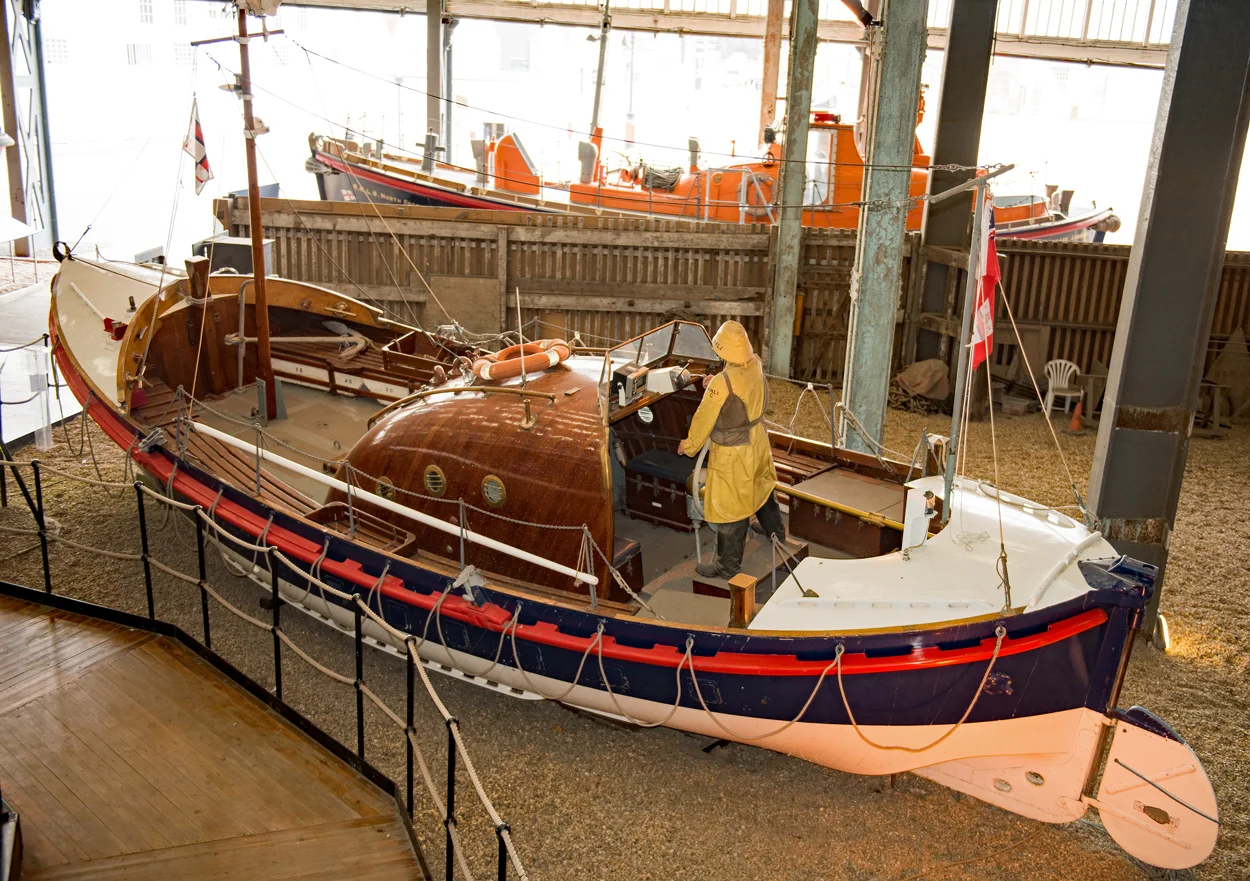

Youghal Lifeboat Station
On 23 February 1840, the new Youghal lifeboat made its first recorded service launch. There was no engine - it was a 26-foot, six-oared rowing boat - and there was no easy way to get it to the wreck. The brigantine Medora had run aground at Ardmore, seven miles up the coast on the way to Swansea. Lieutenant Richard Roe Metherell, Royal Navy, took charge. The lifeboat was transported by hand the entire seven miles. Metherell, six coastguards, and another seaman then rowed out into difficult conditions and pulled all four of the Medora's crew off the wreck. The RNIPLS Gold Medal followed. The Youghal station was just a year old, and it had already proved why coastal Ireland needed it.
The Wreck That Demanded a Station
Before the lifeboat, this stretch of coast simply lost ships. On 13 February 1828, the sloop Mermaid was driven ashore at Whiting Bay, County Waterford, in a winter storm. Lieutenant Richard James Morrison of HM Coastguard managed to rescue all five crew - including one boy - by means of rocket lines fired from the shore. He received the RNIPLS Silver Medal. The Royal National Institution for the Preservation of Life from Shipwreck (forerunner of the RNLI, founded in 1824) had been giving such medals for years, even when no lifeboat was directly involved. But it was the paddlesteamer Killarney - lost at Roberts Cove on the Cork-Bristol run with 24 dead - that finally provoked organised demand for a permanent lifeboat at Youghal. The Youghal Harbour Trust was established in 1838, and the following year a 26-foot lifeboat from Taylor of Limehouse arrived in town. It had cost £76.
Neglected, Then Rescued
By 1856, the visiting Inspector of Lifeboats found the Youghal boat in a yard, in what the official report called a neglected state. Maintaining a lifeboat is expensive; maintaining one that almost never gets called out can come to seem pointless. In 1857 the RNLI - successor to the older RNIPLS - took over management of the station. A new 30-foot self-righting Pulling and Sailing lifeboat, designed for both oars and sails, was sent over from London at no charge by the Cork River Steamer Company. A boathouse was built at Green Hole near Green Park at a cost of £100. The Duke of Devonshire, principal landowner in Youghal and the man who would soon win the House of Lords case over Blackwater fishery rights, was among the main contributors. For the first time in nearly two decades, the lifeboat had a roof over its head.
The Boat From Leeds
In 1867 a larger boat arrived, funded by the people of Leeds at a cost of £250. They named it William Beckett of Leeds, after the local RNLI branch president. Before sending it on, Leeds put the boat on display at its own Town Hall, where the mayor formally handed it over to the RNLI. The lifeboat then travelled by rail to Liverpool, and from there by free passage to Cork on a steamship line. This was how the Victorian charity economy worked - a community in West Yorkshire paying for a vessel that would save lives off the Munster coast, and the major shipping companies waiving the freight as their contribution. The William Beckett was the second of several boats the station would operate before all-weather lifeboats were finally withdrawn in 1984.
Gordon and Phil
Today the Youghal station operates an inshore Atlantic 85 lifeboat called Gordon and Phil (call sign B-890), on station since 2016. Two new Atlantic 85s were officially named in County Cork that September - one of them here. The boathouse stands on The Mall, on the western bank of the River Blackwater estuary, just up the coast from where Cromwell once sailed for England. The volunteers who crew the boat come from the same kind of jobs that Liam Heffernan came from in 1920 - chauffeurs, shopkeepers, fishermen, civil servants. The work is the same as it was in 1840 except that the boat is faster, the radios work better, and the call-out time is measured in minutes instead of hours.
Why It Still Matters
Youghal Harbour has a notoriously shallow sandbar at its mouth, which has kept larger ships out since the 18th century and made the approach treacherous in heavy weather. The Blackwater estuary spits a strong outgoing current. The Celtic Sea behind it can turn rapidly when an Atlantic depression rolls in. The whole coastline from Ballycotton east to Helvick Head has been a graveyard for vessels for centuries - the Killarney off Roberts Cove, the Medora at Ardmore, the SS Folia off Ram Head in 1917, the SS Ary off Ardmore in 1947. The RNLI's stations along this coast - Youghal still active, Ardmore closed in 1895, Helvick Head, Ballycotton - represent a continuous, mostly volunteer answer to a problem that has not gone away. The fishermen still get caught out. The leisure boaters more often. Each call ends one of two ways. The good ones are the ones the lifeboat crews are willing to talk about.
From the Air
Located at 51.95°N, 7.84°W on The Mall in Youghal, County Cork, on the western bank of the Munster Blackwater estuary. Best viewed from 1,500-3,000 ft AGL. The station building sits close to the water with the slipway running directly into the river. The 24-metre Clock Gate Tower and the 13th-century St Mary's Collegiate Church are visible higher up in the town. Nearest airport: Cork (EICK) approximately 54 km / 30 nm to the west-southwest; Waterford (EIWF) approximately 50 km / 27 nm to the northeast. The shallow sandbar at the harbour mouth - the historic reason so many lifeboat services were needed here - is visible at low tide as a pale arc across the estuary entrance.
Nearby Stories
- The Glen, Cork 3.8 km away
- Liam Lynch (Irish republican) 6.1 km away
- All Together Now (festival) 9.4 km away
- Castle Oliver 14 km away
- Kilbrittain 17 km away
- 1999 Tramore helicopter crash 30 km away
- Walter Siepmann 37 km away
- SM U-27 107 km away