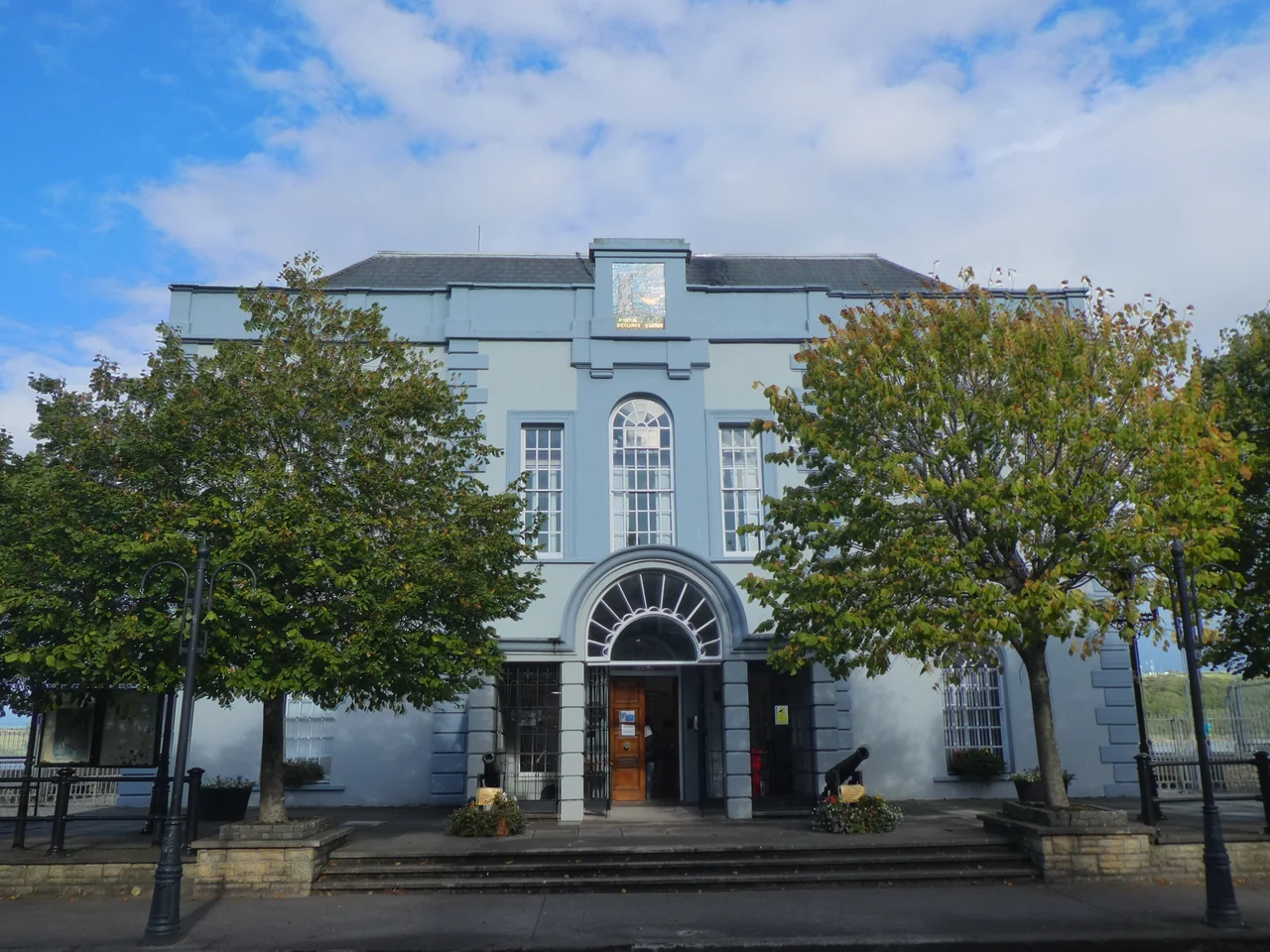

Youghal Town Hall
In 1846, the second year of the Great Famine, hungry people in Youghal gathered outside this building to try to stop the ships. The corn they had grown was being loaded onto vessels bound for England and other parts of Ireland while their own children were starving. They failed. The Illustrated London News published an engraving of the scene that November - one of dozens of similar reports from Irish ports that year, almost all with the same outcome. The Mall House, as the building was then known, had been built sixty-seven years earlier as the courthouse and assembly rooms for the borough corporation. By 1846 it had already been a venue for power for two generations. It would remain one for a hundred and seventy-five more years.
Replacing the Tholsel
The original municipal building on this site was an early 17th-century tholsel - the standard Irish town hall combining toll-house, market space, and meeting room. By the late 1770s the corporation wanted something grander. William Meade was already superintending the construction of The Mall itself in 1774, and may also have overseen the new town hall, which opened in 1779 under the rather flat name "the New Rooms." The design was Italianate: a symmetrical three-bay frontage built in brick with a cement render finish, a slightly projected central bay with a fanlight and Venetian window above, rounded-headed windows in the outer bays, quoins at the corners, a cornice and parapet broken by a central square pediment containing the town's coat of arms. The Borough Corporation used it as their courthouse until 1840, when the Municipal Corporations (Ireland) Act swept the old corporations away.
Food Riots and Council Reform
The famine years were the building's most violent moment. Protestors in 1846 "unsuccessfully sought to prevent crops being loaded onto ships" - the dry phrase of the official record covering what was, in practice, a desperate confrontation between starving people and the legal export of their food. After the Famine, the building was repurposed. The mid-19th-century town commissioners moved in. From 1900 onwards it housed Youghal Urban District Council, the new body created by the Local Government (Ireland) Act 1898. Between the Famine riots and the new century, the Mall House had transitioned from a place where power was held by a closed Anglican borough corporation to a place where elected councillors represented the broader town.
Costumes for Captain Ahab
In 1954, John Huston brought a film crew to Youghal to shoot exteriors for Moby Dick. New Bedford, Massachusetts had changed too much in the intervening century to play itself on screen, so the Cork seaport stood in. Gregory Peck spent weeks here as Captain Ahab. The Town Hall served as the costume department for the production. For a few months the 18th-century rooms that had heard borough court sessions and famine-era debates were full of 19th-century whaler outfits, oilskins, sou'westers, and the heavy woollens of a fictional Massachusetts port. A pub in Youghal still bears the film's name. In the 1970s a distinctive barrel-vaulted porch was added to the building - a flanking architectural intervention that was either a sympathetic modern addition or a 1970s eyesore, depending on whom you ask.
Cannons at the Door
In 2008 two 17th-century cannons were installed in front of the Town Hall. Smoothbore muzzle-loading guns recovered from a long-vanished artillery battery that had once defended Youghal's town walls, they had spent the intervening centuries in various states of decay. Restored at a cost of €20,000 they now stand outside the building like silent commentary on everything that has happened here - the famine riots, the borough court, the costume department, the council chambers. The town walls themselves date back to a charter granted by Edward I in 1275 "for their repair and extension," which means the walls were already old in 1275.
From Council to Arts Centre
The building served as the offices of Youghal Town Council until 2002, then as the offices of its successor body. In 2014, Ireland's Local Government Reform Act dissolved the town councils entirely. Administration of Youghal was amalgamated with Cork County Council, and the Mall House lost the function it had held for two centuries. An extensive refurbishment programme by Wilson Architecture, completed in April 2015, converted most of the interior into the Mall Arts Centre - a music and performance venue - with a new glazed extension at the rear. The Italianate façade survives. The Venetian window survives. The coat of arms in the pediment survives. The borough corporation, the urban district council, the town council - none of them survives. The building is older than the town's right to govern itself, and outlived it.
From the Air
Located at 51.95°N, 7.84°W on The Mall in central Youghal, County Cork, immediately adjacent to the Youghal Lifeboat Station and overlooking the Munster Blackwater estuary. Best viewed from 1,500-2,500 ft AGL. The three-bay Italianate frontage is one of several historic buildings along The Mall, but the Town Hall's pediment with its coat of arms and the symmetrical façade make it identifiable from low altitude. Nearest airport: Cork (EICK) approximately 54 km / 30 nm to the west-southwest; Waterford (EIWF) approximately 50 km / 27 nm to the northeast. The Clock Gate Tower and St Mary's Collegiate Church spire are visible higher up the slope to the west.
Nearby Stories
- The Glen, Cork 3.8 km away
- Liam Lynch (Irish republican) 6.1 km away
- All Together Now (festival) 9.4 km away
- Castle Oliver 14 km away
- Kilbrittain 17 km away
- 1999 Tramore helicopter crash 30 km away
- Walter Siepmann 37 km away
- SM U-27 107 km away