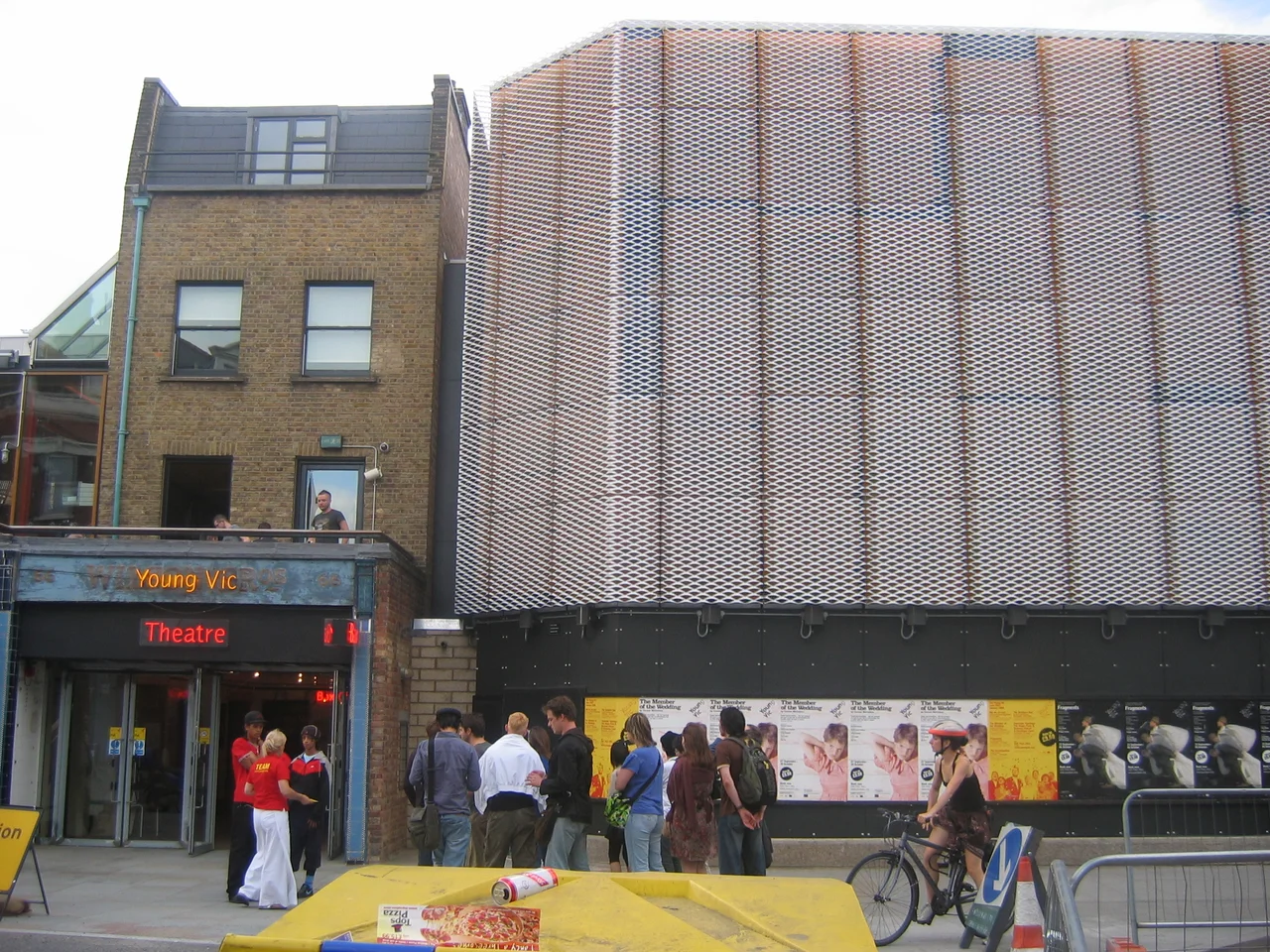

Young Vic
The auditorium was built out of breeze blocks. The entrance is a former butcher's shop. The bench seating was made of red wooden slats. The whole structure was meant to last about five years. The Young Vic opened in 1970 on a patch of land where, in 1941, a Blitz bomb had killed fifty-four people sheltering in the cellars of the building that had previously stood there - a building that is commemorated by a plaque at the theatre's southeast corner. The five-year structure is still standing. Its makeshift charm became its identity. The Who played free weekly concerts here in 1971 to rehearse what became Who's Next. Helen Mirren, Judi Dench, John Malkovich, and Michael Sheen have walked its thrust stage. In 2007 the refurbished building won the RIBA London Building of the Year.
Olivier's Experiment
The idea came from Laurence Olivier, then director of the National Theatre. "Here we think to develop plays for young audiences," he said when it opened in September 1970, "an experimental workshop for authors, actors and producers." The aim was an accessible theatre - high quality, low cost, informal environment, not specifically a children's theatre but one that would appeal to young audiences. Frank Dunlop, who had directed the original Young Vic Company in the 1940s as an offshoot of the Old Vic Theatre School, became founder-director of the new venue. The opening production was Scapino, Dunlop's free adaptation of Molière's The Cheats of Scapin, with Jim Dale in the title role and designs by Maria Björnson. It was presented as a National Theatre production - the Young Vic became an independent body four years later, in 1974.
A Building Made of Provisional Things
Dunlop built the theatre from what was at hand. A butcher's shop on The Cut, near Waterloo Station. The adjacent bombsite. Breeze blocks. Red wooden slat benches. The thrust stage seats approximately 420, with the configuration changing depending on the production. The provisional nature was meant to be temporary. But the temporary became permanent because the theatre worked. The actors performed close to the audience. The cheap seats were everywhere. The atmosphere was the opposite of grand. By the early 1970s, despite its small size, the Young Vic was attracting the cream of British acting. Ian Charleson made his professional debut here in 1972, playing Hamlet in the first revival of Stoppard's Rosencrantz and Guildenstern Are Dead in 1973. Vanessa Redgrave, Timothy Dalton, Robert Lindsay, Willard White, Arthur Lowe - all played the breeze-block stage.
Memorial at the Corner
A plaque at the theatre's southeast corner commemorates fifty-four people killed in October 1940 while sheltering in the cellars of the previous building during the Blitz. The Young Vic was literally built on a bombsite. The memorial was rededicated in 2007 when the rebuilt theatre reopened. For an institution that has always insisted on rough edges over polish, the plaque is part of the architecture - a refusal to forget what the empty lot before 1970 had once been. The theatre's whole tone is shaped by this kind of memory. It runs the Belarus Free Theatre - the company forced underground in Minsk, sometimes performing in cold cells of London's old Clerkenwell House of Detention. It produced Sarah Kane's 4.48 Psychosis. It commits to art that comes from places of crisis.
Refurbishment Without Polish
In 2003, the Young Vic launched a £12.5 million campaign to rebuild. The architects were Haworth Tompkins, who had also refurbished the Royal Court and the Regent's Park Open Air Theatre. The theatre closed in 2004. Reconstruction took two years. When it reopened in October 2006, the main auditorium had been left intact but technically enhanced. The butcher's shop entrance had been retained, becoming the box office. Around it, new foyers, dressing rooms, and two smaller studios had been added: the Maria, named for designer Maria Björnson, seating 150; and the Clare, named for former artistic director Clare Venables, seating 70. £5 million came from the Arts Council. The reopening production was Tobias and the Angel, a community opera with music by Jonathan Dove and a libretto by David Lan, then the artistic director. The next May, the Young Vic won the RIBA London Building of the Year. It was shortlisted for the Stirling Prize. The provisional structure had become award-winning architecture without losing its character.
From The Inheritance to a New Era
Under David Lan (2000-2018), the Young Vic accumulated Olivier Awards: Best Musical Revival for The Magic Flute in 2008, Best Revival for Yerma in 2016, Best New Play for The Inheritance in 2019. Kwame Kwei-Armah followed Lan as artistic director until 2024, when Nadia Fall took over in 2025. The theatre's signature is risk. Classic plays staged in radically new ways, new writing that does not flinch from difficulty. The 30-year-old "sit anywhere" policy was abandoned in 2010 in a rebranding by Sense Worldwide that gave the theatre a new strapline: "It's a big world in here." The original strapline had been an invitation. The new one was a promise. Both remain true.
From the Air
The Young Vic sits at 51.5032°N, 0.1075°W on The Cut near the South Bank of the Thames in the London Borough of Lambeth, central London. The dense brick fabric of South Bank theatres surrounds it, with Waterloo Station 200 metres north and the National Theatre and Royal Festival Hall along the Thames just beyond. Nearest major airports: London City (EGLC) 5nm east, London Heathrow (EGLL) 15nm west. From altitude, the great curve of the Thames between Westminster Bridge and Blackfriars frames this whole cluster of cultural institutions. The London Eye is the most prominent visual landmark.
Nearby Stories
- Battle of Britain, Northfleet 1.1 km away
- Bayham Old Abbey 5.4 km away
- Catharine Macaulay 6.4 km away
- Hatfield rail crash 8.8 km away
- Chequers 8.9 km away
- Chelmsford Cathedral 10 km away
- Queen Victoria Hospital 13 km away
- Fishbourne Roman Palace 36 km away