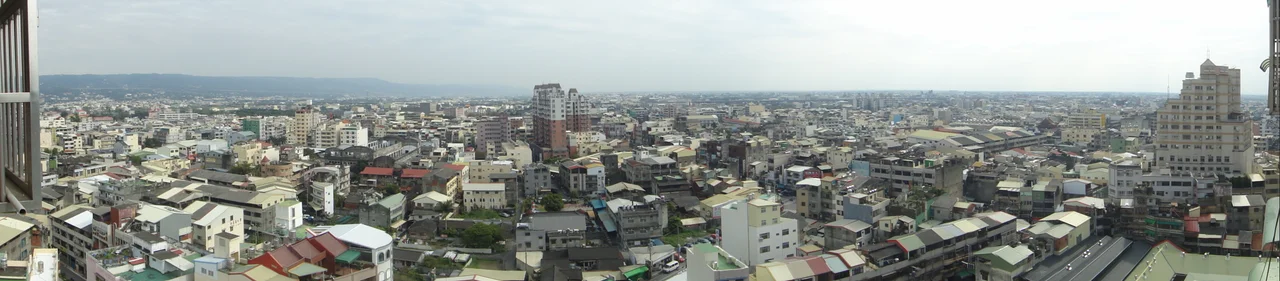

Yuanlin
The name survived long after the thing it described was gone. Early settlers in what is now Yuanlin cleared the forest so methodically — trees felled for timber, land broken for fields — that eventually only a single round patch of woodland remained. They called the place Oân-nâ-á in Hokkien: "the round woodland." The trees did not last. The name, rewritten in Mandarin characters as Yuanlin, did. Today a city of more than 122,000 people occupies land that was still dense with trees when the Yongzheng Emperor sat on the Qing throne.
From Forest to Furrow
Settlement of the Yuanlin area began in earnest during the Yongzheng era of the Qing dynasty, roughly between 1723 and 1735, as Han Chinese migrants pushed into the fertile plains of Changhua. By the 16th year of the Qianlong reign, the land was already well developed — fields replacing forest, villages replacing clearings. The transformation was swift enough that historians can trace the town's name as a kind of ecological timestamp: first the whole forest, then the round remnant, then just the memory preserved in characters. Yuanlin's soil proved productive. The city still celebrates its fruit-growing tradition, and succade — fruit cooked in sugar syrup and crusted with sugar crystals — remains one of its signature local specialties. The sweet confection connects modern Yuanlin to centuries of agricultural abundance on the Changhua plain.
Capital for a Season
When Japan's fifty-year rule over Taiwan ended in 1945 and the Republic of China took administrative control, Taiwan's county boundaries were redrawn. Yuanlin found itself briefly elevated to an unexpected status: capital of the newly created Taichung County. It held that distinction for only five years. In 1950, Changhua and Nantou were carved out as separate counties, and Yuanlin slipped back into being an ordinary — if sizeable — city within Changhua. Fengyuan became the new county seat for what remained of Taichung County. The episode left little visible trace, but it speaks to Yuanlin's position as a natural hub on the central Taiwanese plain, large enough to serve as a regional center even if the administrative title eventually passed elsewhere. The city finally received formal city status on 8 August 2015, when the population threshold for county-administered city designation was revised downward from 125,000 to 100,000.
The Weight of Governance
Yuanlin's recent political history is, by its own officials' accounting, an uncomfortable one. In the early 2010s, two consecutive mayors were convicted on corruption charges. Former mayor Tu Quanchong was sentenced in July 2010 to 16 years in prison for soliciting NT$3.5 million in kickbacks from a construction project. The then-sitting mayor, Wu Zongxian, was impeached in April 2011 and subsequently sentenced to 14 years; investigators found he had taken bribes exceeding NT$16 million across 81 separate construction projects since 2005. Taiwan's Control Yuan — the government branch responsible for investigating official misconduct — described the scale of Wu's activities as "unprecedented" and noted that "virtually no construction projects in the town were untainted by corruption." The cases prompted soul-searching about governance at the local level, and they are part of the public record that shapes Yuanlin's modern story.
Lines of Movement
For a city that grew from a crossroads of cleared land, Yuanlin remains a place defined by transit. Taiwan Railway's Western Line passes through on its north-south spine, stopping at Yuanlin Station. Plans to elevate the track through the city — converting an at-grade line that cuts across three road crossings and threads under five underpasses — have been on the books for years, with a vision of a mixed-use redevelopment where the current station precinct stands. Provincial Highway 76 slices east-west through the city, offering the quickest route to either of Taiwan's major national freeways, the National 1 to the west and the National 3 to the east. These connections make Yuanlin less a destination than a departure point — a city from which the rest of central Taiwan becomes quickly reachable. The Yuanlin Performance Hall stands as evidence that the city has cultural ambitions of its own, despite the through-traffic character of the place.
People of the Plain
The demographic arc of Yuanlin tracks neatly with Taiwan's twentieth-century growth. A December 1946 census — conducted just one year after the handover from Japan — counted 37,999 residents. Within seven years, the population had crossed 50,000. By 1979 it cleared 100,000. Since the mid-1990s, the numbers have held remarkably steady, fluctuating within a narrow band between roughly 124,000 and 128,000 — a sign of a city that has found its natural size. As of March 2023, 122,763 people call Yuanlin home, divided almost exactly between 60,510 men and 62,253 women across 41,855 registered households. Notable people born here include singer-songwriter Chan Ya-wen and Steve Chan, who served as vice chairperson of the Kuomintang from 2016 to 2017. Oân-lîm in Hokkien, Yuanlin in Mandarin — whatever name you use, the city is deeply rooted in the life of central Taiwan.
From the Air
Yuanlin lies at approximately 23.96°N, 120.57°E on the eastern edge of the Changhua plain in central Taiwan. From altitude, the city presents as a compact urban grid bordered by agricultural land on most sides, with Nantou City just across the eastern county line. Taichung International Airport (RCMQ) is roughly 25 km to the north-northeast. A recommended approach altitude of 3,000–5,000 feet provides a clear view of the flat Changhua agricultural landscape giving way to the foothills of the Central Mountain Range to the east. The Taiwan Railway's Western Line is visible as a north-south corridor through the city, and Provincial Highway 76 can be traced as the elevated east-west roadway.
Nearby Stories
- Huwei, Yunlin 2.8 km away
- Geographic Center of Taiwan 4.2 km away
- Gaomei Wetlands 15 km away
- China Airlines Flight 611 21 km away
- Shei-Pa National Park 25 km away
- Yushan Weather Station 27 km away
- TransAsia Airways Flight 222 30 km away
- Battle of Xiapi 1136 km away