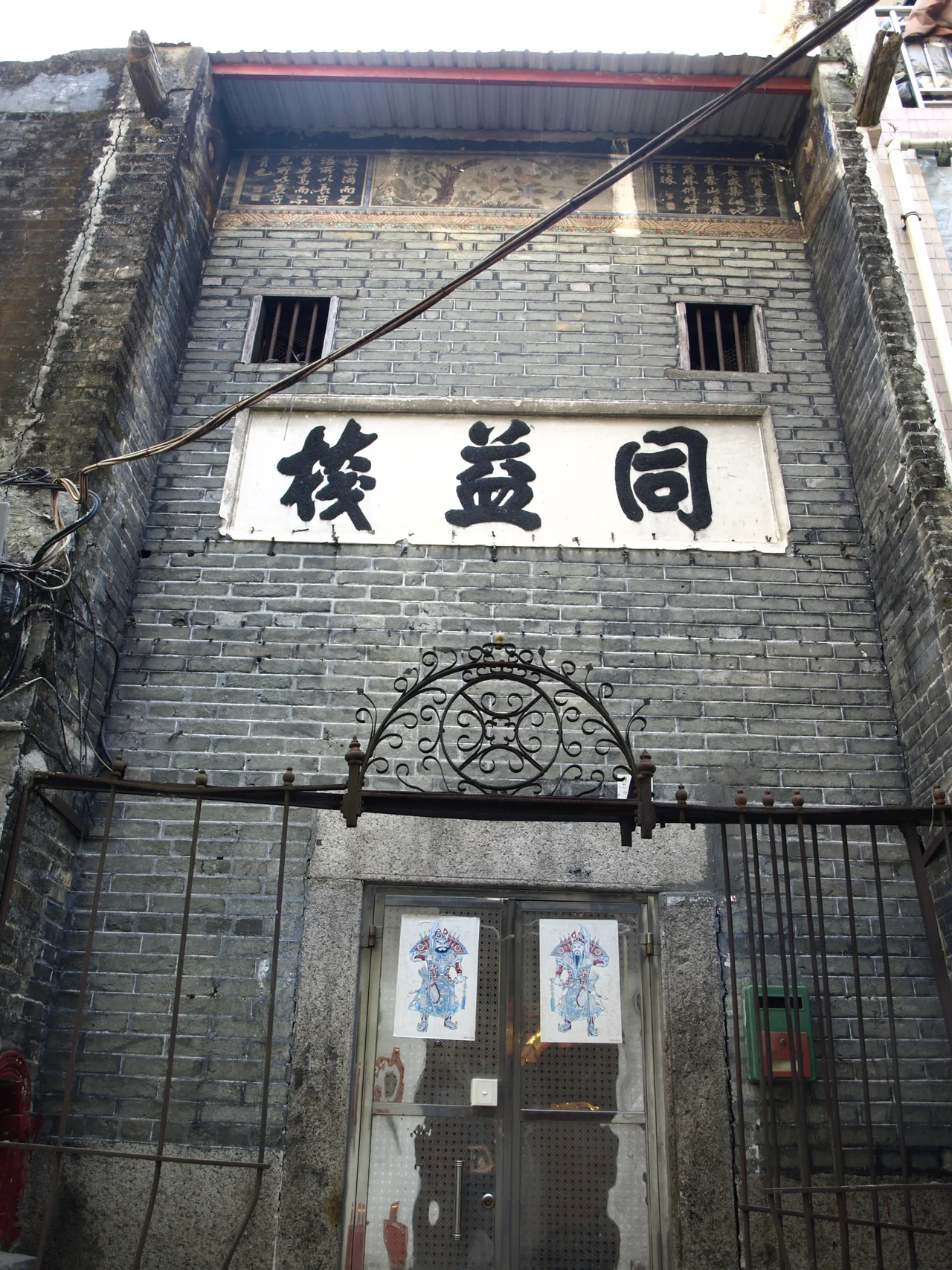

Yuen Long Kau Hui
In 1661, the Qing dynasty issued one of the most disruptive orders in the history of South China's coastline. To deny supplies to Ming loyalist forces at sea, the Kangxi Emperor's government ordered entire coastal populations to evacuate inland. In Yuen Long, the evacuation lasted eight years. When the ban was finally lifted in 1669, the people returned to find that the original market — which had operated since the late Ming dynasty south of the main road, near Tai Kiu Tun — was gone. A new site was chosen, for political reasons, in the area now known as Yuen Long Kau Hui. The man who re-established the market there was Tang Man-wai, a 23rd-generation member of the Tang clan of Kam Tin, and a district magistrate of Longyou County in Zhejiang Province. When he set up the stalls, he was standing beside the seashore. Today, the sea is nowhere in sight.
A Market on the Shore
The name Yuen Long Kau Hui translates roughly as the old market quarter of Yuen Long — kau meaning old, hui meaning market gathering. In 1669 it was a coastal trading post; over the centuries, as the Pearl River Delta continued to silt up and land formed to the north, the shoreline receded and left the market stranded inland. Farmers, boat people, and traders came from as far as the coastal districts of Guangdong Province to buy and sell agricultural produce and daily necessities. The market was administered by the Kwong Yu Tong, a trust run by a branch of the Tang clan from Kam Tin — a formal institutional arrangement that gave the Tangs both commercial and social authority over western New Territories trade for generations.
The Walled Villages Within
Yuen Long Kau Hui is not a single settlement but a constellation of villages, most of them walled, arranged in a rough east-west line north of present-day Yuen Long MTR station. From west to east: Sai Pin Wai, Nam Pin Wai, Tung Tau Tsuen, Tsoi Uk Tsuen, Ying Lung Wai, Tai Wai Tsuen, and Wong Uk Tsuen. Each has its own clan history. Ying Lung Wai was founded by a Tang clan branch that relocated from Nam Pin Wai for feng shui reasons. Tai Wai Tsuen was established by the Wong and Choi clans around the early 16th century. Tai Kiu Tsuen, named for a stone bridge that once stood to its west, was settled some 400 years ago by four clans — the Chan, the Tang, the Tse, and the Leung — with the Chans reportedly originating from Bao'an in Guangdong. Seven of these villages later formed the Tung Tau Alliance, a formal grouping for shared governance and collective worship.
The Temple at the Centre
Religious and civic life in Yuen Long Kau Hui converged at the Yuen Kwan Yi Tai Temple on Cheung Shing Street, built probably between 1662 and 1722 and dedicated to the deities Hung Shing and Yeung Hau. It served as the main temple for Nam Pin Wai as well as the broader Kau Hui area. Beyond religious ceremonies, the temple functioned as a venue where merchants and villagers resolved disputes, discussed market affairs, and collectively governed trade. At one point it even served as a yamen — a local government office — with officials living on the premises. The temple occupied, in other words, the roles that courts, chambers of commerce, and community halls would separately fill in a later era.
Buildings That Outlasted Their Purpose
Chun Yuen Ngat, a former pawnshop at No. 72 Cheung Shing Street, was founded by Tang Lim-ming of the Tang clan. Originally located on Lee Yick Street, it moved to its present site in the 1910s and continued operating until World War II, when the market's decline brought business to a halt. After the war, the building found a second life as a school for village children, serving that purpose from the 1930s to the 1960s, before briefly hosting a kindergarten in 1967 and 1968. The structure stands today as a listed historic building. Nearby, early 20th-century shophouses — tong-lau in Cantonese, the distinctive column-fronted terrace buildings of southern Chinese cities — survive at Nam Mun Hau. In a neighbourhood where decades of redevelopment have erased much of the streetscape, their presence is worth pausing over.
Still Linked to the River
On the northern edge of the Kau Hui cluster sits Shan Pui Tsuen, founded by Lam Siu-yuen, a 13th-generation member of the Lam clan who moved from Tai Wai Tsuen roughly 200 years ago. Near the village entrance, a small boat serves as a ferry across the Shan Pui River to Nam Sang Wai on the northern bank — a wetland area that floods seasonally and hosts migratory birds. It is one of the few places in Yuen Long where the old relationship between settlement and waterway persists in something close to its original form: a boat, a river, and the sound of birds on the far bank.
From the Air
Yuen Long Kau Hui lies at approximately 22.45°N, 114.033°E, northeast of the main Yuen Long town centre. From the air, it appears as a dense cluster of low-rise village structures tucked behind the MTR station and modern development. The Shan Pui River, visible to the north, separates it from the Nam Sang Wai wetlands. Nearest airport is VHHH (Hong Kong International), approximately 18 km to the southwest. Flying at 2,000–3,000 feet on approach to VHHH, the flat alluvial plain and river channels of the area are clearly visible.
Nearby Stories
- Chapel of St. Francis Xavier 3.5 km away
- Cuiheng 4.1 km away
- 2015 Shenzhen Landslide 16 km away
- Shunde 31 km away
- Wanshan Archipelago 37 km away
- Nanxiong Formation 96 km away
- Heyuan 149 km away
- Checheng Fu'an Temple 629 km away