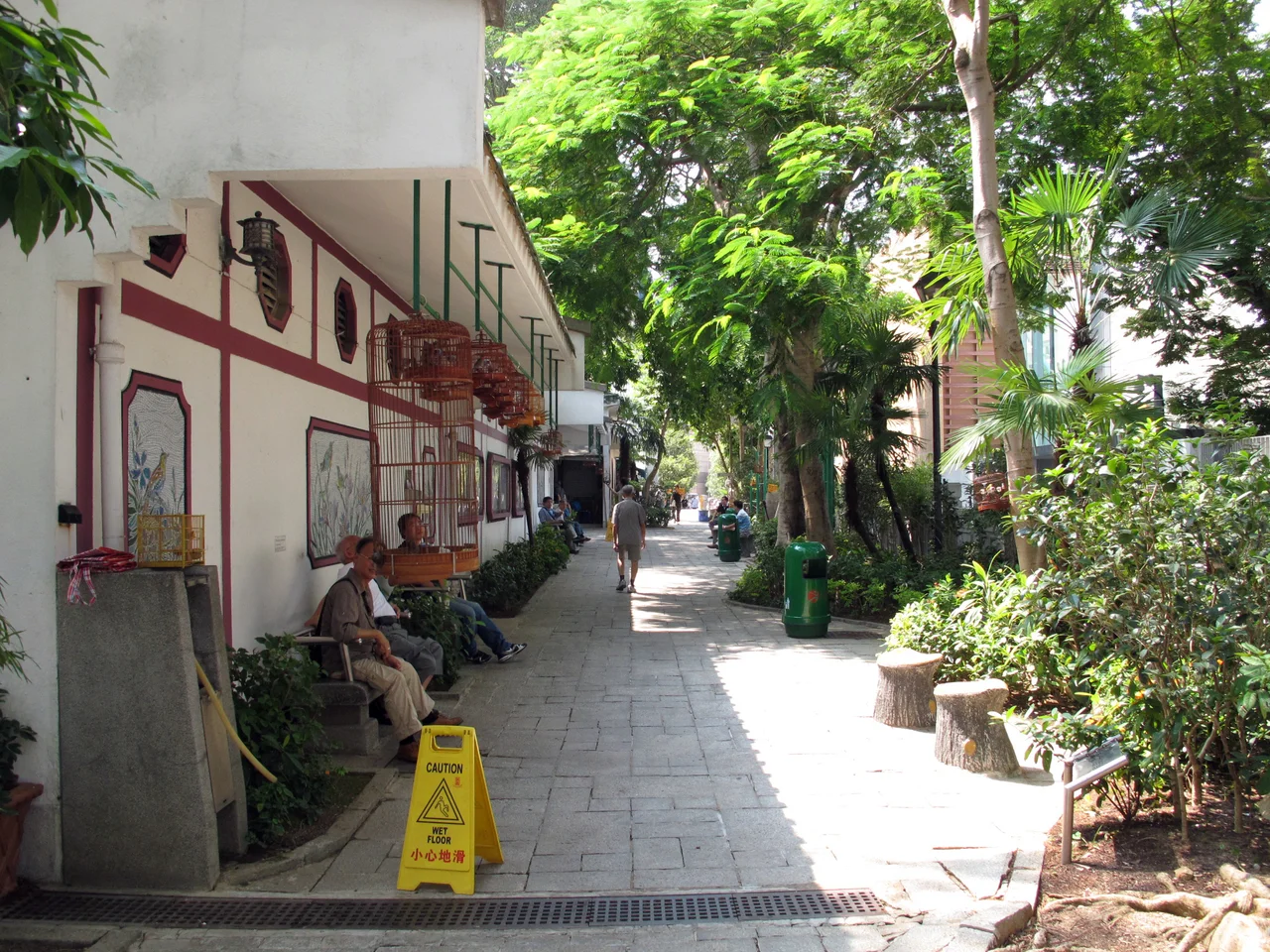

Yuen Po Street Bird Garden
Early on a weekday morning, before Mong Kok wakes fully into its commercial roar, an older man walks through a narrow gateway and into a different Hong Kong. He carries a cloth-draped bamboo cage. Inside, a songbird is quiet. He finds a spot along one of the garden's covered walkways, removes the cloth, and hangs the cage among dozens of others. Within minutes the birds begin to respond to each other — a conversation in birdsong between cages whose owners have gathered, as they do most mornings, to let their animals socialise. This is Yuen Po Street Bird Garden, 3,000 square metres of aviaries, stalls, and covered passages in the heart of Mong Kok — a place that has been making the same sounds for longer than most of the surrounding buildings have existed.
A Tradition Older Than the Garden
The culture of keeping songbirds as pets in Hong Kong traces to practices that took hold during the Qing dynasty, when keeping birds as companions was considered a mark of leisure and refinement. By the 1920s and 1930s, bird-keeping had become a popular daily activity across Hong Kong's working population — not just the wealthy, but street hawkers, tradesmen, and labourers who kept a caged bird as a source of music and company. The ritual of "walking the bird" — taking a caged songbird out each morning, swinging the cage gently to exercise it, and meeting other bird-keepers for a shared hour in a garden or park — became embedded in Cantonese urban life. It is a practice that still continues at Yuen Po Street today.
From Bird Street to Bird Garden
The Yuen Po Street Bird Garden did not originate at its current address. Its predecessor was an informal market known as Bird Street, located at Hong Lok Street off Argyle Street in Mong Kok — a lane of vendors selling birds, cages, feed, and accessories that had operated for decades. In the early 1990s, the former Land Development Corporation — now the Urban Renewal Authority — demolished the Hong Lok Street site as part of a redevelopment project. Langham Place, the large commercial complex on Argyle Street, now occupies that ground. A replacement garden was constructed on a more peripheral site near Boundary Street, and completed in March 1997. The garden is bounded by Boundary Street to the north, Embankment Road, Prince Edward Road West, and Yuen Po Street itself — a 3,000-square-metre enclosure that is small for the function it serves and the culture it carries.
Inside the Garden
The garden is organised around covered walkways lined with stalls. Vendors sell live birds — thrushes, mynahs, canaries, and other songbirds prized for their voices — as well as the full material culture of bird-keeping: dried insects for feed, small porcelain water cups, decorative cage accessories, and the bamboo cages themselves. Ornate handmade bamboo cages, a craft with its own specialists in Hong Kong, involve bending bamboo rods into precise shapes, carving patterns or inscriptions onto the wood, and finishing the surface. The cages are functional objects but also display pieces — expressions of the keeper's taste and the bird's status. In the garden's aviaries, larger enclosures house birds that can be listened to collectively, a communal resource for the morning regulars who come as much for the company of other bird enthusiasts as for the birds themselves.
Mong Kok's Unlikely Quiet
What makes the garden remarkable is what surrounds it. Mong Kok is one of the most densely populated urban areas on Earth — a district of electronics markets, clothing stalls, noodle shops, karaoke parlours, and apartment blocks packed together with a compression that is almost architectural in its intensity. The bird garden sits directly west of Mong Kok Stadium and near Mong Kok East station. Step through its entrance and the sound of traffic does not disappear, but it retreats. The dominant audio becomes birdsong. Old men sit on benches. Cages hang from hooks. The pace changes. For visitors accustomed to Mong Kok's usual energy, the garden functions as a form of mild astonishment — a reminder that the street-level texture of Hong Kong can contain, within a few paces, entirely different worlds.
A Fragile Continuity
The traditions the garden preserves are not guaranteed to outlast the people who practise them. Bird-keeping in Hong Kong has declined over decades as housing has become smaller and younger generations have moved away from the leisure patterns of their grandparents. The craft of bamboo birdcage-making has narrowed to a very small number of practitioners. The morning ritual of walking the bird persists, but its practitioners are, on average, older each year. The Yuen Po Street Bird Garden continues because the people who care about it keep showing up — the vendors, the regulars, the keepers of birds who have been coming since the Hong Lok Street days. Whether the next generation will find in it what their parents did is the question the garden carries quietly beneath its birdsong every morning.
From the Air
Yuen Po Street Bird Garden is located at approximately 22.326°N, 114.174°E in Mong Kok, Kowloon — well south of Yuen Long and clearly within the urban Kowloon peninsula. From the air, Mong Kok appears as intensely dense residential and commercial development. The garden's 3,000 m² footprint is too small to be identified distinctly from altitude. Nearest airport is VHHH (Hong Kong International) on Lantau, approximately 25 km to the west. The garden lies near Boundary Street, which historically marked the boundary between British Kowloon and the leased New Territories — itself a line visible on historical maps and still referenced in Hong Kong's administrative geography.
Nearby Stories
- Chapel of St. Francis Xavier 3.5 km away
- Cuiheng 4.1 km away
- 2015 Shenzhen Landslide 16 km away
- Shunde 31 km away
- Wanshan Archipelago 37 km away
- Nanxiong Formation 96 km away
- Heyuan 149 km away
- Checheng Fu'an Temple 629 km away