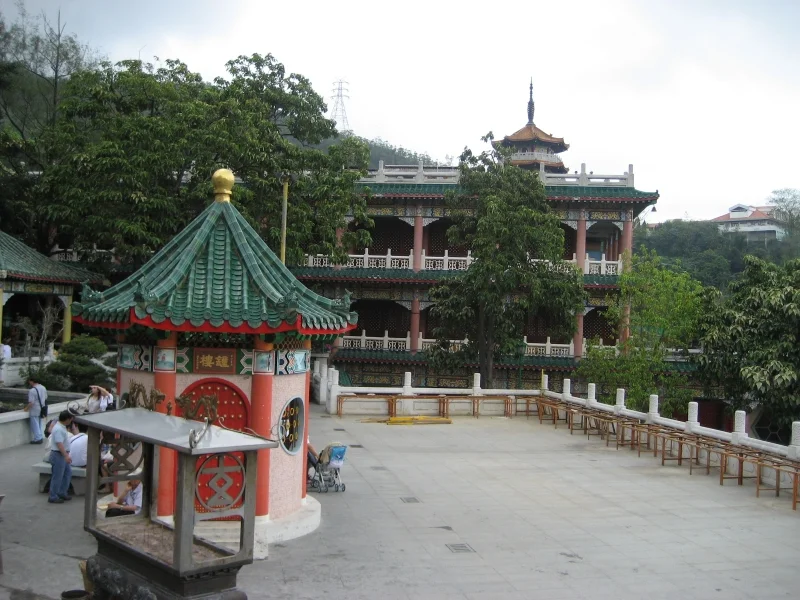

Yuen Yuen Institute
Three religions walk into a temple — and in Tsuen Wan, that is not the setup to a joke. The Yuen Yuen Institute is the only place in Hong Kong where Taoism, Buddhism, and Confucianism are honoured together in a single compound. Its founders chose the name deliberately: the first three Chinese characters encode the essence of each faith, a quiet declaration that what unites these traditions runs deeper than what separates them. At the heart of the complex rises a scaled replica of Beijing's Temple of Heaven, its circular silhouette incongruous and magnificent against the New Territories hillside.
One Roof, Three Faiths
When monks from the Sanyuan Gong — the Three Originals Palace — arrived in Hong Kong from Guangzhou and established the Institute in 1950, they brought with them a lineage stretching back to the Longmen, or Dragon Gate, branch of Quanzhen Taoism, one of the most disciplined and philosophically rigorous schools of Complete Perfection practice. Yet they chose not to build a purely Taoist institution. The doctrine they set out to spread was one of harmony: the idea that Taoism, Buddhism, and Confucianism, for all their doctrinal differences, share a common root in the cultivation of virtue. That conviction shaped every stone of the compound. Pavilions and monasteries are interspersed across hectares of land around Sam Dip Tam, and the architecture shifts in register as you move through the grounds — now clearly Taoist, now Buddhist, the transitions deliberate rather than accidental.
A Temple of Heaven in the New Territories
The centrepiece of the Yuen Yuen Institute is startling. The main building is a faithful replica of the Temple of Heaven in Beijing — the triple-tiered, blue-roofed rotunda that Chinese emperors once used for annual prayers to Heaven for good harvests. Transplanted to Tsuen Wan, it becomes something different: not an imperial ritual space but a democratic one, open to worshippers of all three traditions. The decision to model the main hall on one of China's most iconic structures was both an aesthetic statement and a theological one. The Temple of Heaven was built to bridge the human and the divine. The Yuen Yuen Institute, its founders seemed to say, intended to do the same — for everyone, regardless of which path they followed.
The Eight Virtues and the Work of Charity
The Institute's stated purpose extends well beyond worship. Alongside spreading the principles of the three religions, the founders committed themselves to upholding eight virtues — filial piety, respect, loyalty, fidelity, propriety, justice, honesty, and honour — and to promoting social welfare. That commitment has taken concrete form over the decades. The Institute operates an Old Age Home, runs hospitals, and supports schools. During the annual Lantern Festival, worshippers exchange donations for lanterns in the belief that the gesture brings fortune and health; the proceeds fund these charitable institutions. It is an arrangement that blurs the line between religious practice and community service, which may be exactly the point.
Festivals and the Living Calendar
Throughout the year, the grounds pulse with activity tied to the Chinese ritual calendar. Chinese New Year brings crowds to the temple precincts. The seventh lunar month — Ghost Month, when the boundary between the living and the departed is said to thin — draws worshippers for ceremonies of remembrance. The annual Bonsai and Stone Appreciation Show offers a quieter pleasure: the Taoist aesthetic of finding the world in miniature, mountains compressed into a pot, time concentrated in a gnarled trunk. The vegetarian restaurant on site has fed pilgrims and curious visitors for decades, its menu an extension of Buddhist principles about the sanctity of life. At the Institute, even lunch is a philosophical position. In 1968, within the grounds, Taoist masters Moy Lin-shin, Mui Ming-to, and Mrs Tang Yuen Mei co-founded the temple of the Fung Loy Kok Institute of Taoism, extending the compound's reach far beyond Hong Kong.
Finding It
The Institute sits in Lo Wai, Tsuen Wan, in the New Territories — a short distance from the bustle of Tsuen Wan's urban core but a world removed in atmosphere. Arriving through the main gates, the density of the city gives way to a compound that rewards slow walking. The replica Temple of Heaven dome draws the eye first, but the real texture of the place reveals itself in the smaller pavilions, the shaded walkways, the incense drifting from courtyards where worshippers from all three traditions share the same air. For visitors familiar with Hong Kong's pace, the Yuen Yuen Institute offers something rare: a large space explicitly designed for contemplation, where the urgency of the city is not merely absent but actively refused.
From the Air
The Yuen Yuen Institute lies at approximately 22.3833°N, 114.123°E in Tsuen Wan District, New Territories. From the air at 2,000–4,000 feet, the circular roofline of the Temple of Heaven replica is the most distinctive feature — look for it amid the low-rise residential fabric of Lo Wai, roughly 5 km northwest of Kowloon's city centre. The nearest major airport is Hong Kong International Airport (VHHH) on Lantau Island, approximately 17 km to the west-southwest. Sha Tin and Tsuen Wan's urban grid is visible to the east and south respectively. Best viewed in clear winter weather when visibility exceeds 15 km and the green hillsides of the New Territories provide sharp contrast to the temple compound below.
Nearby Stories
- Chapel of St. Francis Xavier 3.5 km away
- Cuiheng 4.1 km away
- 2015 Shenzhen Landslide 16 km away
- Shunde 31 km away
- Wanshan Archipelago 37 km away
- Nanxiong Formation 96 km away
- Heyuan 149 km away
- Checheng Fu'an Temple 629 km away