
Yuexiu Hill
Five stone rams came down from the sky — or so the people of Guangzhou have believed for more than two thousand years. Celestial immortals, the legend says, rode the rams into what would become this city, carrying stalks of rice as gifts, promising the land would never know famine again. Then the immortals disappeared, and the rams turned to stone atop Yuexiu Hill. In 1960, the city made the myth permanent: a sculpture of five rams carved from more than 130 pieces of granite was installed at the summit, and it has been Guangzhou's defining emblem ever since. The hill is not large — its park covers 860,000 square meters — but few places in southern China hold this density of history, legend, and civic identity in a single green space.
The Hill That Held the City's Edge
For much of Guangzhou's long history, Yuexiu Hill marked the northern limit of the city. The old walled city pressed up against its slopes, with the hill itself serving as a natural defensive anchor. Most of those walls are gone now — the expanding city swallowed them as it grew outward in every direction — but the hill retains something of its original watchful quality. From its crest, you can look south over the dense urban fabric of Yuexiu District, one of the oldest and most densely populated parts of the city, and understand why generations of rulers considered this high ground worth protecting. The park that now covers the hill is officially Yuexiu Park, one of Guangzhou's most visited public spaces. Families come on weekends for the walking paths and lotus ponds. Elderly residents practice tai chi in the cooler morning hours. The hill is simultaneously a monument and a neighborhood park, civic symbol and everyday retreat.
Stone Rams and Celestial Promise
The Five Rams Sculpture stands at the park's highest point, and it rewards the climb. Carved in 1960 from solid granite — assembled from more than 130 separate pieces — the group shows five rams at rest, one larger than the others, clustered together as if they have just arrived from somewhere far away. The craftsmanship is precise and the scale is imposing. But what gives the sculpture weight is the story behind it. The five immortals who rode the rams were said to be culture heroes who brought rice cultivation to the Pearl River Delta, turning a region prone to hunger into one of China's most fertile and prosperous. Guangzhou's nickname, the "City of Rams" or "City of Goats," flows directly from this legend, as does the city's alternative name, "City of Five Rams." For residents, the rams are not decorative — they are an origin story made visible in stone, a reminder of abundance that the city has carried from its founding.
A Tower Built Against Prophecy
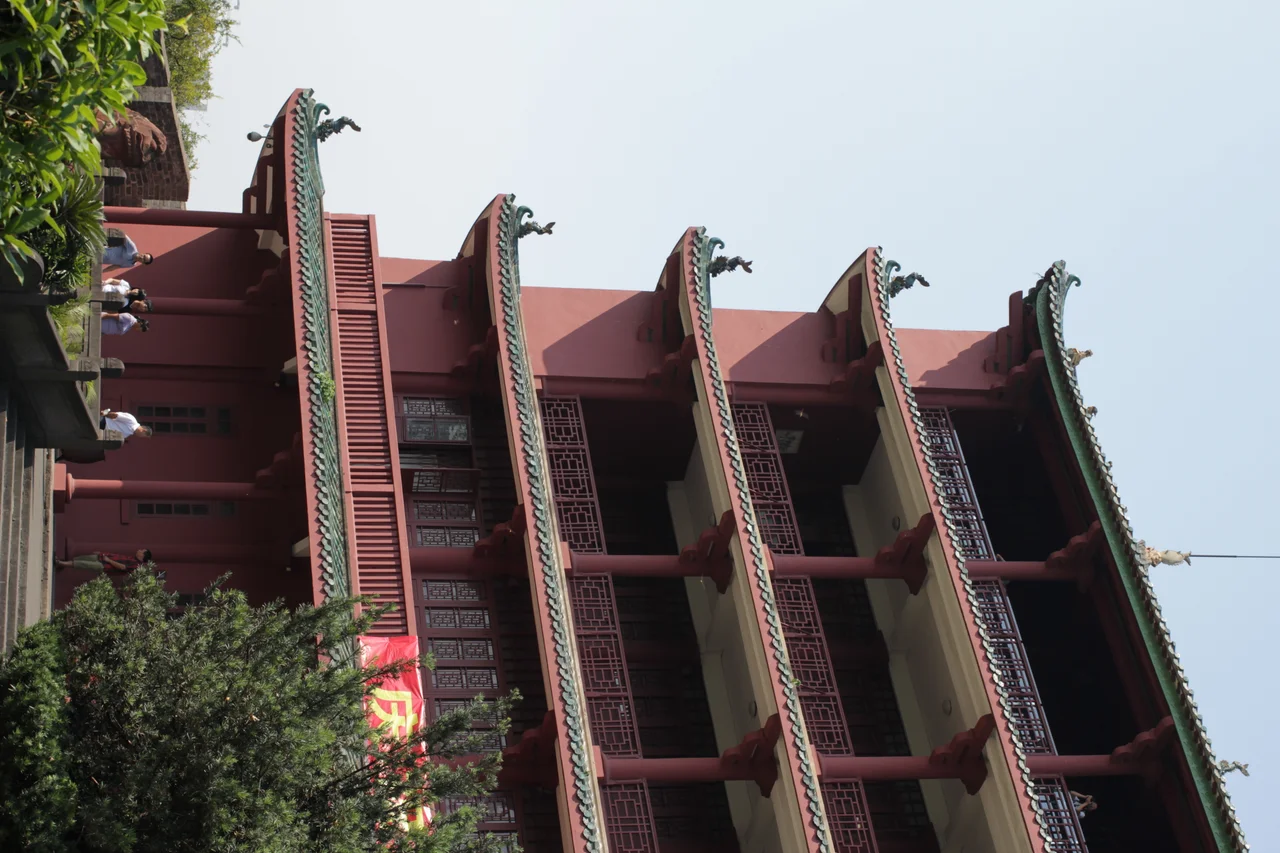
The most architecturally striking thing on Yuexiu Hill is the Zhenhai Tower, a red-walled, five-storied pagoda that has stood — in one form or another — since 1380. Its origin story is remarkable: a Ming dynasty nobleman named Zhu Liangzu, Marquis of Yongjia, reportedly saw yellow and purple air rising over Yuexiu Hill and was warned that this was the omen of a new emperor. To prevent the prophecy from coming true — and perhaps to forestall any challenger to his own dynasty — he ordered a guard tower built atop the hill, incorporating it into the city's defensive walls. The idea was to alter the hill's feng shui and suppress whatever celestial energies were at work. Whether the tower succeeded is a matter of interpretation. What is certain is that the structure became beloved enough to be destroyed and rebuilt five times over the centuries, each iteration rising on the same commanding site. The current tower, 28 meters tall and 31 meters wide (16 meters deep), dates from a later reconstruction and has housed the Guangzhou Museum since 1928.
Memory, Sport, and the Weight of War
The hill holds other layers of history that are easy to miss if you come only for the view. Near the base stands the Pavilion of Regaining, a square structure erected in 1948 on the site of an earlier 1928 memorial to the Xinhai Revolution — the uprising that ended the Qing dynasty and established the Republic of China. The original pavilion was destroyed in fighting with Japanese forces during World War II; the current one is a replacement, a monument to a monument. Yuexiu Stadium, at the hill's foot, adds a different dimension. Opened in October 1950 at the direction of Mayor Ye Jianying, it covers 43,000 square meters and can hold 35,000 people. It served as an Asian Games venue in 2010 and has hosted more than 280 concerts and 200 public gatherings since it opened. A hill that once anchored the edge of a walled city now anchors an entire neighborhood's civic life.
Lingnan Roots, Living Park
Yuexiu Hill exists within the broader geographic and cultural world of Lingnan — the region "south of the mountains" that encompasses Guangdong and Guangxi provinces, with Cantonese culture at its heart. The park's atmosphere is distinctly Cantonese: vendors sell sugarcane juice near the entrance, couples stroll beneath banyan trees whose aerial roots trail toward ponds thick with lotus, and the sounds of Cantonese conversation drift through the morning air. The hill's significance has only grown as Guangzhou has become one of China's largest cities. What was once a defensive promontory and then a dynastic symbol is now a breathing space inside a metropolis of more than fifteen million people. Yuexiu Park doesn't fight the city — it absorbs it, offering a place where legend, architecture, and the ordinary rhythms of daily life coexist as naturally as the granite rams who never left their hilltop.
From the Air
Yuexiu Hill sits at approximately 23.143°N, 113.260°E in the Yuexiu District of central Guangzhou. The nearest major airport is Guangzhou Baiyun International (ZGGG), about 18 km to the north. At altitude, the park's green footprint is visible amid the dense urban grid of central Guangzhou, with the red-roofed Zhenhai Tower (Five-Storied Pagoda) as the clearest visual anchor on the hilltop. Best observed at 3,000–5,000 feet on approach to ZGGG from the south, when the Pearl River and Guangzhou's central urban core are spread below. Clear weather offers good visibility of the park's footprint against the surrounding cityscape.
Nearby Stories
- Shunde 12 km away
- 2015 Shenzhen Landslide 15 km away
- Mount Luofu 23 km away
- Qingyuan Maglev Tourist Line 32 km away
- Kaiping 56 km away
- Heyuan 90 km away
- Chikan, Kaiping 92 km away
- Erlitou Site Museum of the Xia Capital 1257 km away