.jpg)
Yunlin Hand Puppet Museum
The building was a district office. Then it was a police station. Then it sat empty for years while the town around it figured out what it was worth. What saved it, in the end, was puppets — specifically, the tradition of budaixi, the Taiwanese glove-puppet theater that was performed at temple festivals and broadcast on television and passed through families across Yunlin County for generations. In 1997, a national arts festival in Huwei made officials look at the old 1931 wooden building with fresh eyes. What they saw was a cultural home waiting to be claimed.
The Building That Held On
The Yunlin Hand Puppet Museum occupies what is likely the oldest surviving courtyard house in Huwei Township. Built in 1931 during Taiwan's Japanese colonial period, the structure was designed as the Huwei District office — a 2.5-story wooden building arranged around a central courtyard in a style that blends Japanese administrative practicality with Chinese courtyard house traditions. When Taiwan was handed over from Japan to the Republic of China in 1945, the building changed hands and changed purpose: it became a police station, serving that function until 1989 when the station relocated.
The years between 1989 and 1997 were not kind to the building. Empty, aging, and without a clear purpose, it risked the fate of many Japanese-era structures in Taiwan: eventual demolition for something more immediately useful. The National Festival of Culture and Arts, which Huwei hosted in 1997, changed the calculus. Officials examining the town's heritage realized the building's age and architectural integrity made it irreplaceable. The decision was made to restore and repurpose it.
The Restoration and What It Cost
Preserving a nearly seventy-year-old wooden building is not inexpensive, and the path from decision to completion took time. Yunlin County Government applied to the Council for Cultural Affairs — the national body overseeing cultural preservation — for restoration funding. In 1999, the application succeeded: NT$20 million in subsidies arrived, supplemented by an additional NT$8 million from the county government itself.
In early 2000, National Yunlin University of Science and Technology was commissioned to produce the planning report. Tender and detailed design followed, with construction beginning and restoration completing by December 2004. Interior design work continued through April 2007, and the museum formally opened to the public in November 2007 — a decade after the 1997 festival first sparked the conversation about what the building could become. In April 2009, management of the museum passed to the Yunlin County Culture Foundation, which continues to operate it. The timeline reflects the patience that serious historic preservation requires.
What Budaixi Is
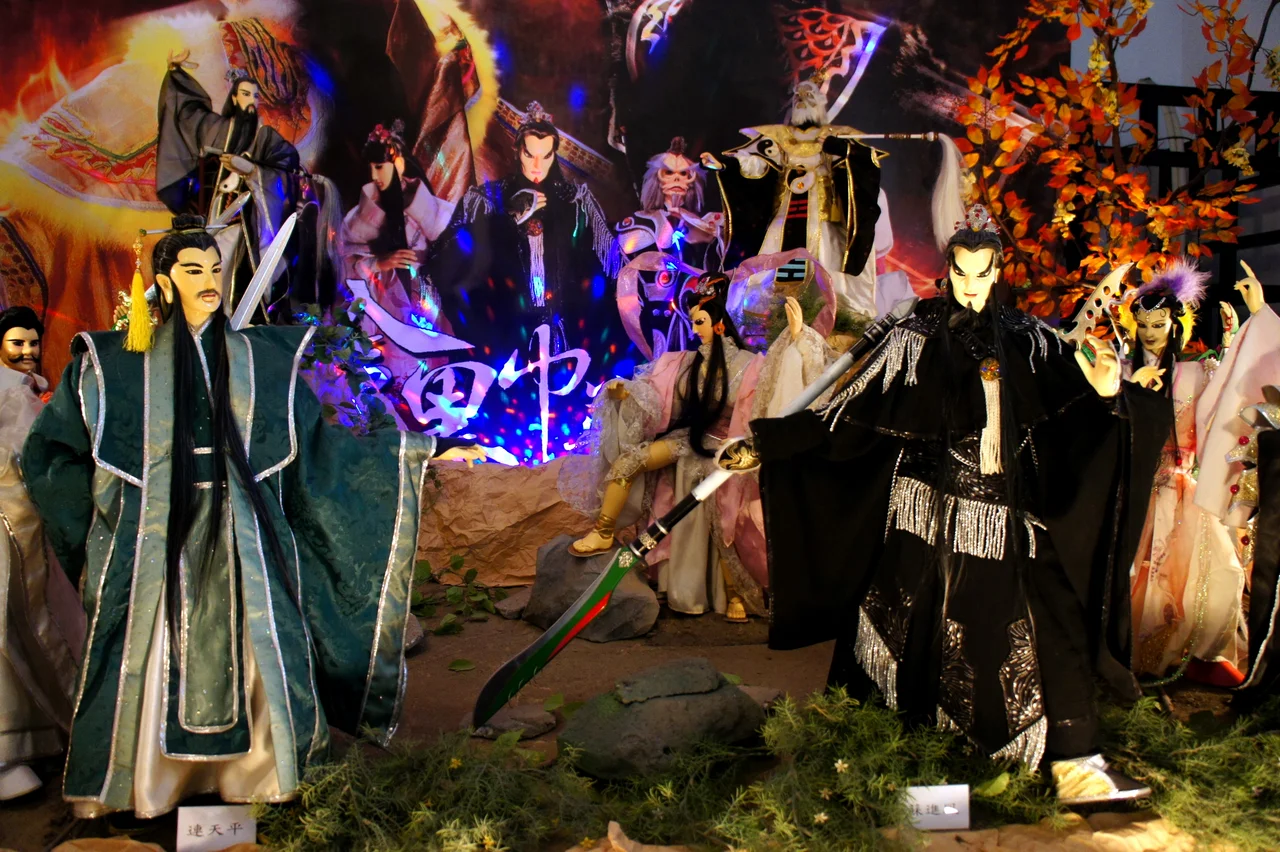
Glove-puppet theater — budaixi in Taiwanese Hokkien — arrived in Taiwan from Fujian Province in China and was performed at temple festivals and outdoor stages across the western lowlands for generations. The puppets are elaborate: beautifully costumed figures with hand-carved wooden heads, each one representing a character type from traditional Taiwanese drama — heroes, villains, scholars, demons, generals. A single performer manipulates the puppet from below, controlling head and hands simultaneously while voice-acting the character's lines. Multiple performers work a stage together, creating the illusion of battles, romance, and intrigue between figures no larger than a forearm.
From the 1960s onward, televised budaixi brought the tradition into Taiwanese living rooms and created a mass audience for what had previously been a community-based performance art. The puppeteer families who adapted to television built enormous followings. The tradition remained centered in Yunlin, where the craft was most deeply embedded in local religious and social life. The museum at Huwei preserves this history across multiple dimensions — puppets themselves, performance equipment, historical documentation, and the living practice that continues in the events the museum hosts.
A Living Museum, Not a Memorial
The Yunlin Hand Puppet Museum does not function as an archive of something finished. It functions as a stage for something ongoing. The museum regularly hosts the Yunlin International Puppet Festival, organized in collaboration with the Yunlin Story House next door and the Cultural Affairs Department of Yunlin County government. These events bring puppetry practitioners from Taiwan and abroad, creating an exchange between local tradition and international puppetry forms.
Other events include commemorations of puppetry masters — the acknowledged virtuosos of the budaixi tradition whose techniques and characters shaped the art's development. These commemorations honor the people who carried the tradition across difficult decades: through the Japanese period, through the post-war years when Mandarin promotion policies pressured Taiwanese Hokkien culture, through the television era when the art form both expanded its audience and risked commodification. The museum's programming insists that budaixi is not past tense.
The Courtyard at the Center
Inside the museum, the 1931 building's wooden structure creates an atmosphere that reinforces the art it houses. The courtyard around which the building is arranged lets in light and air in ways that more modern construction rarely does. The 2.5-story scale — that half-story suggesting mezzanines, storage, and the adaptive use of space under pitched roofs — gives the interior a quality that larger, purpose-built museums sometimes lack: a sense of human scale, of rooms meant to be occupied and worked in rather than merely passed through.
The exhibitions within range across the full history of Taiwanese glove puppetry, from the early hand-carved wooden heads of traditional figures to the more elaborate modern puppets developed for television. The variety of puppet sizes reflects the range of performance contexts: small enough for intimate stage performances at temple fairs, large enough to register on a television screen. The hands that shaped them, and the hands that moved them, belong to a tradition that Huwei has made it its purpose to keep alive.
From the Air
The Yunlin Hand Puppet Museum is located at 23.7094°N, 120.433°E in the historic district of Huwei Township, Yunlin County. From the air, Huwei's compact urban core is visible as the densest settlement in northern Yunlin's flat agricultural plain. The museum itself is not visible as a distinct landmark from altitude, but its historic district location is near the center of the Huwei township grid. Chiayi Airport (RCKU) lies approximately 40 kilometers to the south. The Taiwan Strait coastline lies roughly 15 kilometers to the west, and Yunlin HSR Station — the Taiwan High Speed Rail stop serving the county — is located within Huwei Township. Recommended viewing altitude is 2,000–3,500 feet for a clear view of Huwei's position in the Yunlin plain.
Nearby Stories
- Puli 7.3 km away
- Guanzihling 11 km away
- Fangyuan Lighthouse 11 km away
- Yakou Mountain Pass 13 km away
- 1999 Jiji Earthquake 15 km away
- China Airlines Flight 611 23 km away
- TransAsia Airways Flight 222 26 km away
- Dongji Island 26 km away