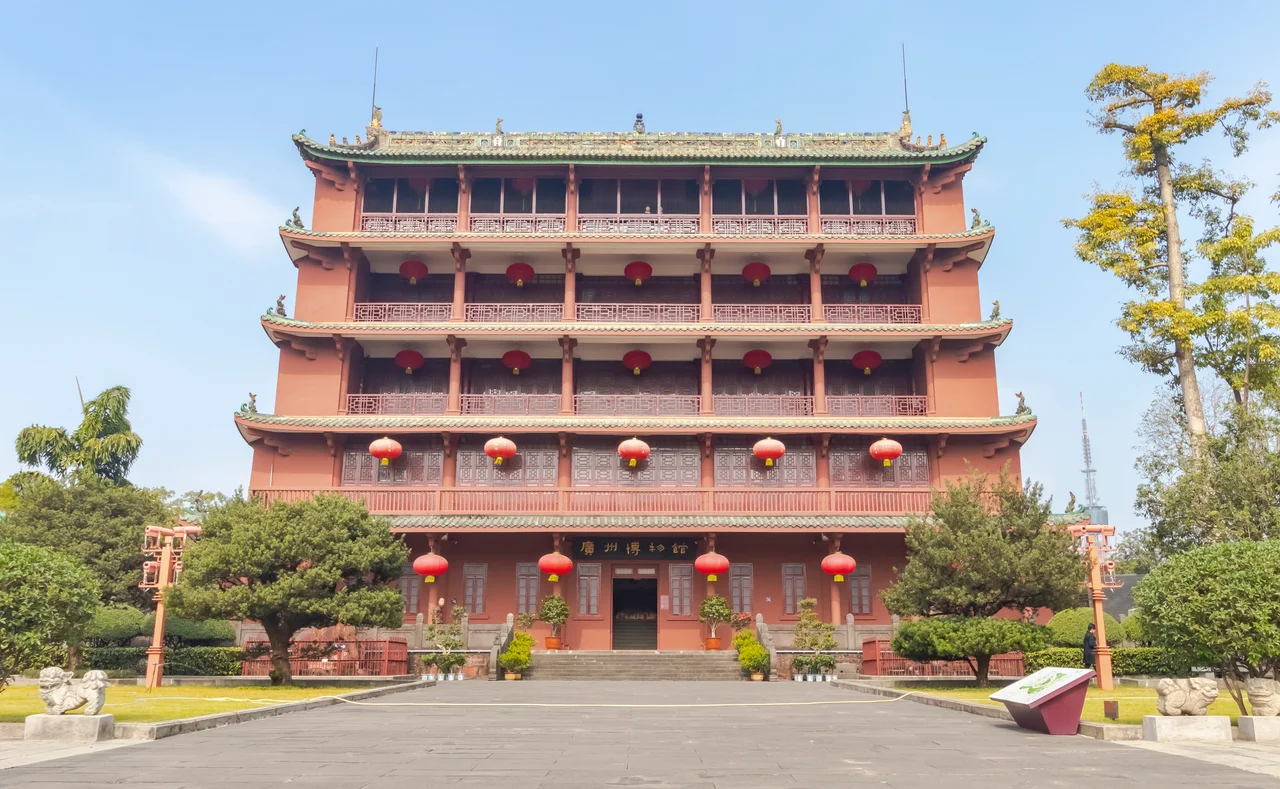

Zhenhai Tower
A Ming dynasty nobleman saw colored light rising over a hill and was told it meant a new emperor was coming. His response was to build a tower. That act of architectural politics — erecting a watchtower to suppress celestial energies and scramble an inconvenient prophecy — gave Guangzhou one of its most enduring landmarks. The Zhenhai Tower, also known as the Five-Story Pagoda, has stood in some form on Yuexiu Hill since 1380, surviving destruction and reconstruction five times over six and a half centuries. Today its red walls and layered eaves look down over a city of more than fifteen million people. It houses the Guangzhou Museum. History, as it turns out, is more durable than prophecy.
Built to Break a Prophecy
The story of the Zhenhai Tower begins with fear. In 1380, early in the Ming dynasty, Zhu Liangzu — the Marquis of Yongjia and one of the dynasty's powerful military nobles — reportedly witnessed yellow and purple air rising over Yuexiu Hill. This was no casual sighting: in classical Chinese cosmology, such atmospheric phenomena were interpreted as auspicious signs indicating the presence of an emperor-in-waiting. For a loyal Ming official, the prospect of a new claimant to imperial power was an existential threat. Zhu Liangzu's solution was architectural. He ordered a guard tower built at the hilltop, incorporating it into Guangzhou's city walls. The explicit purpose was to alter the mountain's feng shui — to redirect or suppress the energies that the prophecy had identified. Whether this was genuine belief or calculated politics is impossible to say from this distance. The tower rose regardless, becoming the first of its kind constructed in the Lingnan region.
Five Destructions, Five Rebirths
The Zhenhai Tower's resilience is almost implausible. The structure has been destroyed five times and rebuilt five times, each iteration rising on the same commanding site above Guangzhou. Fires, military conflict, and the ordinary violence of time each took their toll — but the city kept rebuilding. This persistence says something about what the tower meant. By the time it first fell, it had already become more than a defensive structure: it appeared in Chinese poetry and ink paintings, standing as a shorthand for Guangzhou itself. Travelers arriving by sea or river used it to orient themselves. Merchants knew they had reached the right city when they spotted its tiered silhouette above the old walls. The current structure is 28 meters tall and 31 meters wide (16 meters deep) — not especially large by modern standards, but perfectly proportioned for its hilltop site, visible from considerable distance in the direction of the Pearl River.
From Watchtower to Museum
The transformation of the Zhenhai Tower from military installation to cultural institution happened gradually, then permanently, in 1928 — the year the Guangzhou Museum opened its doors to the public inside the tower's walls. The decision made a kind of sense: a building that had for five centuries served as a record of the city's persistence and survival was now asked to hold that city's artifacts and memories more explicitly. The museum occupies the tower's five floors, displaying objects that trace Guangzhou's history from ancient times through the modern era. The tower's red exterior walls, typical of Ming military architecture, frame the museum's entrance and give the institution a visual authority that few museums can claim. Visiting feels less like entering a gallery than stepping into a document — a building that is itself the oldest exhibit on display.
The View From the Summit
From the platform near the Zhenhai Tower, Guangzhou stretches in every direction with a comprehensiveness that makes the city's scale legible in a way that street-level experience never quite achieves. The dense residential towers of Yuexiu District press close from the south. The Pearl River glints somewhere beyond them. To the north, the city continues for kilometers before it encounters anything resembling countryside. The Five Rams Sculpture stands not far away on the same hilltop — the two monuments sharing the summit in a kind of compressed historical dialogue, the granite rams of legend and the red-walled tower of dynastic calculation side by side on the same green hill. The park around them hums with ordinary life: children running, older residents sitting in the shade, vendors moving through the paths below. The tower watches it all, as it has watched everything that has happened in this city since the Ming dynasty decided prophecy needed a physical answer.
From the Air
Zhenhai Tower is located at approximately 23.141°N, 113.260°E atop Yuexiu Hill in central Guangzhou, Guangdong. The nearest major airport is Guangzhou Baiyun International (ZGGG), approximately 18 km north-northwest. At altitude, the red-roofed five-story pagoda is the most visually distinctive structure in Yuexiu Park, standing out against the surrounding greenery and urban fabric. Best visible at 2,000–4,000 feet on a clear day, particularly on northbound approaches to ZGGG. The Pearl River is visible to the south, and the tower's elevated position on Yuexiu Hill makes it identifiable from several kilometers away in good visibility.
Nearby Stories
- Shunde 12 km away
- 2015 Shenzhen Landslide 15 km away
- Mount Luofu 23 km away
- Qingyuan Maglev Tourist Line 32 km away
- Kaiping 56 km away
- Heyuan 90 km away
- Chikan, Kaiping 92 km away
- Erlitou Site Museum of the Xia Capital 1257 km away