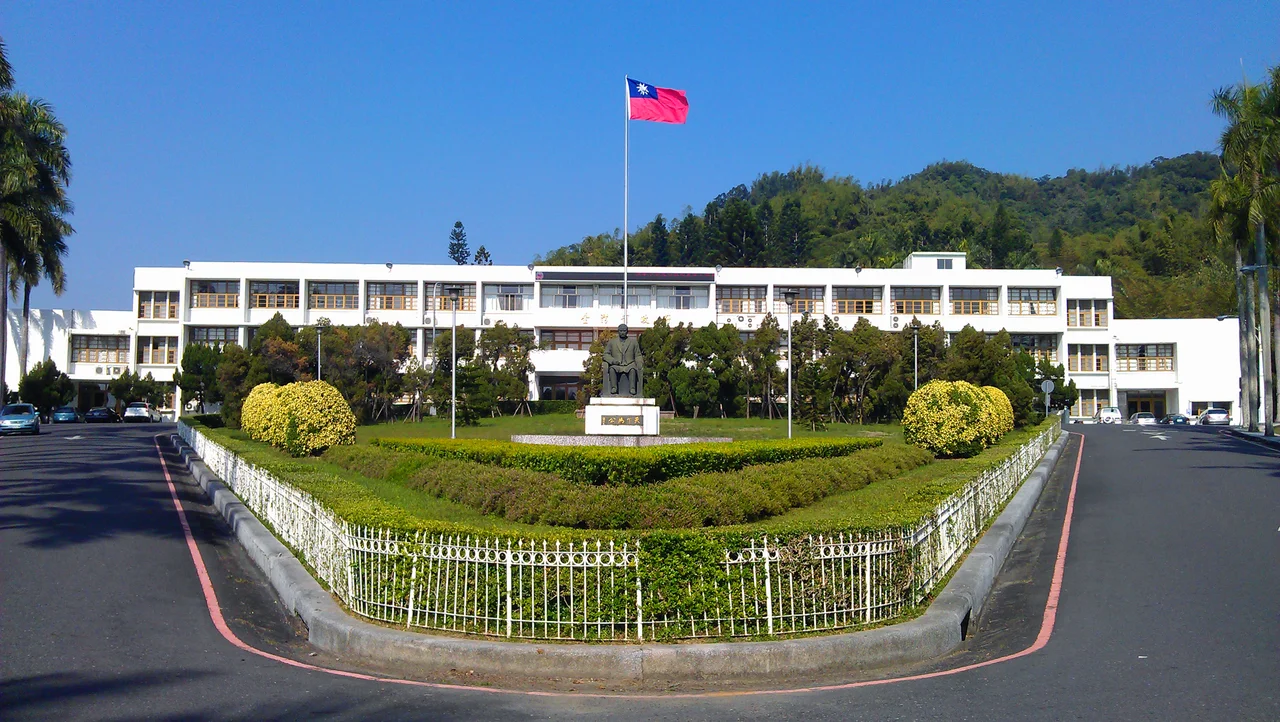

Zhongxing New Village
The name carries a legend inside it. Zhōngxīng — the term comes from the Shao Kang Resurgence, a Chinese myth about a king who restored a fallen dynasty. When the KMT government gave a planned town this name in the 1950s, the meaning was pointed: this was a place built in the expectation of return, of eventual restoration. The return never came. What remained was a very well-planned small city in Nantou County, preserved largely intact by the same government ownership that once controlled every brick of it — a garden-city capsule from a specific moment in Taiwan's political history, now adapting itself to a different future.
Drawn on Paper, Built from Scratch
Ground broke on Zhongxing New Village on November 4, 1955. The first government staff moved in on July 5, 1956. The Taiwan Provincial Government held its inaugural meeting in the new village on November 27, 1957. These dates have a deliberateness to them — each one a milestone in a project that was also a statement. The ROC government, having retreated from the mainland in 1949, had been running Taiwan Province from Taipei, the temporary capital. Moving the provincial administration inland to a purpose-built facility served both practical ends (relieving Taipei's overcrowding) and symbolic ones (establishing institutional permanence). The design drew from British new-town planning concepts — wide streets, green buffers, integrated residential and office zones, a scale calibrated to feel ordered and livable rather than overwhelming. Because all the land and buildings were government property, the result was unusually uniform: consistent architecture, regular spacing, abundant trees, none of the organic ad-hoc accumulation of a commercial city.
A Town Without Shareholders
Every building in Zhongxing New Village is government property. That fact has defined its character for seventy years. No private developer has put up a tower. No speculative boom has replaced the original housing stock with something newer and taller. The residential blocks from the 1950s and 1960s still stand, inhabited and maintained. The streets retain their original proportions. The parks and green corridors that were planned in remain in place. For a place its size, the population of around 25,000 as of the early 2010s — this level of preservation is exceptional. It exists not through heritage protection legislation but through a property ownership structure that simply never allowed the normal forces of urban change to operate. The result is something rare in Taiwan: a mid-century planned environment that looks, to a significant degree, as it was designed to look.
The Government That Left
The Taiwan Provincial Government was progressively wound down through the late 1990s, and formally abolished in 2018. The administrative machinery it housed at Zhongxing New Village gradually dispersed. Ministries and councils relocated, staff numbers fell, and the village that was built to be an active provincial capital found itself in a new and quieter role. Taiwan Historica, the provincial historical archive, remained. Plans emerged for an industrial innovation park — a technology incubation center that would bring new economic life to the planned zone, with an estimated cost of NT$10.7 billion and projections of 13,000 new jobs. The transformation from government seat to innovation hub is ongoing and unfinished. Zhongxing New Village sits in an interesting position: too historically significant to redevelop wholesale, too large and intact to leave as pure monument.
Preserved by Circumstance
Walking through Zhongxing New Village today is a particular experience. The scale is human — nothing here feels monumental or imposing. The streets are wide but not grandiose. The architecture is modest and functional, the postwar institutional idiom of somewhere that needed to work reliably rather than impress. Trees have grown for seven decades and now shade the footpaths thoroughly, softening the regularity of the grid. On weekends the village draws visitors interested in its retro atmosphere — it has become a site of nostalgic tourism, an intact specimen of a Taiwan that no longer exists anywhere else in quite this form. The 1950s houses, the sleepy governmental boulevards, the absence of chain convenience stores on every corner: Zhongxing New Village wears its history lightly, as a living place rather than a museum, while being both.
From the Air
Zhongxing New Village lies at approximately 23.959°N, 120.687°E in Nantou City, Nantou County. From altitude, its planned grid is clearly distinguishable from the surrounding unplanned urban fabric — look for the unusually regular street pattern and extensive tree canopy within a defined boundary east of the Nantou City core. The site sits in the broad basin at the edge of the Central Mountain foothills, with the Bagua Plateau visible to the west. RCMQ (Taichung International Airport) is approximately 30 km to the north-northwest. The village is best observed at 3,000–5,000 feet, where the contrast between the planned grid and the organic street pattern of surrounding neighborhoods is clearly visible.
Nearby Stories
- Shigang Dam 2.7 km away
- Taixi, Yunlin 4.9 km away
- Xitou Nature Education Area 7.2 km away
- Lintianshan Forestry Culture Park 11 km away
- Taroko National Park 20 km away
- Smangus 36 km away
- China Airlines Flight 611 56 km away
- Taiwan Strait 69 km away