
Zhunan
The name gives you the geography. Zhúnán (竹南) means 'south of bamboo' — or more precisely, south of Hsinchu, since the character for bamboo (zhú) is the same one that begins Hsinchu's name. So Zhunan is defined, from its very founding, by its relationship to the city to its north: it is the place that comes after. This small township on the northwestern coast of Taiwan has made peace with that secondary status and built something quietly distinctive around it — a fishing harbor, a beach long enough for kite-surfing, a great Matsu temple, and the peculiar freedom of a town that the bigger places don't bother trying to be.
Matsu and the Sea
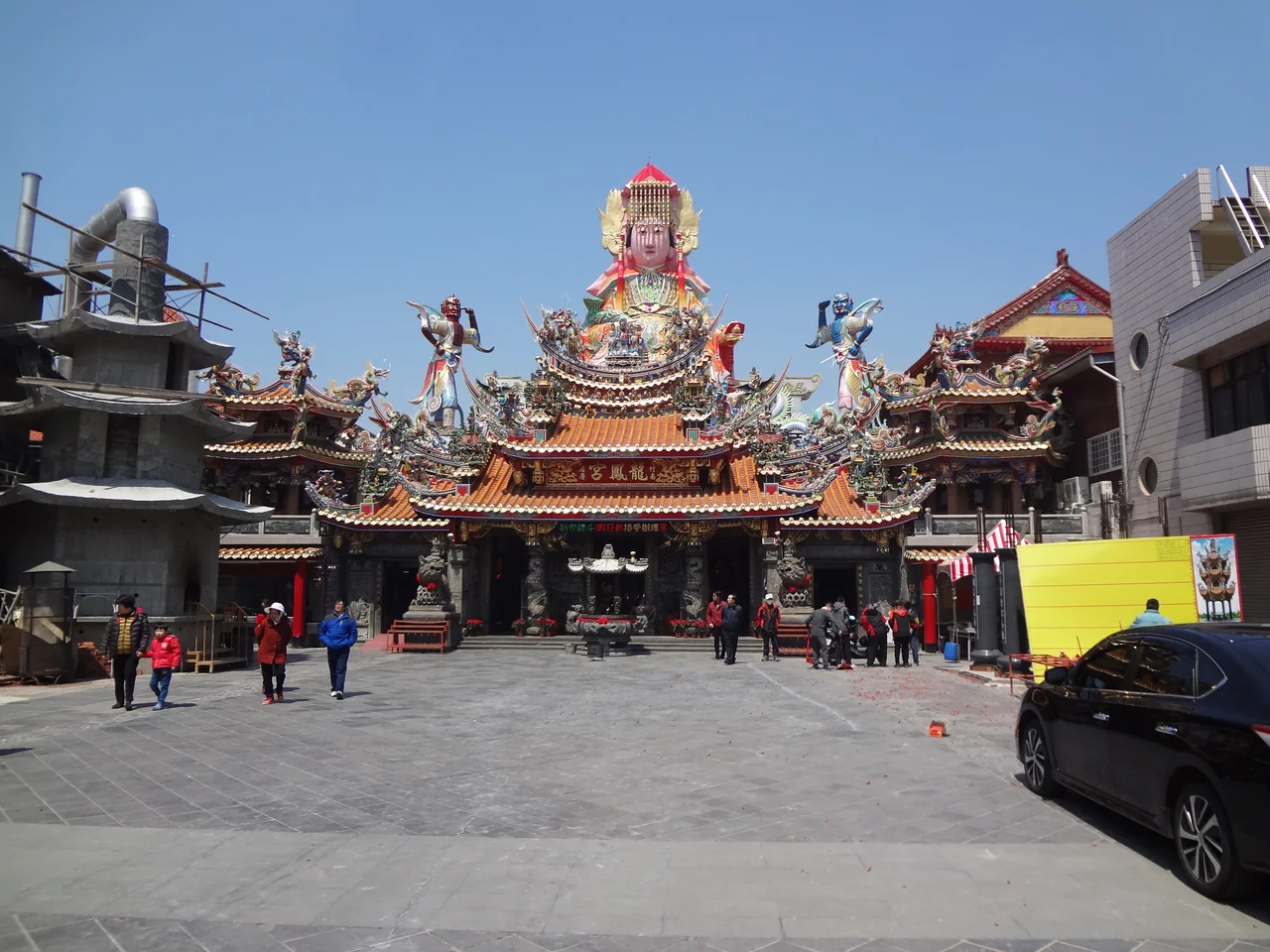
Zhunan grew up as a fishing and beach community, and the sea goddess Matsu has watched over it for as long as anyone can say. The largest Matsu temple in the township is the town's principal tourist attraction and its spiritual center — a fact that reveals something important about the order of priorities here. Before the train station, before the beach, before the restaurants, there is the temple.
Matsu is the patron deity of fishermen and sailors throughout southeastern China and Taiwan, worshipped from the Fujian coast to the ports of Malaysia and Singapore. In Zhunan, as in hundreds of fishing communities across the Taiwan Strait, her presence in the landscape is not decorative. It is architectural. The temple is large because the need that built it was real: fishermen going out onto open water required the most powerful divine protection available, and Matsu — a deified woman from Song dynasty Fujian said to have died young while trying to rescue her father and brothers at sea — provided it.
A Town at the Junction
Zhunan train station is no ordinary stop. It sits at the intersection of the mountain line and the coastal line of the Taiwan Railway Administration, which means that trains arriving here can split in two different directions: one route continuing south along the coast, the other turning inland toward the hills of Miaoli. This geographic pivot point makes Zhunan unexpectedly useful — it is 10 to 15 minutes from both Hsinchu to the north and Miaoli to the south, close enough to both to make day trips trivial.
The name Zhúnán also implies a relationship with Zhubei to the north of Hsinchu — just as Zhunan means 'south of Hsinchu,' Zhubei means 'north of Hsinchu.' Zhunan is thus part of a directional system of place names that cartographically arranges the townships around Hsinchu like compass points, each defined by where it stands relative to the center.
Waves, Kites, and the Longfeng Harbor
The beach at Zhunan is large and open — broad enough to absorb wind and produce the conditions that surfers and kite-surfers need. Equipment rental is available near the Child and Parent Forest, a recreational area along the shoreline. The beach is not a resort beach; there are no hotels perched above the sand, no rows of beach chairs for rent. It is a working coast with working weather, the kind of place where the ocean is a presence rather than a backdrop.
Longfeng Fishing Harbor handles the serious maritime business of the township. Fishing boats come and go with the tides and the season, and the harbor has the functional, unsentimental beauty of places designed entirely around purpose rather than appearance. The seafood sold nearby comes from this harbor, caught the same morning it reaches the market — a directness of supply chain that most urban food culture has long since surrendered.
Lion's Head Mountain on the Horizon
From Zhunan station, a shuttle bus runs to Shitoushan — Lion's Head Mountain — in the highlands above neighboring Toufen. The mountain takes its name from its profile as seen from below: a rounded crest said to resemble a crouching lion's head. Along the trails, a series of temples and hermitages occupy the hillsides, some cut directly into the rock face. The largest offers overnight stays at modest prices, making it possible to spend the night on the mountain and watch dawn break over the valley.
Nearby Nanzhuang is an old farming town with traditional food, hot springs, and Xiantian Lake. The road there from Zhunan, Highway 124, loops through the Nanzhuang valley before reconnecting with the main highway farther south — a route that manages, in the space of an hour's drive, to pass from coastal township to hill village to mountain scenery.
Duck, Noodles, and the Texture of a Real Town
Zhunan does not perform itself for tourists. The restaurants serve what locals eat: braised duck, curry noodles, black bean noodles, spiced purple rice fried with vegetables, eggs, and walnuts. One noodle shop on Bo-Ai Street is identified by a small sign with a picture of a bird; regulars know it without needing directions. A cafeteria buffet nearby has a yellow sign with red characters and stays open for lunch and dinner.
This is a town that expects you to find things yourself, which is part of its appeal. The streets near the station are walkable; the beaches are reachable by bike. The tea museum in the industrial area near Kexue Road is small and free, worth an hour if you are passing through. For those willing to slow down and look, Zhunan offers what the bigger cities around it cannot: the ordinary texture of Taiwanese coastal life, relatively undisturbed.
From the Air
Zhunan sits at approximately 24.68°N, 120.88°E on the northwestern coast of Taiwan, where the land meets the Taiwan Strait. From the air at 6,000–10,000 feet, the Longfeng Fishing Harbor is visible to the west, and the town's railway junction is identifiable by the convergence of mountain and coastal rail lines. The beach stretches visibly along the coastline. Approaching from the coast at lower altitudes, the flat coastal plain transitions quickly to rising terrain heading east — Lion's Head Mountain (Shitoushan) is visible in the southeast. Nearest airports: RCSS (Taipei Songshan, ~70km N), RCMQ (Taichung, ~60km S). Coastal breezes can be significant; marine layer is common in early morning.
Nearby Stories
- Tapung Old Fort 1.5 km away
- Sanyi, Miaoli 1.9 km away
- Taipei Prison 6.2 km away
- Taoyuan Guanxin Algal Reefs Ecosystem Wildlife Refuge 27 km away
- Taroko National Park 30 km away
- Taiwan Strait 33 km away
- China Airlines Flight 611 75 km away
- Battle of Xiapi 1065 km away