
82nd Airborne Division War Memorial Museum
The street corner tells you what the museum is about before you read a single label. Ardennes. Gela. One name from the snowbound forests where the 82nd Airborne held the line in the Battle of the Bulge, the other from the Sicilian beachhead where its paratroopers jumped into hostile fire on the night of July 9-10, 1943. The 82nd Airborne Division War Memorial Museum sits at the intersection of those two names because that is the geography of paratrooper memory - addresses that mean nothing in Cumberland County, North Carolina, and everything to anyone who has worn the AA patch.
An Army Museum, Civilian Curated, Born of War
The museum was established in 1945, before the war it commemorates had even ended. That timing matters. The original collection grew from objects troopers brought home from Europe and the Pacific, things that meant something specific to the men who carried them - a Luftwaffe officer's tunic, a captured Fallschirmjager helmet, the small ephemera of someone else's defeat. The exhibits trace the All American Division from its founding at Camp Gordon, Georgia in 1917 (the AA stood for soldiers from every state of the Union, a deliberate symbolism in a still-segregated army) through both World Wars, Vietnam, Grenada, Panama, the Persian Gulf, Operation Restore Hope in Somalia, Operation Golden Pheasant in Honduras, and Operation Enduring Freedom in Afghanistan. The collection includes light armor weapons, rifles, handguns, and uniforms from every era the division has served. The grounds themselves serve as a parade space - reenlistment ceremonies, retirements, and remembrance events happen here regularly.
Aircraft on the Lawn
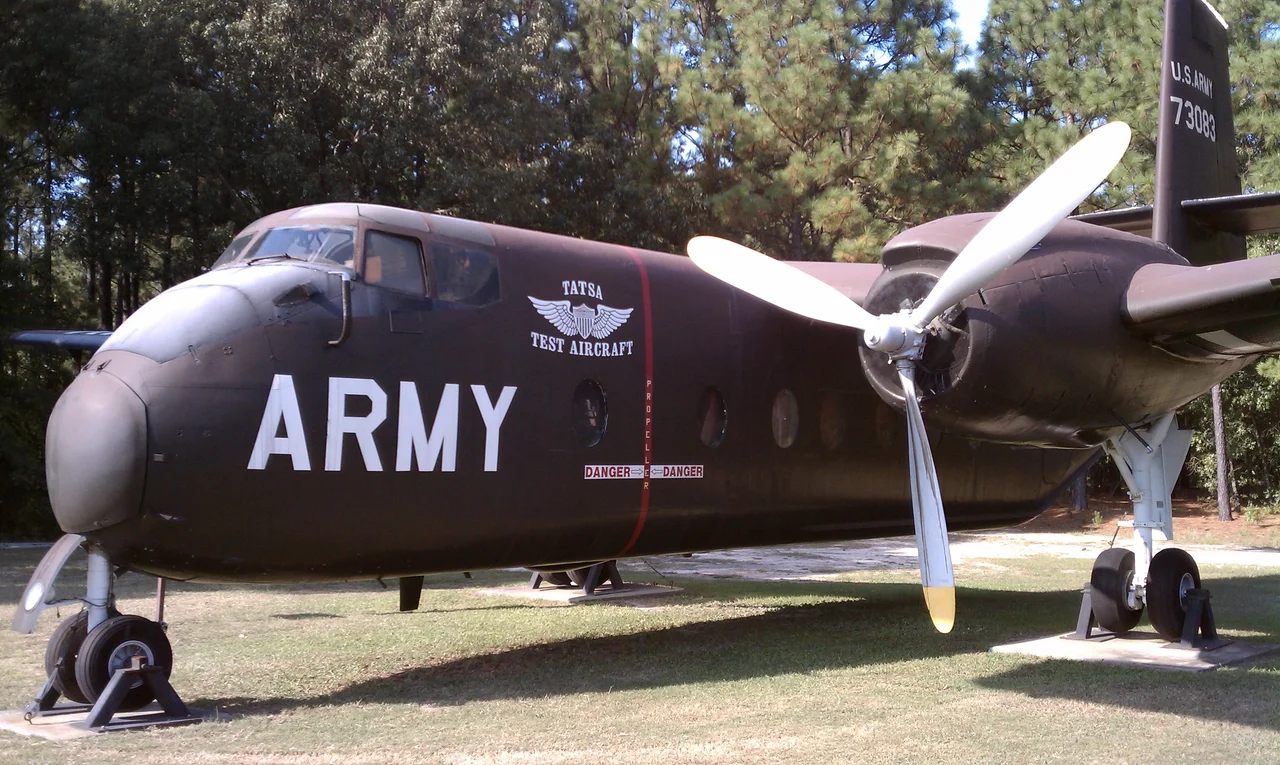
Step outside the main building and the airframes do the talking. A Douglas C-47 Skytrain, the workhorse that delivered paratroopers to Normandy and Sicily and Holland, sits weathered in the North Carolina sun. Next to it: a Fairchild C-119 Flying Boxcar from the Korean War era, twin-boomed and unmistakable. A de Havilland Canada C-7 Caribou - the Army's go-anywhere short-field transport, used by the U.S. Army Parachute Team. A Bell UH-1A Iroquois, the first generation of the helicopter that defined a generation of American war. A Curtiss C-46F Commando, the C-47's larger cousin. A Fairchild C-123K Provider. The selection isn't comprehensive, but it tells a particular story: this is how paratroopers got to the fight, from World War II through the helicopter age. Each aircraft is a kind of monument to the unglamorous side of the airborne mission - the loadmasters, jumpmasters, and crew chiefs who put men out the door in the right place at the right time.
Noriega's Name Tag
Among the more pointed artifacts is a name tag and military uniform that once belonged to Manuel Noriega - the Panamanian dictator captured during Operation Just Cause in December 1989. The 82nd Airborne played a central role in that operation, parachuting onto Tocumen Military Airport and Torrijos International Airport in the largest combat jump since World War II. Noriega himself was not caught at the airport - he holed up in the Vatican embassy and surrendered weeks later - but the personal items eventually made their way north to this museum on Fort Bragg, where they sit in a glass case as evidence of a particular kind of resolution. Captured material always raises questions about how it should be displayed; here the framing is straightforward. These objects belonged to a man whose regime trafficked drugs and brutalized Panamanians, captured in an operation that cost American paratroopers their lives. The exhibit honors the people who did the capturing.
Visiting and Entry
The museum is open to the public, but Fort Bragg is an active military installation, and access requires a photo ID and a vehicle search at the gate. Plan extra time. Once on post, the museum stands at the intersection of Ardennes and Gela on the All American Freeway side of the cantonment, near the divisional headquarters of the 82nd. The neighborhood is residential and busy with families and soldiers; the museum is one of several memorial sites in walking distance. The Iron Mike statue stands a short drive away in the traffic circle at the post headquarters, and the much larger Airborne and Special Operations Museum sits off-post in downtown Fayetteville. Together they form an unofficial route through American airborne history, the kind of trail that takes a half day to walk and a long lifetime to understand.
From the Air
The 82nd Airborne Division War Memorial Museum sits inside Fort Bragg at 35.14°N, 79.00°W. Closest field is Simmons Army Airfield (KFBG) on the installation. Pope Field (KPOB), home of Air Mobility Command's 43rd Air Mobility Operations Group, lies just to the north. Fayetteville Regional Airport (KFAY) handles civilian commercial traffic about 12nm south. The installation hosts substantial restricted airspace; check NOTAMs and consult the Fayetteville sectional.
Nearby Stories
- Laurinburg, North Carolina 4.7 km away
- Sampson County, North Carolina 9.1 km away
- Rockingham Speedway 18 km away
- Campbell University 19 km away
- The Robesonian Takeover 20 km away
- Johnston County, North Carolina 21 km away
- North Carolina Aviation Museum 53 km away
- Pender County, North Carolina 57 km away