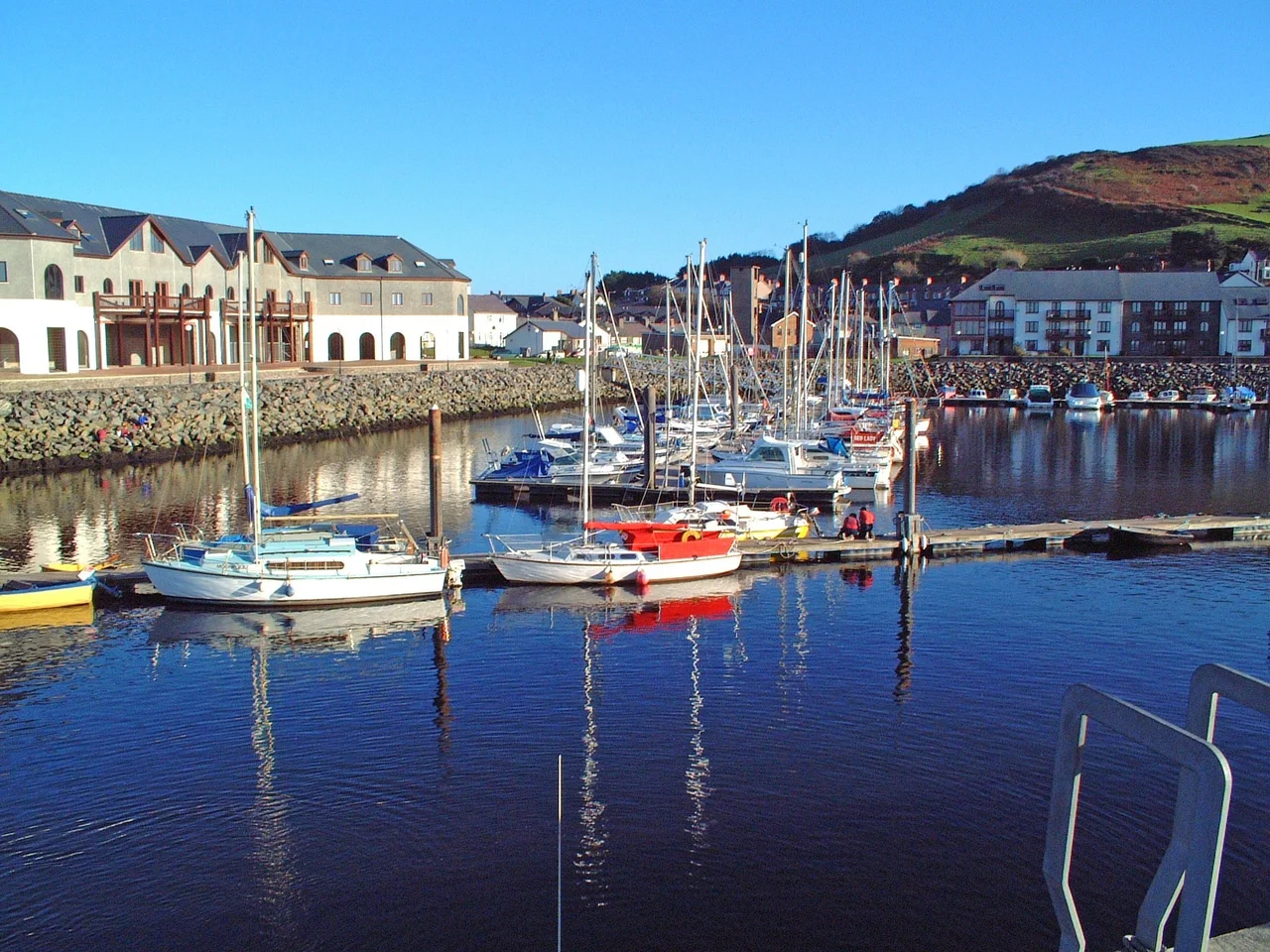

Aberystwyth
Cardigan Bay swings west from the headland of Constitution Hill, and the town that rises behind it is one of the most idiosyncratic places in Wales. Aberystwyth is a population of fewer than fifteen thousand, but it holds the National Library of Wales (one of six legal deposit libraries in the United Kingdom and Ireland), a university founded in 1872 in a bankrupt seaside hotel, a vintage cliff railway, a ruined Edwardian castle, a working harbour, the Welsh-language television industry's main commissioning relationship, and — since 2025 — the title of the first Welsh UNESCO City of Literature, granted in recognition of a place that has been arguing about books in two languages for at least four hundred years.
The Castle on the Hill
The recorded history of Aberystwyth begins in 1109, when the Norman lord Gilbert Fitz Richard built a fortress on a hill above the south bank of the Ystwyth — the river that gives the town its name. That site (now Tan-Y-Castell) sat a mile and a half from the present town centre, and the original castle did not last: the Welsh kings of Deheubarth ran the surrounding country and the position was vulnerable to raids from Gwynedd and Powys. Llywelyn the Great destroyed and rebuilt fortifications here in 1208. Edward I built a new, more substantial castle on Castle Hill, the high point of the present town, in 1277, after the Welsh again destroyed Strongbow's older works. Between 1404 and 1408 Owain Glyndŵr held it during his rebellion against English rule, until the future King Henry V starved it into surrender on 23 September 1408. From 1639 to 1642, silver coins were minted at Aberystwyth Castle on behalf of the Royal Mint, using silver from the local mines — £10,500 worth, equivalent to 2.5 million silver pennies. In 1649 Parliamentarian troops razed the castle. Three towers, partly, survive. In 1988 an excavation within the castle area found a complete male skeleton, deliberately buried, probably preserved by the lime from the collapsed Parliamentarian demolition; he is now in Ceredigion Museum, known affectionately as 'Charlie', a likely casualty of the siege.
The Railway and the Hotel That Became a University
The Cambrian Railways line from Machynlleth reached Aberystwyth in 1864, and rail links to Carmarthen followed shortly afterwards. The town's terminus station, rebuilt in 1924, is itself an architectural set-piece, mixing Gothic, Classical Revival, and Victorian styles in the way that prosperous Edwardian terminals often did. Good Friday 1869 saw two openings on the same day: the new line through the Cambrian Mountains, and Eugenius Birch's 292-metre Royal Pier, which drew 7,000 visitors. Hotels went up rapidly to accommodate the influx of working-class and middle-class holidaymakers from south Wales and the Midlands. One of the largest of those Victorian hotels, the Castle Hotel, never quite opened. It went bankrupt before completion, and the half-finished building was sold cheaply to the Welsh National University Committee — a remarkable group of small donors and patriotic gentry who had been collecting subscriptions for a Welsh university. The College of Wales opened in the unfinished hotel in 1872, the first university institution to take Welsh students of any social class at a time when Oxford and Cambridge mostly did not. That institution became Aberystwyth University, whose current main campus sprawls across Penglais Hill above the town. The library next to it became, in 1907, the National Library of Wales.
Constitution Hill and the Camera Obscura
The Aberystwyth Cliff Railway runs up Constitution Hill at the north end of the seafront. It was built in 1896 by the Aberystwyth Improvement Company, originally water-balance powered (with water tanks under each carriage filled at the top and emptied at the bottom to drive the system by gravity); it was later electrified, but the cars themselves still look largely Victorian. At the top of the hill stands the world's largest camera obscura — a darkened room into which an external image is projected through a lens, providing, on a clear day, a 360-degree panorama of Cardigan Bay, the town below, and the Snowdonian mountains stretching north. The funicular and the camera obscura are unfashionable Victorian technology that has somehow refused to be replaced. They are also, more pointedly, a working piece of seaside infrastructure that the town has chosen to keep rather than modernise.
Books, Films, and the Language Question
The National Library of Wales, established by Royal Charter in 1907 on the same day as Amgueddfa Cymru, sits on Penglais Hill — the cliff above the university campus, looking out across the town. It is a legal deposit library, which means it receives a copy of everything published in the United Kingdom and Ireland; it holds the largest collection of Welsh-language material in the world, the National Screen and Sound Archive of Wales (one of six British regional film archives), and the medieval manuscript collections that include the White Book of Rhydderch and Llyfr Aneirin. The town's relationship with the Welsh language is dense and politically alive. In 1963, on Trefechan Bridge across the Rheidol, Cymdeithas yr Iaith Gymraeg (the Welsh Language Society) held their first protest — a sit-down on the bridge demanding bilingual road signs. The town hosts the Society's national offices, the Welsh Books Council, the standard historical dictionary of Welsh (Geiriadur Prifysgol Cymru), and substantial offices of the Welsh Government. By the 2011 census Ceredigion (the surrounding county) was no longer a majority Welsh-speaking county, but the town remains genuinely bilingual in a way that older industrial parts of south Wales are not.
The Sea and the Storms
Aberystwyth lives with weather. On the night of Friday, 14 January 1938, a storm with estimated gusts of 90 mph destroyed most of the promenade, broke 200 feet off the Royal Pier, and damaged every seafront property north of the King's Hall, with Victoria Terrace worst hit. Reconstruction took until 1940 and cost £70,000 — about £2.5 million in present-day terms. The aftermath of Cyclone Dirk on 3 January 2014 flooded the promenade again, evacuated 250 students from seafront university residences for five days, and led the Welsh Government and Natural Resources Wales to undertake emergency coastal defences. The promenade has been rebuilt, twice. The Old College sits a few feet above sea level. The pier still stretches out into Cardigan Bay, shorter than it once was.
What the Town Does Now
Hinterland — the bilingual Welsh-English crime series filmed in and around Aberystwyth from 2013 — gave the town a moody, slate-grey screen identity that has drawn film tourists ever since; the police station in the show was filmed at the County Office on Queens Road, formerly the Queens Hotel. The Aberystwyth Arts Centre on the university campus is one of the largest such centres in Wales, with a 312-seat theatre, a 900-seat concert hall, a 125-seat cinema, galleries, studios, cafés. Aberystwyth Town F.C., founded 1884, plays in Cymru South, Wales's second division. The Aberystwyth Cliff Railway still climbs Constitution Hill. The lifeboat still launches from the beach by the harbour. The hymn tune 'Aberystwyth' — composed by Joseph Parry in 1879 and set to 'Jesus, Lover of My Soul' — is sung in chapels and choirs around the world by people who have never been here. In 2025 UNESCO formally recognised what residents have known for a long time: that Wales's unofficial mid-coast capital is, for its size, one of the most literary places in Europe.
Flight Context
Aberystwyth centres at 52.415°N, 4.083°W, on the central western coast of Wales facing Cardigan Bay. From the air the town has a distinctive shape: the long curve of seafront and pier; the bulk of Constitution Hill at the north end (with the funicular railway carriages just visible on the cliff face); the spread of university buildings on Penglais Hill to the east; the National Library above them; the harbour mouth and the lifeboat station at the south end of the promenade. The nearest active airfield is Welshpool (EGCW), 60 km east; Cardiff (EGFF) lies 120 km south. Low-altitude transits along Cardigan Bay (1,500–3,000 ft AGL) give the best view. The Cambrian Mountains rise sharply inland; on a clear day the Snowdonian peaks 50 km north are visible from above the town.
From the Air
Coordinates 52.415°N, 4.083°W (Aberystwyth town centre, central western Wales). Recommended viewing altitude 1,500–3,000 ft AGL. Nearest active airfield Welshpool (EGCW), 60 km east; Cardiff (EGFF) 120 km south. Visible landmarks: Constitution Hill and its funicular at the north end of the promenade, the long seafront curving south to the harbour, the ruined castle on Castle Hill, the university campus on Penglais Hill, and the National Library of Wales above. Cambrian Mountains rise inland; Snowdonia visible on the northern horizon on clear days.
Nearby Stories
- Cambrian Mountains 6.1 km away
- Battle of Orewin Bridge 7.1 km away
- Church of the Holy Cross, Mwnt 9.1 km away
- Cymer Abbey 10 km away
- Plas yn Rhiw 10 km away
- Talgarreg 19 km away
- HMS Whirlwind (R87) 23 km away
- Battle of Oswestry 34 km away