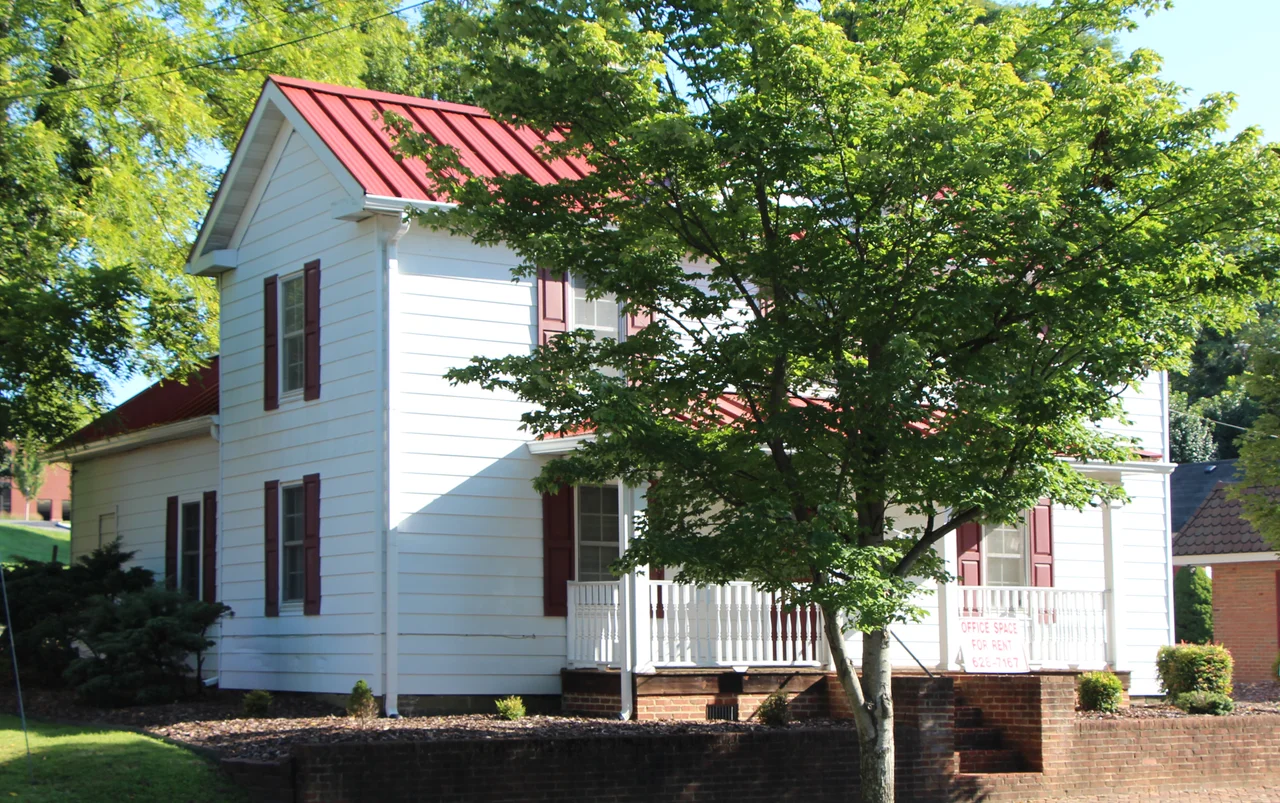

Abingdon Historic District
In 1933, in the worst year of the Depression, a young actor named Robert Porterfield came home to Abingdon with an idea: nobody had cash for theater tickets, but everybody had a ham hock or a jar of preserves. He took over an old Sons of Temperance hall on Main Street and announced that admission to his new theater would be paid in food. Local farmers brought hens and butter. The actors ate. The Barter Theatre opened on June 10, 1933, and ninety-three years later it is still putting on plays - the longest-running professional theater in the United States, still standing in the same Main Street building that anchors the Abingdon Historic District.
A Half-Mile of Time
Abingdon's historic district covers 145 contributing buildings, 13 contributing structures, and 2 contributing sites - everything from a 1773 house belonging to the first settled Presbyterian pastor west of the Alleghenies to mid-twentieth-century commercial blocks. The district was added to the National Register in 1970 and expanded in 1986. The earliest layer survives in the Reverend Charles Cummings House, built around 1773, when Abingdon was still called Black's Fort. The streets themselves run along an old buffalo trace that became an Indian trade path that became a wagon road - a single corridor used by every generation of traveler the region has ever known.
The Preston House
General Francis Preston built the central brick block of what is now the Martha Washington Inn in 1832 as a private home for his wife Sarah Buchanan Preston and their nine children. The original Preston living room is still the hotel's lobby. In 1858 the family sold the house to become a women's college - Martha Washington College - which ran for over seventy years through the Civil War and the Great Depression. During the war the grounds served as training barracks for the Washington Mounted Rifles, and the building became a hospital for wounded soldiers, Confederate and Union both. The college closed in 1932. In 1935, in a town short on jobs, somebody decided the Preston house should reopen as a hotel.
Sinking Spring and the Cashier's House
Sinking Spring Cemetery, near the eastern edge of the district, marks where the first Presbyterian congregation in the region built a log church in the early 1700s. By 1833 they had moved to what is now the Barter Theatre building. In 1837 the congregation split, and one branch built the Greek Revival Sinking Spring Presbyterian Church that still stands on East Main Street. Across the street, the Abingdon Bank from around 1845 housed both the bank's counting room and vault and the cashier's family - a clear architectural expression of the era's idea that the man who guarded the money should sleep next to it. The same building today operates as the Fields-Penn 1860 House museum.
Living On
Most historic districts are quiet. Abingdon's is not. The Barter still draws audiences to evening shows, the Martha Washington still serves dinner in the Prestons' old dining room, the courthouse from 1868 still hears cases, and the storefronts still sell things. Walk Main Street on a summer afternoon and you pass an 1827 house, a 1913 high school, a 1851 church, and a coffee shop in a building older than the Civil War, all sharing the same sidewalk. The district works because almost nobody tore anything down. The Wolf Hill tract that surveyor Thomas Walker first marked between 1748 and 1750 is still recognizably the same place.
From the Air
Abingdon Historic District lies at 36.71 N, 81.97 W in Washington County, southwest Virginia, in the Great Appalachian Valley between the Middle and North Forks of the Holston River. The district is a roughly half-mile stretch along Main Street, easily picked out from the air by the dense block of mature trees and the white spire of Sinking Spring Presbyterian Church. Nearest airport is Virginia Highlands (KVJI) at Abingdon, with Tri-Cities Regional (KTRI) 17 nm southwest. Recommended viewing altitude 3,500 to 5,000 feet MSL; town sits at 2,070 feet.
Nearby Stories
- Wise County, Virginia 6.2 km away
- Sycamore Shoals 16 km away
- David Crockett Birthplace State Park 21 km away
- Tazewell County, Virginia 24 km away
- Big Stone Gap, Virginia 28 km away
- Buchanan County, Virginia 40 km away
- Moravian Falls, North Carolina 47 km away
- Wytheville Raid 54 km away