
Wytheville Raid
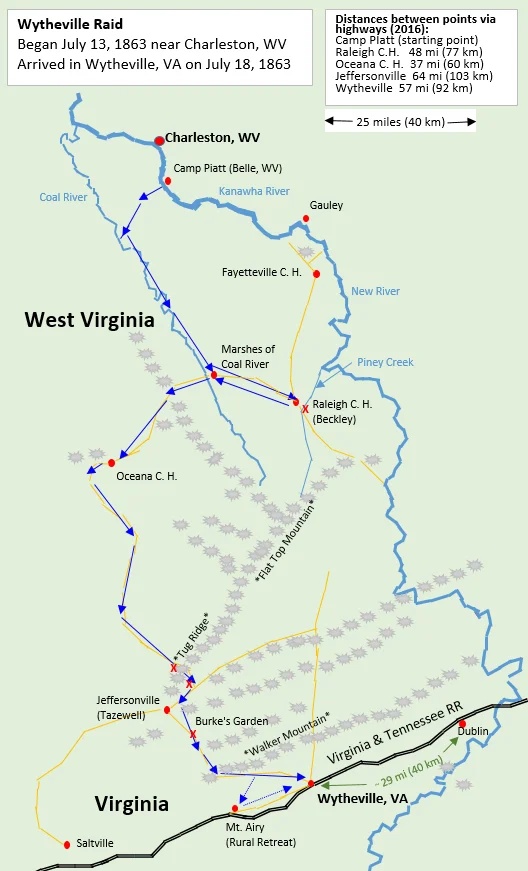
One Union soldier called the road into Wytheville an avenue of death. Colonel John T. Toland's brigade of 870 men had ridden for five days through the West Virginia mountains to reach this Wythe County county seat on the evening of July 18, 1863, with orders to cut the Virginia and Tennessee Railroad and, if circumstances allowed, to wreck the lead mine that supplied a third of the Confederacy's bullets. The cavalry charged in column down the main street toward the railroad station. Then the windows opened. About 120 civilians — men, women, home guard — fired their muskets from inside their own houses. Toland was killed almost immediately. So were eight others. The raid succeeded militarily and failed in every other way that mattered.
Why Wytheville
George Wythe — the Virginia jurist who tutored Thomas Jefferson in law and signed the Declaration of Independence — gave his name to the town and the county. But it was the lead under the county that interested the Union army. The Wythe County mines at Austinville produced roughly a third of the lead used by the Confederate Army for ammunition. The Virginia and Tennessee Railroad ran east-west through Wytheville and carried that lead to Confederate factories in Lynchburg, Petersburg, and Richmond. Telegraph wires strung along the rails connected the Confederate capital to Tennessee. Forty-four miles west at Saltville sat the salt mines that preserved meat for Confederate armies. Twenty-five miles east at Dublin Depot sat a regional Confederate headquarters. Wytheville was the keystone of southwestern Virginia's military economy. The Union wanted it broken.
Toland's Brigade
On July 13, 1863, an undersized brigade of 870 men left a base camp near Charleston, West Virginia. The orders came from General Eliakim P. Scammon: disable the railroad, cut the telegraph, and if you can, hit the lead and salt mines. The brigade consisted of 365 men of the 2nd West Virginia Volunteer Cavalry and 505 men of the 34th Ohio Volunteer Infantry. A Civil War brigade normally fielded around 2,600. Colonel John T. Toland, of the 34th Ohio, commanded as acting brigadier general. His second was Colonel William H. Powell of the 2nd West Virginia — already a Medal of Honor candidate for the Sinking Creek Raid the previous November, in which he had taken 22 men and captured an entire Confederate camp. A Confederate paper later called Powell "a one-eyed Colonel by the name of Powell." He was. He had lost the eye in a previous engagement and he never stopped fighting.
The Ride East
The brigade rode up the Coal River, crossed it many times, lost two men to a Confederate ambush near Beckley on July 14, and pressed on through the mountains. To keep the operation secret, they captured every rebel they encountered and held them as prisoners rather than let word spread. They almost succeeded. But somewhere in Tug Ridge or Abbs Valley a single Confederate either escaped capture or escaped after being captured, and the warning reached southwestern Virginia ahead of the column. By the time Toland's men camped on the evening of July 17 just six miles from Tazewell Court House, the Confederate command knew a Union force was riding for Wytheville. They didn't know exactly how many. They didn't know exactly which target. But they had time to send word into Wytheville itself.
Avenue of Death
The town's defenders were about 130 Confederate soldiers and roughly 120 civilians, including home guard who had volunteered when the warning came. Many residents fled south or hid in their cellars. Those who stayed loaded their muskets and waited at their windows. The Union cavalry entered Wytheville first, charging in column down the main road toward the railroad depot. The Confederate ambush opened fire from the storefronts and houses on both sides of the street. The road filled with the smoke of black powder and the screams of horses. Most of the local defenders were firing one-shot muskets from inside their homes — a form of unconventional warfare that horrified Union veterans, who had not expected to be shot at by women through bedroom windows. Colonel Toland was hit and killed almost immediately. The cavalry pushed through and reached the depot, but the cost was paid in the first hundred yards.
The Mine That Survived
Powell, second in command, took over after Toland's death and the brigade burned the depot, wrecked the railroad cars, cut the telegraph, and rode out before Confederate reinforcements could close. The Austinville lead mine — the real strategic target — survived untouched. The Union force lost eight men killed and 20 captured according to the Confederate after-action report; Powell himself was captured later in the retreat. Toland was buried with military honors; his death made the Wytheville Raid one of the bloodier small-scale actions of the southwestern Virginia campaign for the Union officer corps. The railroad was repaired within weeks. The lead kept flowing east. And the next Union raid through Wythe County, eleven months later under William Averell, would be stopped before it even reached the town. The civilians' muskets had set the precedent. Wytheville would not surrender easily.
From the Air
The Wytheville Raid was fought in the streets of Wytheville at 36.948 N, 81.087 W, with the action centered on Main Street between the town and the railroad depot 0.75 mi south. New River Valley Airport (KPSK) lies 23 nm east. The Austinville lead mines were 10 miles southeast along the New River near present-day Austinville, Va. The Virginia & Tennessee Railroad alignment is now used by the Norfolk Southern. From cruising altitude, look for the I-77/I-81 wrong-way concurrency intersection just north of Wytheville — one of the most famous interstate junctions in the southeast. Crockett's Cove Presbyterian Church survives 8 miles northwest, witness to both raids.
Nearby Stories
- War, West Virginia 12 km away
- Princeton, West Virginia 13 km away
- Galax, Virginia 13 km away
- Floyd County, Virginia 15 km away
- Patrick County, Virginia 21 km away
- Emory and Henry University 35 km away
- Washington County, Virginia 36 km away
- Salem, Virginia 40 km away