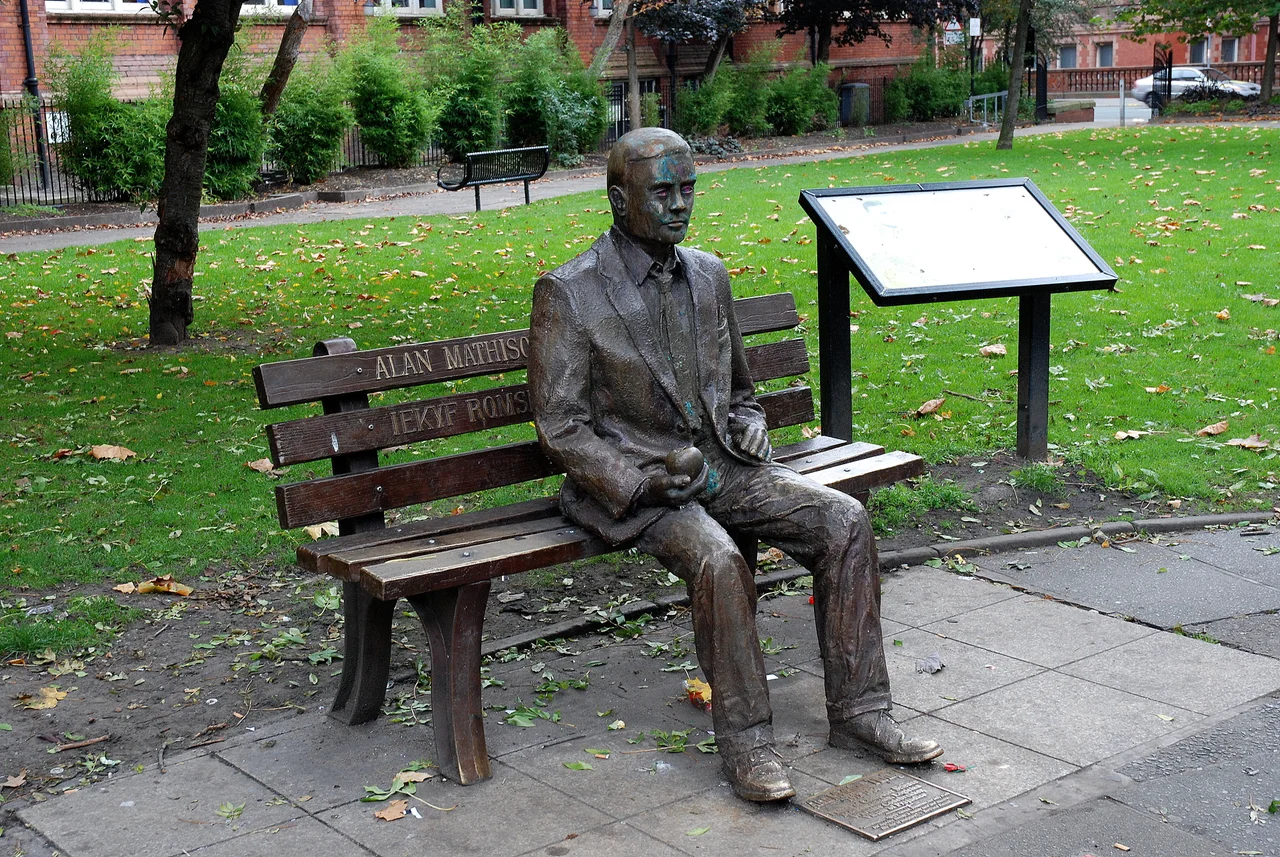

Alan Turing Memorial
In 1952, the British state prosecuted Alan Turing for having sex with a man. He pleaded guilty rather than go to trial; the alternative to prison was a course of synthetic oestrogen, a chemical castration that he endured for a year. He had built the machines that broke the Enigma cipher and shortened the Second World War by an estimated two years. He had laid the mathematical foundations for the computer you are reading this on. On 7 June 1954, two weeks before his 42nd birthday, he was found dead in his bed in Wilmslow, an apple beside him laced with cyanide. The verdict was suicide. The country he had served had broken him for being gay. The memorial in Sackville Gardens, unveiled on his birthday in 2001, returns him gently to the world.
A Bench Between Worlds
The sculptor Glyn Hughes placed Turing on a bronze bench, life-sized, in a small park called Sackville Gardens in the middle of Manchester. He is shown holding an apple, the fruit that killed him. On Turing's left is the former Sackville Street Building of the University of Manchester, where he held the post of Deputy Director of the Computing Machine Laboratory after the war. On his right is Canal Street, the centre of Manchester's Gay Village. Hughes chose the location for exactly that reason. "It's got the university science buildings on one side," he said, "and it's got all the gay bars on the other side, where apparently he spent most of his evenings." The bench is placed where Turing might have sat, between the work that defined his mind and the life he was punished for living.
A Barrister in Stockport
The memorial began with a Stockport barrister called Richard Humphry. He had watched Derek Jacobi play Turing in Hugh Whitemore's play Breaking the Code and decided his city — Manchester, where Turing had lived and worked — owed him a statue. He set up the Alan Turing Memorial Fund. Jacobi became its patron. Roy Jackson, who had spent years raising money for HIV/AIDS charities and gay awareness in Manchester, came on to drive the fundraising. Within twelve months, donations and a "village lottery" — quietly organised among the bars and clubs of Canal Street — had raised £15,000. A British foundry quoted around £50,000 to cast the bronze; instead it was cast by the Tianjin Focus Company in China for a fraction of the cost. The statue was unveiled on 23 June 2001, the day Turing would have turned 89.
The Plaque, the Code, and the Amstrad
The plaque at the statue's feet reads: "Father of Computer Science, Mathematician, Logician, Wartime Codebreaker, Victim of Prejudice." Beneath it is a quotation from Bertrand Russell: "Mathematics, rightly viewed, possesses not only truth but supreme beauty, a beauty cold and austere like that of sculpture." There is also a coded inscription that was originally said to read "Founder of Computer Science" — which planning documents held in Manchester Archives reveal was actually intended to read "Pioneer of digital computing." Hughes, the sculptor, buried his own old Amstrad computer in the foundations of the statue. It was an act of homage, one machine paying respects to the man who imagined them all. The Olympic Torch stopped at the memorial on 23 June 2012, Turing's centenary.
A Royal Pardon, Decades Late
It took the British state another sixty years to apologise. In 2009, Prime Minister Gordon Brown issued an official apology on behalf of the government, calling Turing's treatment "appalling" and saying "we're sorry, you deserved so much better." In December 2013, Queen Elizabeth II granted a posthumous royal pardon. In 2017, the "Alan Turing law" passed, retroactively pardoning thousands of other men who had been convicted under the same legislation that destroyed him. In 2021 the Bank of England placed Turing's face on the new £50 note. He is now one of the most decorated figures in British scientific history. None of it can undo what happened in 1952. The point of the statue in Sackville Gardens is that it doesn't try to. It just sits him on a bench, in a place he might have liked, and lets you sit beside him.
Visiting Sackville Gardens
The park is small, a triangular green space wedged between Sackville Street, Whitworth Street and the Rochdale Canal. Flowers appear at the statue's feet every year on Turing's birthday. There are usually a few small offerings any other day — a single rose, a note, the occasional apple. The University of Manchester's engineering buildings rise behind him. The bars of Canal Street are loud behind his other shoulder. The Sackville Gardens itself also contains the city's Beacon of Hope memorial to those who died of AIDS-related illnesses, and a memorial to transgender people lost to violence. It is a small park doing a great deal of remembering.
From the Air
The Alan Turing Memorial is in Sackville Gardens in central Manchester at 53.4767N, 2.2360W, immediately south of the city centre between Whitworth Street and Canal Street. From the air, the orienting features are the Rochdale Canal cutting east-west through the city centre, Piccadilly station to the north-east, and the University of Manchester campus directly south. Nearest airport: Manchester (EGCC) 5 nm south-southwest. Manchester city centre at this point is densely built; the small park is identifiable by its green triangle in a grid of red-brick warehouses. Best viewing altitude 1,500-2,500 ft.
Nearby Stories
- National Science and Media Museum 0.2 km away
- Jodrell Bank Observatory 3.2 km away
- Siege of Lathom House 5.6 km away
- Chester Zoo 6.2 km away
- Whalley Abbey 8.9 km away
- Haddon Hall 10 km away
- Wentworth Castle 16 km away
- Blackpool 16 km away