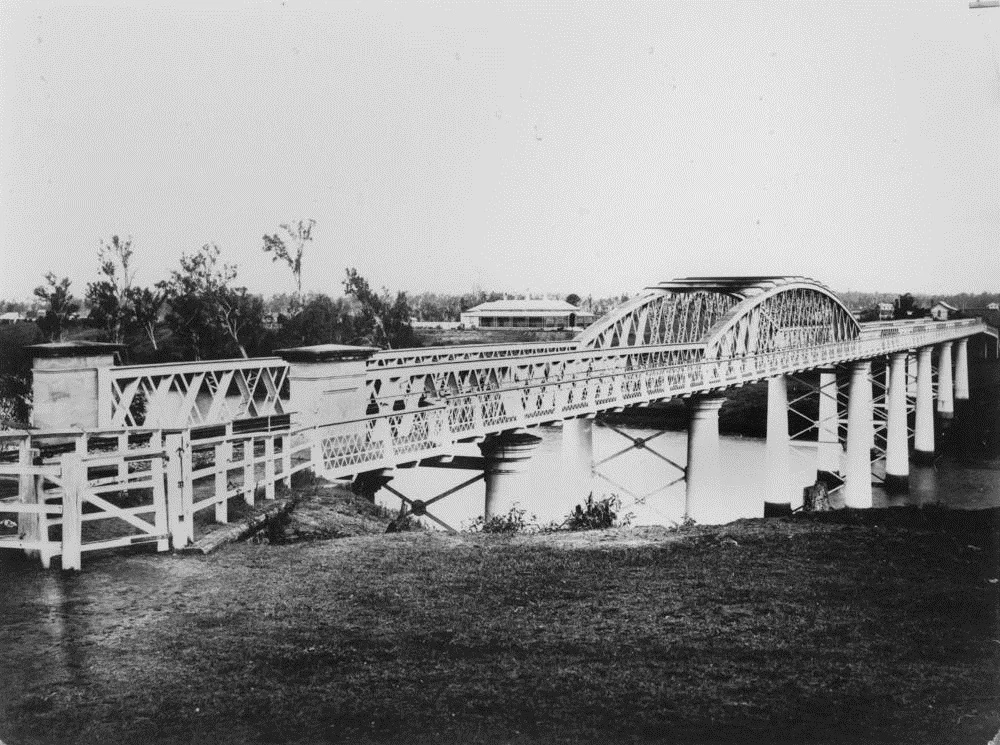

Albert Bridge, Brisbane
Just before six on the morning of 5 February 1893, the people watching from the banks at Indooroopilly heard what one witness called a great crash and a roar like thunder. The swollen Brisbane River had been climbing for days, and now one of the railway bridge's iron spans canted downstream and vanished beneath the seething water. The first Albert Bridge was gone. The graceful steel structure that replaced it - hauled into place over the same reach by 1895 - still carries passenger trains between Indooroopilly and Chelmer, one of the largest truss bridges Australia has ever built.
The Crossing That Opened the West
Before the bridge, the river was a wall. To build a railway from Brisbane out to the mining town of Ipswich, engineers had to span the deep water at Indooroopilly, where until then only a river-boat service linked the two centres. The first Albert Bridge, completed in June 1876, solved the problem at a stroke. Suddenly goods could move by rail between Ipswich and Brisbane that had only ever travelled by ship. The line reached on to the Darling Downs and across the south-east. Both the first bridge and its successor were named for Prince Albert, the Prince of Wales - a touch of imperial formality on a structure whose real importance was thoroughly practical: it tied the colony's capital to its interior.
The Flood and the Ferry
The 1893 flood was one of the great disasters of colonial Queensland, and it took both of Brisbane's river crossings - the Victoria Bridge in the city and the Albert Bridge upstream. Chief Engineer of Railways Henry Charles Stanley had tried to save the Albert, wedging steel into the expansion rollers atop the piers to stop the spans swaying. It was not enough. With the bridges gone, ferries again became the only way across the river - and that improvisation led to its own tragedy. On 13 February 1896, the ferry Pearl was caught by the current and driven onto the anchor chain of a moored government yacht, which cut the little vessel in two. It sank within seconds. An official inquiry put the death toll at 57, making it one of Australia's worst river disasters.
Stanley's Masterpiece in Steel
The second Albert Bridge, built between 1894 and 1895 by the Brisbane firm John McCormick and Son, is considered Henry Charles Stanley's major work. It is a fully riveted structure of two arched hogsback trusses resting on stone abutments and a central concrete pier sunk inside a wrought-iron caisson. Each truss runs 103.7 metres, stands 12.6 metres tall at the centre, and weighs roughly 606 tonnes. The diagonal web members follow the Linville system, an American design from the 1860s, braced overhead and at deck level against the wind. When it was finished, only the first Hawkesbury rail bridge surpassed it in span; it remains Australia's third-longest metal truss span, behind Brisbane's own Story Bridge of 1940 and the second Hawkesbury crossing. At the time of building, it was the largest bridge in Australia manufactured locally.
Still Carrying Trains
For more than sixty years, the Albert Bridge was the only railway link across the Brisbane River, carrying the entire south-western system on its two tracks. A second, plainer rail bridge was added just upstream in 1957 when the Ipswich line was quadruplicated, and the Merivale Bridge finally gave the city a second crossing in 1978. Today the heritage-listed Albert Bridge handles passenger traffic only, its hogsback trusses arching over the junction of the Indooroopilly and Chelmer reaches. Listed on the Queensland Heritage Register in 1992, it is valued as much for its looks as its engineering - a riveted steel landmark on the riverscape, highly intact after more than a century, and a monument to the moment Brisbane rebuilt what the river had torn away.
From the Air
The Albert Bridge crosses the Brisbane River at approximately 27.506°S, 152.974°E, linking Indooroopilly and Chelmer roughly 7 km south-west of central Brisbane, at the junction of the Indooroopilly and Chelmer reaches. From low altitude the twin arched 'hogsback' trusses are distinctive, sitting beside the plainer 1957 rail bridge and not far from the suspension-style Walter Taylor Bridge - a cluster of crossings that makes this bend of the river easy to identify. Brisbane Airport (YBBN) lies about 15 km to the north-east; Archerfield (YBAF) is roughly 8 km to the south-east. The meandering Brisbane River is the dominant navigational feature, and the bridge is best seen at lower altitudes in clear conditions.
Nearby Stories
- Redcliffe Peninsula 2.7 km away
- Tamborine National Park 12 km away
- Cressbrook Homestead 27 km away
- Main Range National Park 31 km away
- 2010-2011 Queensland Floods 38 km away
- Cape Byron 96 km away
- Cape Byron Light 126 km away
- HMS Porpoise (1799) 588 km away