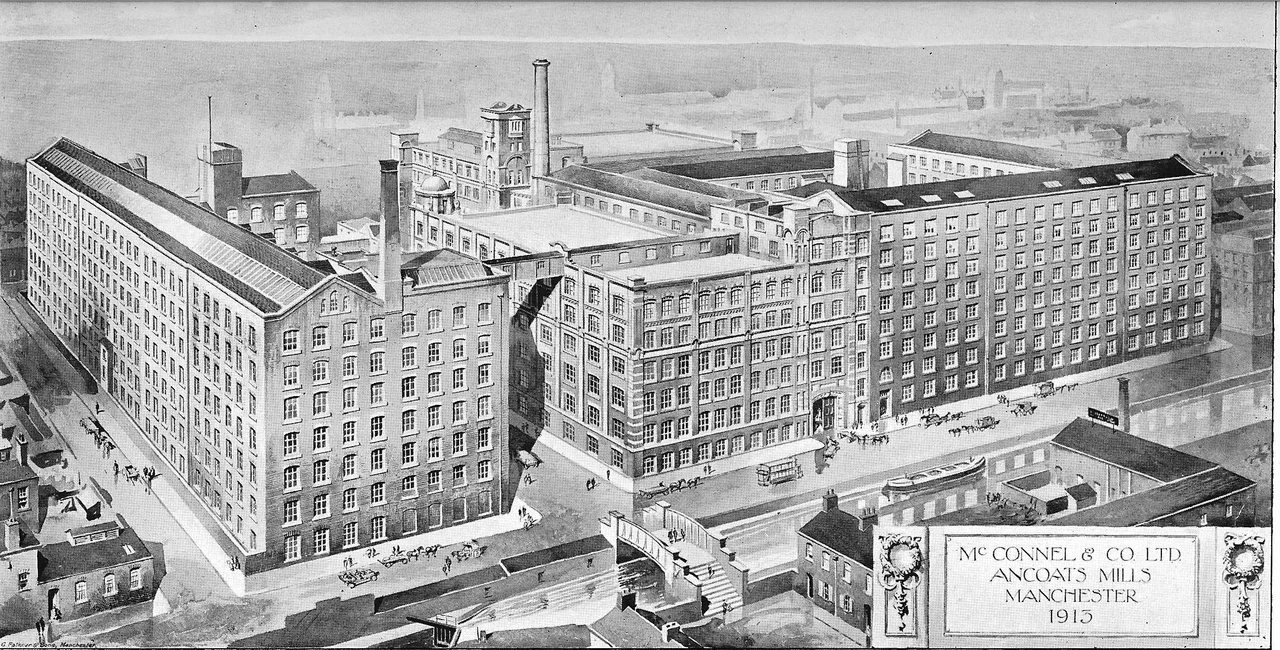

Ancoats
By 1815 Ancoats was the most populous district in Manchester. By 1851 it held 53,737 people — more than Bury or Blackburn — in a square mile of back-to-back houses, cellars rented out as separate dwellings, and a forest of cotton-mill chimneys. The historian Asa Briggs called it the world's first industrial suburb. Friedrich Engels walked these streets and what he saw shaped The Condition of the Working Class in England. The mills had names like Royal, Paragon, Beehive, Sedgwick, Murray's. By the 1960s most of the people had been moved out and most of the buildings looked finished. Now the mills are flats, the canal has narrowboats again, and there is a plaque acknowledging the Little Italy that the Italians of Frosinone built here in the 1890s.
Lonely Cottages by the River Medlock
The name probably comes from Old English ana cots — "lonely cottages." The settlement is first recorded as Elnecot in 1212, and in a 1320 survey Ancoats was one of the eight hamlets within the township of Manchester. Land here was bequeathed in the fourteenth century by a man called Henry de Ancotes. The village covered the strip between the River Medlock and the River Irk, just outside the medieval town. It stayed lonely cottages for four hundred more years. Then James Brindley surveyed the route of the Rochdale Canal in 1765, the canal opened in 1804, and the lonely cottages were paved over by what came next.
Murray's, McConnel, and the Steam Revolution
Adam and George Murray built their mill on Union Street — now Redhill Street — in 1798, next to where the new canal would run. It was one of the first steam-powered cotton mills anywhere. Murray's Mill grew into a complex that became one of the largest cotton-spinning buildings in the world. Once the canal opened, the building boom became uncontrolled. Victoria, Wellington, Brunswick, India, Decker, New, Beehive, Little, Paragon, Royal and Pin Mills filled the streets in two short generations. The poorest workers lived in court dwellings; for the poorest of those, single houses were split and the cellars rented out separately. A survey driven by cholera fear found that over half of homes in Ancoats had no plumbing, and over half of the streets had never been cleaned.
An Irish District, Then a Little Italy
The 1851 census found that nearly half of all adult men in Ancoats had been born in Ireland. They had come for the mill work and stayed for generations; Ancoats and Manchester-Irish identity were inseparable until the slum clearances of the 1960s. The Shamrock pub on Bengal Street opened in 1808 and finally closed in 2018 — a 210-year continuous Irish presence in a single bar. From the 1880s a second wave arrived from Italy, mostly from Liguria in the north-west and from Frosinone and Gaeta south of Rome. The Italian families clustered around the parish of St Michael's: about 180 families in 1895, around 3,000 people by 1910. This was Manchester's Little Italy. The Ronchetti family ran opticians and instrument-makers. The Casartellis built waterproof clothing. A plaque was installed in 2021 to acknowledge what Ancoats had been to its Italian community. St Michael's church, built around 1869, still stands.
Avro's Aeroplanes
In 1910, A. V. Roe set up the Avro company in Brownsfield Mill on the corner of Great Ancoats Street, where the Rochdale Canal slipped under the road. Aircraft were built in a Manchester cotton mill from machinery designed for spinning thread. During the First World War, men from Ancoats serving with the British Army in France would look up at British aircraft overhead and know they had been made in their own neighbourhood by neighbours. Avro grew far beyond Brownsfield Mill — the Lancaster bomber and the Vulcan jet were later Avro designs — but the company started here. In 1939 the Daily Express newspaper opened a Manchester printing works in Ancoats in the same curtain-wall functional style as its Fleet Street and Glasgow buildings: a famous black glass facade that survived as a printing plant until 1989.
Decline, Slum Clearance, and the Loss of a Community
The cotton industry slumped in the 1930s and never fully came back. Newspaper printing held on, but Ancoats by mid-century was synonymous with deprivation. In the 1960s Manchester City Council emptied much of the area through compulsory slum clearance, relocating tens of thousands of residents to overspill estates at Hattersley, Gamesley, and elsewhere. Whole streets of Victorian terraces vanished. Among those displaced was the family of Lesley Ann Downey, a ten-year-old girl who in 1964 was lured from an Ancoats fairground on Boxing Day by Ian Brady and Myra Hindley and murdered at their house in Hattersley — one of the five Moors Murders victims. The story is among the darkest in postwar British history. The community that had shaped Ancoats for two centuries was scattered across the suburbs.
The Mills Come Back
Newspaper printing left the Daily Express building in 1989, and the depopulated and dilapidated district reached its lowest point. Then the listing started. The Ancoats conservation area was designated in 1989. The Ancoats Buildings Preservation Trust was formed in 1995. In 2000 the government accepted the £250 million New Islington project to redevelop the strip of land between the Rochdale and Ashton Canals; the developer Urban Splash gave it the brand name New Islington, anchoring it around the listed Daily Express Building. Royal Mill, Murray's Mill, Beehive Mill, Paragon Mill, Sedgwick Mill, Brownsfield Mill — all Grade II or II* — have been converted into apartments or workshops. The Hallé Orchestra now has its rehearsal venue in the former St Peter's church on Blossom Street. Ancoats has won restaurant guide nods as one of the most interesting eating districts in northern England. The canal, dredged clean, carries narrowboats again. The Shamrock has closed, but the buildings around it are full.
From the Air
Ancoats is in central Manchester immediately north-east of the city centre, at 53.4833N, 2.2297W. From the air, the orienting features are the Rochdale Canal running south-west to north-east through the district and the Ashton Canal forming the southern boundary. The cluster of tall red-brick listed cotton mills (Royal Mill, Murray's Mill, Sedgwick Mill, Paragon Mill, Beehive Mill) along Redhill Street and Jersey Street are unmistakable. Manchester city centre lies immediately south-west; the New Islington marina is at the southern edge of Ancoats. Nearest airport: Manchester (EGCC) 6 nm south-southwest. Best viewing altitude 1,500-3,000 ft.
Nearby Stories
- National Science and Media Museum 0.2 km away
- Jodrell Bank Observatory 3.2 km away
- Siege of Lathom House 5.6 km away
- Chester Zoo 6.2 km away
- Whalley Abbey 8.9 km away
- Haddon Hall 10 km away
- Wentworth Castle 16 km away
- Blackpool 16 km away