
Ano Doliana
The marble quarried from the slopes above Ano Doliana went into some of the ancient world's most celebrated buildings. Cutters working in the archaic and classical eras extracted a distinctive white stone — tinged with light blue — from outcrops northwest of the village, and it traveled to the Temple of Athena Alea at Tegea, the sanctuary at Epidaurus, the Villa of Herodes Atticus. The quarries are still there, and the stone is still being cut. What makes Doliana marble recognizable is that same blue undertone, a quality that connects the hillside village to a lineage of building that stretches back more than two thousand years.
Built Into the Mountain
Ano Doliana sits between 900 and 1,150 meters on the northern slopes of Mount Parnon, arranged in two neighborhoods that spread amphitheatrically across a hillside filled with chestnut, fir, plane, and cherry trees. Looking north from the village, the horizon opens onto the plateau of Tripoli; on clear days the mountains of Mainalo, Artemisio, Helmos, and Erymanthos are all visible at once — a panorama that takes in much of the central Peloponnese.
The village was founded by shepherds who needed high pastures in summer and descended to Kato Doliana in winter with their flocks. As the economy shifted from livestock to olive cultivation in the valleys below, the role of the two settlements reversed: the lowland village became the year-round home, and Ano Doliana became a summer retreat. Fewer than 70 people now live here through the winter. But the effect of that reversal is that the stone houses were never modernized in the way that inhabited villages often are, and the village has kept its traditional character largely intact.
Marble That Built the Ancient World
The Doliana marble quarries date to the archaic-classical era, and the stone they produced was considered among the finest in the Peloponnese. Scholars have compared it to Pentelic marble from Attica — the material of the Parthenon — though Doliana marble does not quite reach that standard. What it shares with Pentelic stone is a fine crystalline texture and a white ground color; what distinguishes it is the blue undertone that appears in certain light.
The list of buildings that used Doliana marble is a survey of major Peloponnesian sanctuaries. The Temple of Artemis Knakeatis, the Temple of Athena Alea in Tegea, Epidaurus, the Villa of Herodes Atticus — each drew on stone from these Arcadian hillsides. The quarries continued into later periods and are active today, maintaining a connection between the village and the ancient craft of stone extraction that few places in Greece can match.
The Battle That Opened the Peloponnese
On the night of 17–18 May 1821 (Old Style), an Ottoman force of some six thousand men and two cannons marched from Tripoli with the aim of attacking the Greek camp at Vervena. To reach Vervena, they had to pass through Doliana, where the revolutionary commander Nikitaras held a defensive position with approximately two hundred men, using the stone houses of the village as fortifications.
When the Ottoman column arrived, it met unexpected resistance. The Greeks held their position; the Ottomans, surprised and unable to press through, suffered significant casualties — sources record around 300 Ottoman dead — and were forced to withdraw, abandoning their cannons on the field. The pursuing Greeks followed the retreating column back toward Tripoli. The battle was the last time the besieged Ottoman garrison in Tripoli would attempt to break out, and it opened the way for the eventual fall of the city. A bust of Nikitaras now stands at the Tsakonas ravine, the gorge where the hardest fighting took place.
The Village in Every Season
Ano Doliana runs on seasonal rhythms. On 23 April, when the settlers return for warmer weather, the icon of the patron saint Agios Georgios is carried up from Kato Doliana by bus. In November it returns on foot, in a ritual procession that takes several hours along the old path between the two villages. The first Saturday of November brings the Chestnut Feast — Yorti Kastanou — when the harvest from the surrounding trees is celebrated with food, sweets, and liqueurs made from the nut in all its forms.
The E4 European long-distance path passes directly through the village, making it a waypoint for hikers crossing the Peloponnese. Since 2015, an annual mountain half-marathon has wound through its cobblestone streets, gathering runners from across Greece. The Historical and Ethnographical Museum, opened in 2015 in the house where Nikitaras and his fighters sheltered during the battle of 1821, is open free to the public on weekends. It is called "To tampouri tou Nikitara" — the bulwark of Nikitaras — and the name is both description and monument.
From the Air
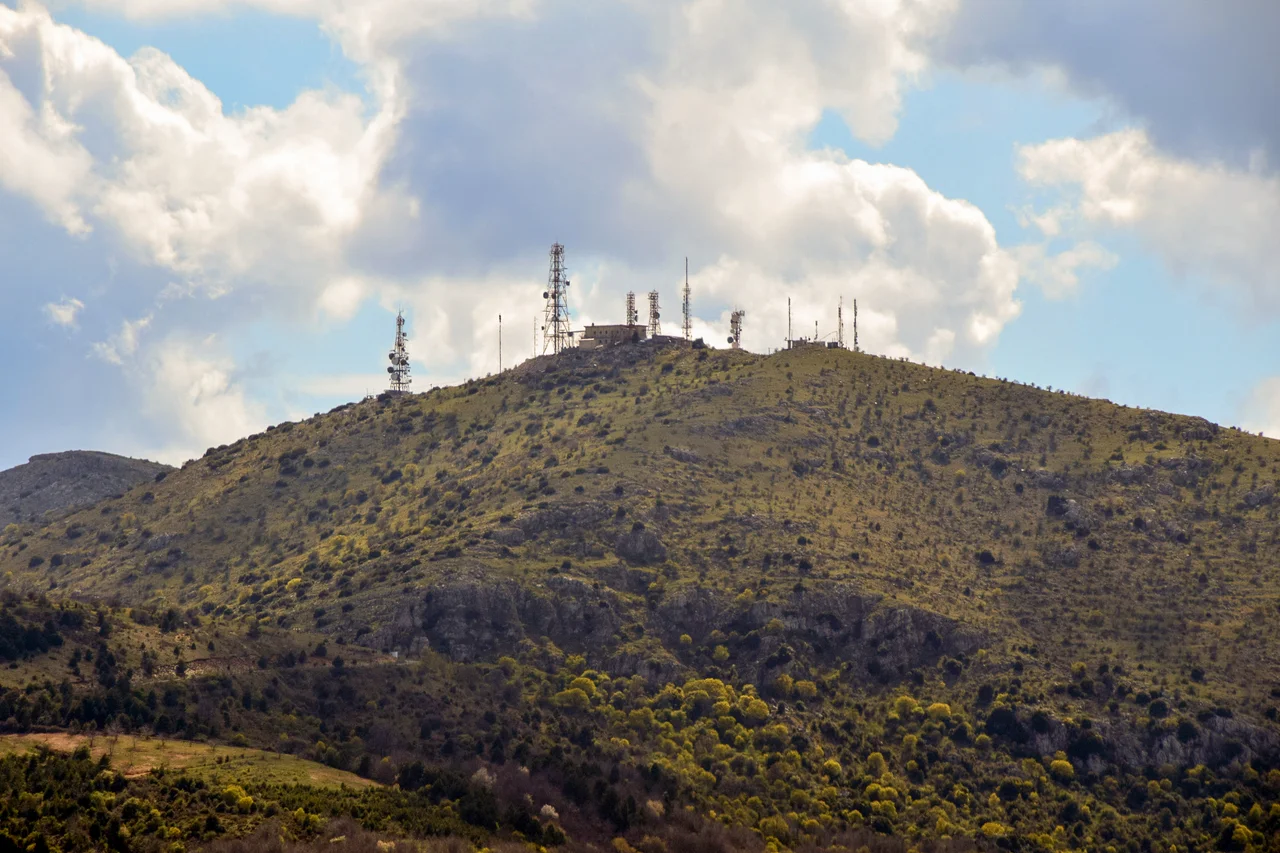
Ano Doliana lies at 37.387°N, 22.499°E on the northern slopes of Mount Parnon in eastern Arcadia, at 900–1,150 meters elevation. Approaching from the northwest at 5,000–7,000 feet, the village is visible as a compact stone cluster on a forested hillside above the Tripoli plateau. The summit of Saint Elias above the village, at 1,390 meters, carries telecommunications antennas and is a useful visual reference point. The nearest major airport is LGKL (Kalamata International), approximately 90 km to the southwest. Afternoon thermal activity over Parnon is common in summer; the plateau to the north tends to be calmer.
Nearby Stories
- Battle of Maniaki 2.6 km away
- Brontochion Monastery 4.1 km away
- Argon Pedion 11 km away
- Lepreum 12 km away
- Battle of Lalas 12 km away
- Leonidio 21 km away
- The Slamat Disaster 29 km away
- Siege of Corinth (1463) 31 km away