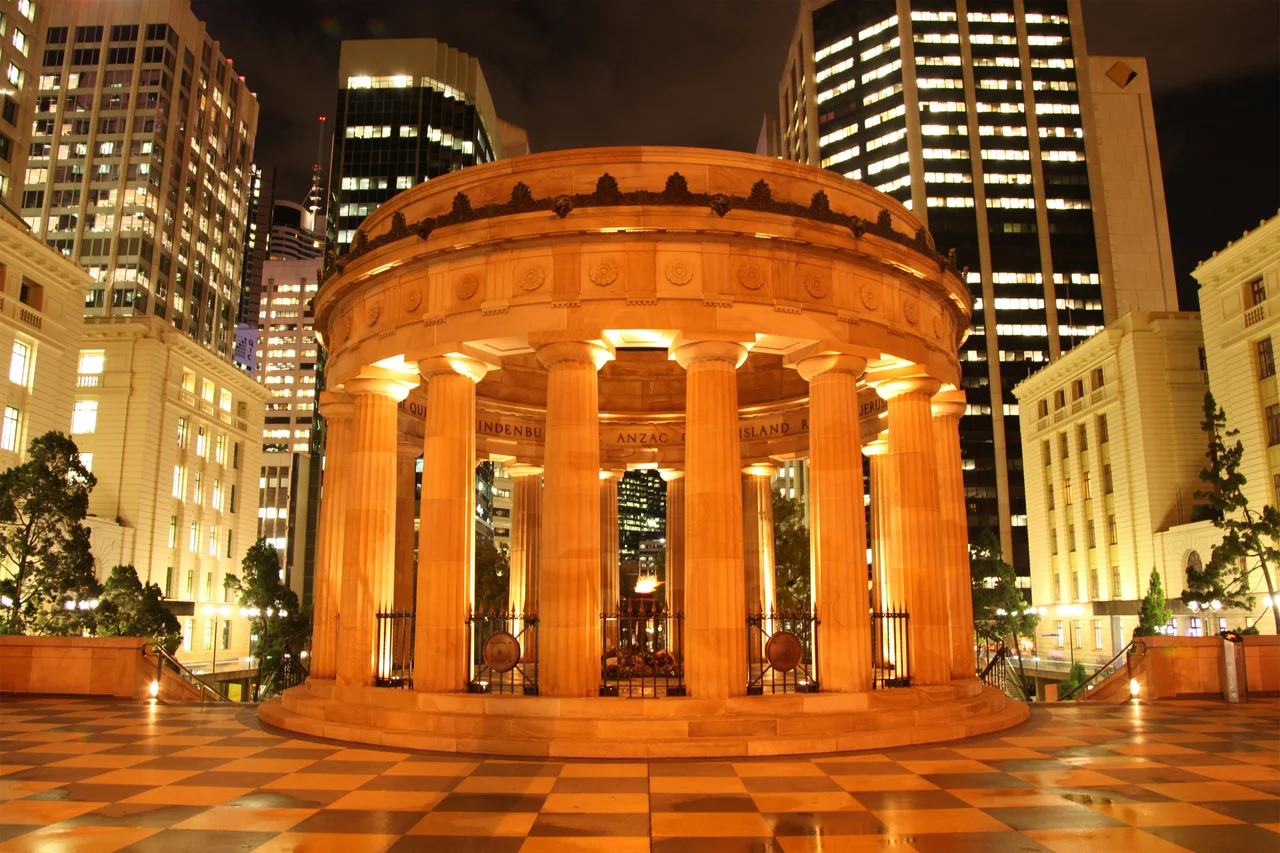

ANZAC Square, Brisbane
Count the columns of the shrine and you are counting a year. There are eighteen of them, a ring of Grecian Doric pillars in pale Helidon sandstone, and they stand for 1918 - the year the guns of the Great War fell silent. Climb the stairs and you find them too speak in numbers: nineteen in the first flight, eighteen in the second. At the centre of the colonnade, a bronze urn holds a flame that has burned without pause since Armistice Day 1930. This is ANZAC Square, Brisbane's principal memorial to those who went to war, a grand civic space carved into the slope between the city and Central Station - a place built to make a nation's grief legible in stone.
A Toll Written in Numbers
The square exists because of a wound that ran through the whole country. Australia entered the First World War with a population of barely five million; it sent its young men across the world, and 60,000 of them never came back. Another 152,000 were wounded. The casualty rate - around 65 percent - was among the highest of any of the Allied forces. There was scarcely a town or street in Queensland that did not lose someone. When the war ended, the impulse to build something equal to that loss took hold across the state, and in Brisbane it took the form of a memorial square at the heart of the city, where the names of distant battlefields could be inscribed close to home.
The Shrine and Its Flame
In 1928 a design competition was won by the Sydney architects Buchanan and Cowper, who proposed a Greek Revival shrine: a circular colonnade ten metres across, eighteen Doric columns of Helidon sandstone rising from a three-tiered base of Queensland granite. Around the entablature ran the names of the places where Australians had fought. Construction took two years. On Armistice Day, 11 November 1930, the Governor of Queensland, Sir John Goodwin, dedicated the shrine and the square, and lit the Eternal Flame - the first memorial flame of its kind in Australia. It has been kept burning ever since, a small constant fire at the centre of a busy city, tended as a symbol of faithful remembrance for the dead who have no grave their families could visit.
A Garden of Meaning
Almost nothing in the square is accidental. The bottle trees were planted to honour the Queensland Light Horse, who served in the Boer War; the date palms, a biblical symbol of victory, recall Australia's campaigns in the Middle East across both World Wars. Three paths climb from the foot of the stairs, one each for the Army, the Navy, and the Air Force. Twin stone staircases wrap around the shrine, and between them lie shallow tiled pools - reflecting water as a symbol of tranquillity and renewed life. The sculptor Daphne Mayo carved the Queensland Women's War Memorial into the memorial wall, a relief that makes this one of the few Australian war monuments to depict servicewomen. Nearby stands Brisbane's only memorial to the Queenslanders who died in the South African War.
Below the Shrine
The grief of the square does not end at ground level. Beneath the shrine lies a crypt and a series of memorial galleries, deepened and renamed in a major restoration completed in 2019. There is now a World War I Memorial Crypt, a World War II Gallery, and a Post-World War II gallery, holding digitised records curated by the State Library of Queensland alongside touchscreens and timelines that let visitors trace individual lives and battles. Later memorials honour the conflicts in Korea, Malaya, and Borneo, and a dedicated memorial recognises Queensland's Aboriginal and Torres Strait Islander servicemen and women, whose contribution went long unmarked. The undercroft turns the square from a monument into a place of learning - and of names.
Before the Dawn
On one morning each year, the square fills in the dark. On 25 April - Anzac Day - thousands gather at the Shrine of Remembrance before first light for the Dawn Service, the hour chosen to echo the time the original ANZACs landed at Gallipoli in 1915. The eternal flame burns as it always does; the city is quiet; and for a while the columns and the carved battlefield names are not architecture but the focus of a living act of memory. Listed on the Queensland Heritage Register in 1992, ANZAC Square is more than a rare and unified piece of urban design. It is the place where Brisbane comes, year after year, to stand together and remember its dead.
From the Air
ANZAC Square sits in the Brisbane central business district at approximately 27.467°S, 153.027°E, between Ann Street and Adelaide Street, opposite Post Office Square and a short walk from Central Station. From the air it reads as a band of green and pale stone within the dense city grid, beside the curve of the Brisbane River as it loops around the CBD; the Story Bridge to the east and the river itself are the strongest navigational references. Brisbane Airport (YBBN) lies about 12 km to the north-east; Archerfield (YBAF) is roughly 9 km to the south-west. Best appreciated at lower altitudes over the city centre in clear conditions. As Queensland's principal war memorial - and an active place of commemoration, especially on Anzac Day - it warrants quiet respect.
Nearby Stories
- Redcliffe Peninsula 2.7 km away
- Tamborine National Park 12 km away
- Cressbrook Homestead 27 km away
- Main Range National Park 31 km away
- 2010-2011 Queensland Floods 38 km away
- Cape Byron 96 km away
- Cape Byron Light 126 km away
- HMS Porpoise (1799) 588 km away