
Archaeological Museum of Naxos
The folded arms come back to you afterward. In a Venetian building high in the Kastro of Naxos, glass cases hold marble figures so old they predate the pyramids' final form - slim, pale women carved with arms crossed at the waist, faces reduced to a single ridge of a nose. They were made on these islands more than five thousand years ago, and their severe, almost abstract beauty so struck modern sculptors that artists like Brancusi and Modigliani borrowed from them. This is the Archaeological Museum of Naxos, where the deep memory of the Cyclades is kept.
A Building With Its Own History
The museum is housed in a building that is itself a relic of Naxos under foreign rule. Raised somewhere between 1600 and 1800 within the walls of the medieval Kastro, it served the Jesuit school founded here in 1700 - one of the institutions through which the Catholic Latin minority educated the island's children during the long Venetian and Ottoman centuries. Only in 1972 did it become the Archaeological Museum, and it has since been declared a historical monument in its own right. To reach the collections you climb the narrow lanes of the old castle town, so the setting prepares you: layers of Naxian history stacked one atop another, the building and its contents both speaking of the island's past.
The Cycladic Idols
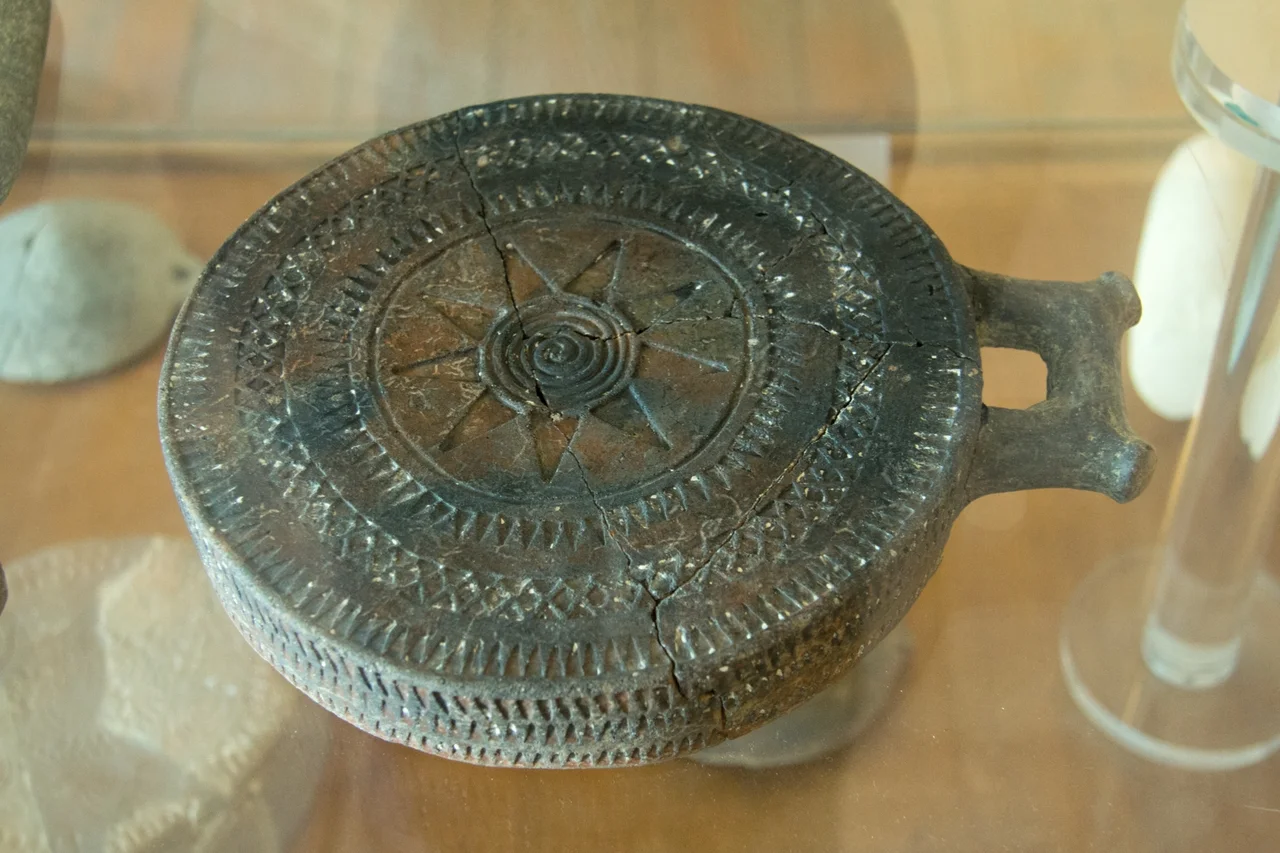
The heart of the museum is its Early Cycladic collection, drawn from Naxos itself and from neighbouring islands like Keros and the Koufonisia. Here are the famous marble figurines, some dating between 3200 and 2300 BC - the violin-shaped early forms, the enthroned figures, the standing women with crossed arms. There are also stone vessels, the curious flat objects archaeologists call 'frying pans,' bronze tools, blades of volcanic obsidian, and jewellery worked four to five thousand years ago. We know little for certain about what these figures meant to the people who made them. Many were found in graves, laid with the dead. Stripped of their original colour and context, they survive as some of the earliest and most haunting sculpture in European art.
Through the Ages
The collection does not stop at the Bronze Age. Late Mycenaean rooms hold stirrup jars and grave goods recovered from chamber tombs at Kamini and Aplomata, including jewellery from the grave of a child who died around the twelfth century BC and a painted hydria showing a fishing scene. Further on stand the geometric pottery of the eighth century BC and a room of kouroi, the standing marble youths Naxos became renowned for carving between 650 and 450 BC - kin to the giant still lying unfinished in the quarry at Apollonas. The journey runs all the way to a mosaic floor and delicate glassware from the Roman age. In a few rooms you walk the whole arc of Naxos, from its first sculptors to the empire that eventually absorbed it.
Planning the Visit
Practical details matter for a museum tucked inside a living medieval town. The Archaeological Museum of Naxos sits within the Kastro of Chora, the island's main town, reached on foot through the old streets where Venetian crests still mark the lintels of houses. Since January 2019 it has been open from 08:00 to 15:30 daily except Tuesdays. The morning hours are deliberate: come early, before the cruise-ferry crowds climb the hill and before the Aegean heat settles in. The reward is time alone with the figurines, those folded arms and blank serene faces that have outlasted everything around them and will outlast us too.
From the Air
The museum sits at 37.10558 N, 25.37725 E, inside the Kastro on the hill above Chora, the main town on the northwest coast of Naxos. From the air the town reads as a dense white cluster climbing to the fortified crown of the old castle, just south of the islet of Palatia and its lone marble gate, the Portara. Nearest airport is Naxos Island National (LGNX), roughly 3 km south. Recommended viewing altitude 1,500-3,000 ft to pick out the hilltop Kastro and harbour; Cycladic summer skies offer long visibility, with afternoon meltemi winds the main complication on approach.
Nearby Stories
- Apollon Theater, Syros 1.6 km away
- Panagia Tourliani 8.5 km away
- Keros 15 km away
- Ikaria 21 km away
- Archaeological Museum of Sifnos 30 km away
- Kimolos 39 km away
- Astypalaia 49 km away
- Cave of the Apocalypse 49 km away