_(cropped_to_Archcliffe_Fort).jpg)
Archcliffe Fort
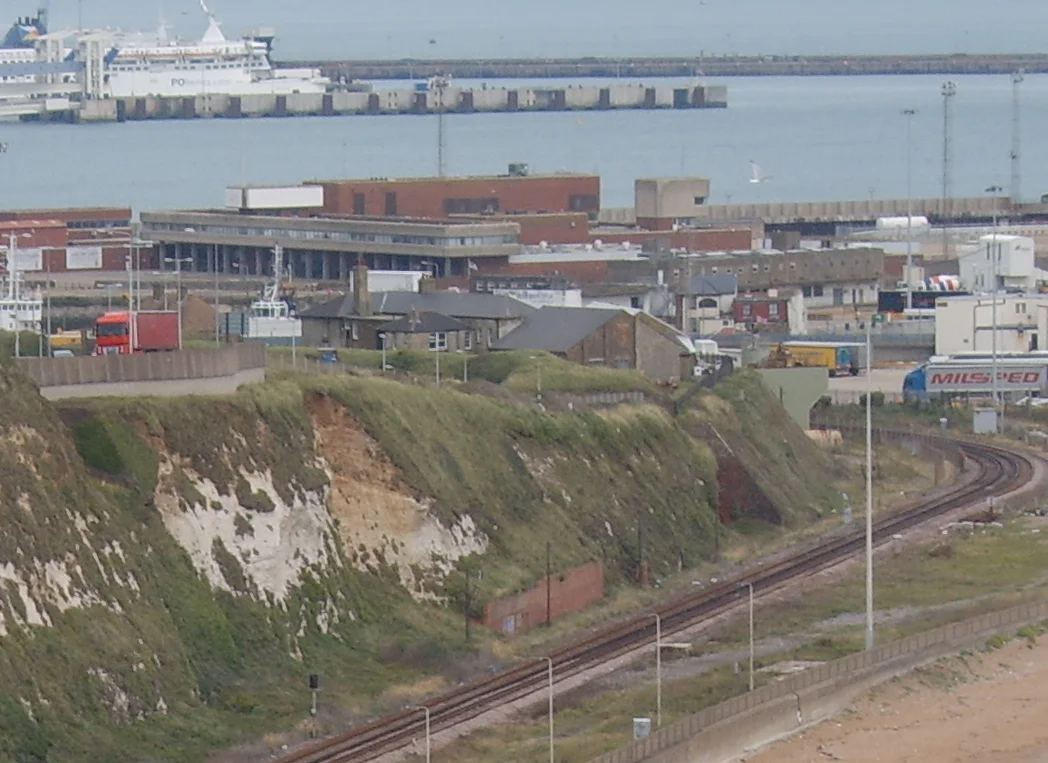
There has been some kind of fortification on this spot above Shakespeare Beach since 1370, but most of Archcliffe Fort has been demolished. The railway took the southern and eastern portions in the 1920s. The A20 road widening took most of what was left in 1958. What survives is two ramparts and two complete corner bastions of a 17th-century layout - the ghost of a fort - and a cluster of modern buildings inside them where the Emmaus Community now runs a furniture workshop, retail centre, and accommodation for formerly homeless people. It is one of the more unusual second lives that a British coastal fortification has ever had. From the high ground above the Western Heights, with the port of Dover sprawling below and the Channel beyond, the fort still does what it has always done: watch the way in.
From Watchtower to Henry's Defence
Worked flints found here go back to the Neolithic and Bronze Age, and pottery scattered through the site dates from the 12th to 14th centuries - this has been a recognisable settled spot for a very long time. The first recorded structure was a watchtower erected in 1370, in the reign of Edward III, during the long French wars that punctuated the late medieval period. No trace of it remains above ground, but contemporary plans show a pentagon-shaped building roughly where the western bastion now stands, connected by a ditch to a gatehouse roughly where the eastern bastion now sits. Henry VIII replaced the medieval watchtower with a more substantial fort by 1539, part of the same defensive programme that produced the Device Forts along the south coast. The fort then fell into disrepair, until 1588 and the Spanish Armada crisis brought every south-coast fortification back into urgent use. James VI and I and Charles I both made improvements during the early Stuart period.
Charles II and the Restoration Garrison
After the 1660 Restoration, Charles II garrisoned Archcliffe heavily as part of the broader strengthening of royal control over the Channel coast. The fort took the 17th-century quadrangular plan with corner bastions whose surviving fragments still define the site. The long 18th century - that historians' term for the period from roughly 1688 to 1815, a stretch dominated by recurrent wars with France - brought a steady cycle of upgrades. Invasion scares in the mid-1700s saw the fort reinforced; a barracks and two guard houses were built in 1745. During the Napoleonic Wars between 1803 and 1815, when the threat from across the Channel was at its peak, the entrance was remodelled between 1807 and 1809 and a brick barbican was added in front of it between 1814 and 1815. By 1872 the seaward defences had been modified again to take five RML 10-inch 18-ton guns - the cutting-edge artillery of the late Victorian period.
First World War, and the Railway
The fort was manned through the First World War, when Dover became a critical naval and military base supporting the cross-Channel supply chain to the Western Front, the Dover Patrol's anti-submarine and minelaying operations, and the constant flow of troops back and forth from France. Quick-firing artillery was installed during the war, specifically intended to engage enemy troops who might try to shelter at the foot of the cliff below the fort. After the Armistice, the role of fixed coastal artillery began to diminish - aircraft and submarines were re-writing the calculus of coastal defence - and in the 1920s the railway came calling. The South Eastern Main Line had previously passed underneath the fort through a tunnel; improvements to the line required the demolition of the southern and eastern portions of the fort, leaving only the surviving two ramparts and two corner bastions. The fort that had been a quadrangle for three hundred years was suddenly a half-circle, traded for a faster journey to Folkestone.
The Second World War and Decommissioning
By the time the Second World War arrived, Archcliffe was already obsolete. A 1940 Luftwaffe targeting dossier for Dover marks the fort as veraltet - obsolete - and the German bombers focused their attention elsewhere. The fort was decommissioned as a military installation in 1956, after nearly 600 years of intermittent military use. Two years later, in 1958, further demolition was carried out to widen the A20 road that runs along the seafront. By this point only the two ramparts and two complete bastions remained, with partial traces of a third. The fort was home to the Dover Sea Cadets after the war, and to the first memorial to the Dover Patrol - a wooden tablet honouring the naval force that had held the Strait open during the First World War. Both the cadets and the memorial moved out in the 1970s. In August 2024 a plaque was unveiled at the site to four soldiers killed clearing mines from Dover's beaches in 1944 and 1945, work that continued for months after VE Day.
Emmaus and the Furniture Workshop
Archcliffe Fort is now occupied by the Emmaus Community, an international charity founded in France in 1949 by the priest and resistance hero Abbe Pierre. Emmaus communities take in people who have been homeless, give them a place to live, and provide meaningful work - typically running second-hand shops, furniture workshops, and recycling enterprises that fund the community's own running costs. The Dover branch turned the surviving ramparts and bastions of the fort into accommodation for its companions and into workshops where they restore donated furniture, which is then sold through the on-site retail centre. The fort that once held the King's troops watching for French invasion now holds men and women rebuilding their lives, and the work they do here is funded by ordinary visitors browsing for a kitchen table. Few British coastal fortifications have ended their long military careers more usefully. The fort sits at the base of the Dover Western Heights and overlooks Shakespeare Beach and the approaches to the port - the same view it has had for six and a half centuries.
From the Air
Archcliffe Fort is at 51.115 degrees North, 1.3072 degrees East, on the western side of the port of Dover in Kent, at the base of the Dover Western Heights. Best viewed at 1,500 to 3,000 feet AGL - the fort sits sandwiched between the A20 road and the South Eastern Main Line railway, with Shakespeare Beach immediately below and the port of Dover and its ferry terminals to the east. The dramatic white chalk cliffs run east from here towards Dover Castle and South Foreland. Nearest airfield: Manston (EGMH) about 12 nautical miles north-east. Watch for heavy Channel ferry and cruise traffic and the controlled airspace around Manston and Lydd.
Nearby Stories
- HMS Hermes (1898) 7.3 km away
- Herne Bay Museum and Gallery 8.5 km away
- Benenden School 9.2 km away
- Boulonnais 9.4 km away
- Priestfield Stadium 12 km away
- 1382 Dover Straits Earthquake 17 km away
- Royal Sovereign Lighthouse 21 km away
- Battle of Boulogne 28 km away