
Battle of Cove Mountain
On the morning of May 10, 1864, a Union private from Company H of the 14th Pennsylvania Cavalry climbed a tree at the edge of a Wythe County, Virginia, cove and counted Confederates. Below him, Brigadier General William W. Averell's 2,000-man division was preparing to charge the narrow gap that led through to Wytheville and its lead mines. What the private saw — Confederate cavalry massing on both sides of the gap, reinforcements still arriving — was enough to stop the charge before it began. It was also enough, eventually, to win Ulysses S. Grant the larger campaign by accident. The Battle of Cove Mountain is the smaller battle that made the bigger one possible.
Grant's Plan
When Ulysses S. Grant took command of all Union forces in March 1864, his Virginia strategy was simple in concept and brutally complicated in execution: hit Robert E. Lee from every direction at once. One of those directions was the southwestern flank, where the Virginia and Tennessee Railroad carried lead from the Wytheville-area mines, salt from Saltville, and food and reinforcements from western Virginia and Tennessee east toward Lee's hungry army. Brigadier General George Crook drew the assignment of cutting that railroad. He had three brigades — about 6,155 men. Crook sent a smaller force under William Averell, about 2,000 cavalry, to raid the salt mine at Saltville while the main column cut the railroad bridge over the New River at Cloyd's Mountain.
A Change of Plans
Averell learned from deserters and prisoners that 4,500 Confederate troops — under John Hunt Morgan and William E. "Grumble" Jones — were waiting for him at Saltville. They knew his target. They knew his strength. They were ready. Rather than ride into a trap, Averell changed his objective and rode east instead, toward the lead mine at Wytheville. Lead was what the Confederacy used to make bullets, and the Wytheville mines supplied roughly a third of those bullets. If he couldn't have the salt, Averell would take the lead. And if he made enough noise doing it, he might pin Morgan and Jones in place long enough for Crook's column to finish its work at Cloyd's Mountain unopposed. As Averell turned east, Morgan came after him.
The Gap at Crockett's Cove
The road through Crockett's Cove was steep, narrow, and rugged — longer than the direct route to Wytheville but harder to defend, and Averell hoped Morgan wouldn't expect it. The Confederates expected it. Schoonmaker's 14th Pennsylvania and the 1st West Virginia opened the fight by driving back the Confederate advance guard, but the moment the Union cavalry crowded the gap, dismounted Confederates on both sides poured musket fire down into the column. When the private in the tree spotted Morgan's brigades arriving as reinforcements, and a cannon hidden in the brush on the road itself, the planned charge was canceled. Averell pulled back and tried to lure the Confederates out of the gap. A large rebel force followed, and the fighting continued through the afternoon.
A Cavalry Withdrawal
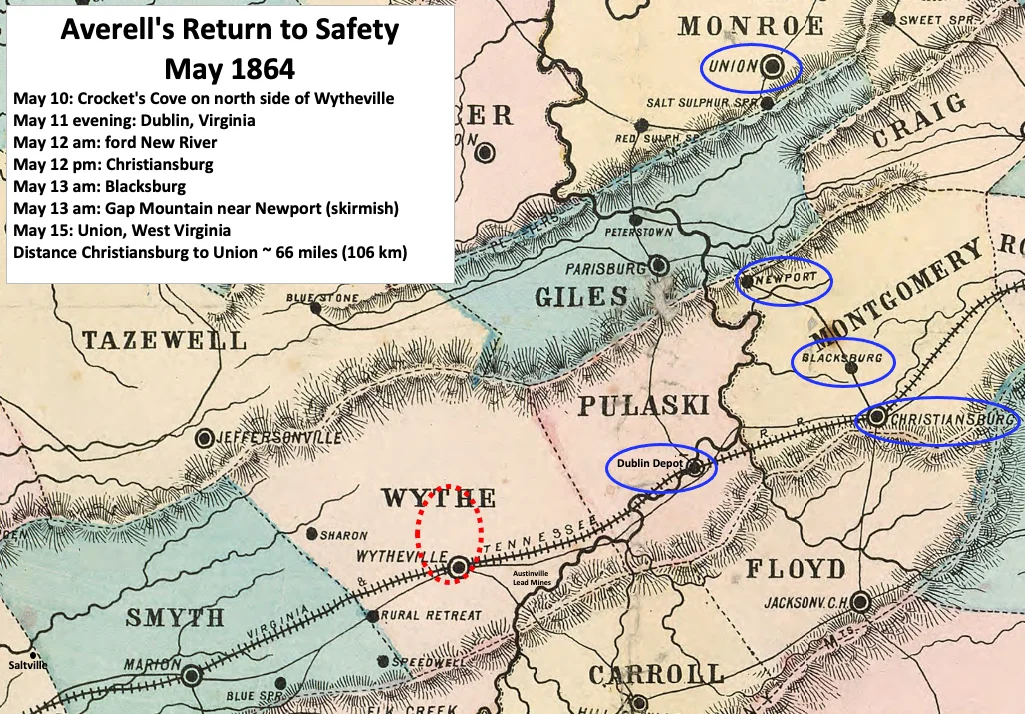
Averell was grazed on the forehead by a bullet early in the fight — a minor wound that bled enough to look serious. Colonel William H. Powell divided the 2nd West Virginia Cavalry into platoons and walked them backward through Confederate fire with what Averell later described as the precision of a dress parade. Through the night, Averell's column slipped through the mountains and escaped pursuit. For five days the Confederates chased him, and for five days Averell stayed one ridge ahead, until he linked up with Crook's force at Union, West Virginia. The National Park Service lists the result of Cove Mountain as indecisive. Confederate accounts call it a Morgan victory. By the numbers, the Confederates won the field. By the larger strategic accounting, the Union won the war they were actually fighting.
The Battle That Made the Other Battle
Because Morgan and Jones spent May 10 chasing Averell up a Wythe County mountain, they could not get to Cloyd's Mountain in time to help Albert Jenkins defend the New River railroad bridge. Crook overwhelmed Jenkins with 6,000 men, won the field at the cost of Jenkins' life, and burned the bridge. Confederate rail communications through southwestern Virginia were severed for weeks. The Virginia and Tennessee Railroad never fully recovered. Cove Mountain saved the lead mine for another season. But the smaller battle on the smaller mountain made the larger one possible, and the war ground forward another year, the way wars do — on the back of cavalrymen riding mountain trails most history books never name.
From the Air
The Battle of Cove Mountain was fought around 37.04 N, 81.12 W, in the narrow gap between Cove Mountain and Crockett's Cove northwest of Wytheville, Wythe County, Virginia. New River Valley Airport (KPSK) lies 25 nm east; Mercer County (KBLF) 35 nm north. From cruising altitude, look for the long Walker Mountain ridge running northeast-southwest, with the broad valley of the Bluestone River to the north. The 1864 Confederate lead mines were near Austinville, 10 miles southeast of Wytheville along the New River. Crockett's Cove Presbyterian Church (1858), a witness building still standing in the cove itself, is on the National Register of Historic Places.
Nearby Stories
- War, West Virginia 12 km away
- Princeton, West Virginia 13 km away
- Galax, Virginia 13 km away
- Floyd County, Virginia 15 km away
- Patrick County, Virginia 21 km away
- Emory and Henry University 35 km away
- Washington County, Virginia 36 km away
- Salem, Virginia 40 km away