
Battle of Pharsalus
Caesar did not want to be here. He had been retreating east through Thessaly after a punishing defeat at Dyrrachium, his troops hungry and footsore, his enemies crowing that the great general was broken. Then, on the morning of 9 August 48 BC, the two armies faced each other across the wheat fields near Pharsalus — Caesar's understrength legions against a Pompeian force nearly twice their size — and the course of the ancient world pivoted on what happened next. What followed was not simply a military victory. It was the moment, as historian Paul K. Davis later wrote, that took Caesar 'to the pinnacle of power, effectively ending the Republic.'
Two Armies, One Plain
The numbers were daunting for Caesar. According to his own account, he fielded approximately 22,000 Roman legionaries spread across eighty cohorts — eight legions, all understrength, some reduced to barely a thousand men from losses at Dyrrachium. Alongside them rode 1,000 Gallic and Germanic cavalry. Facing them, Caesar, Appian, and Plutarch agree, was a Pompeian army of some 45,000 Roman infantry and anywhere between 5,000 and 7,000 cavalry — a multinational force that included Gallic and Germanic horsemen, Thracians, Greeks, Anatolians, Syrians, Phoenicians, and conscripts drawn from Pompey's own enslaved people. More than a dozen eastern kings and despots had answered Pompey's call, either attending in person or sending proxies. It was the Roman Republic assembled against itself.
Caesar's legions were veterans of the Gallic Wars — the VI, VII, VIII, IX, X, XI, XII, and XIII — men who had fought for him across a decade of brutal campaigning and were, in his own words, absolutely devoted to their commander. Pompey's legions were larger but less uniformly seasoned, and Pompey himself had 2,000 re-enlisted veterans dispersed through his lines to stiffen the less experienced.
The Trap Beneath the Surface
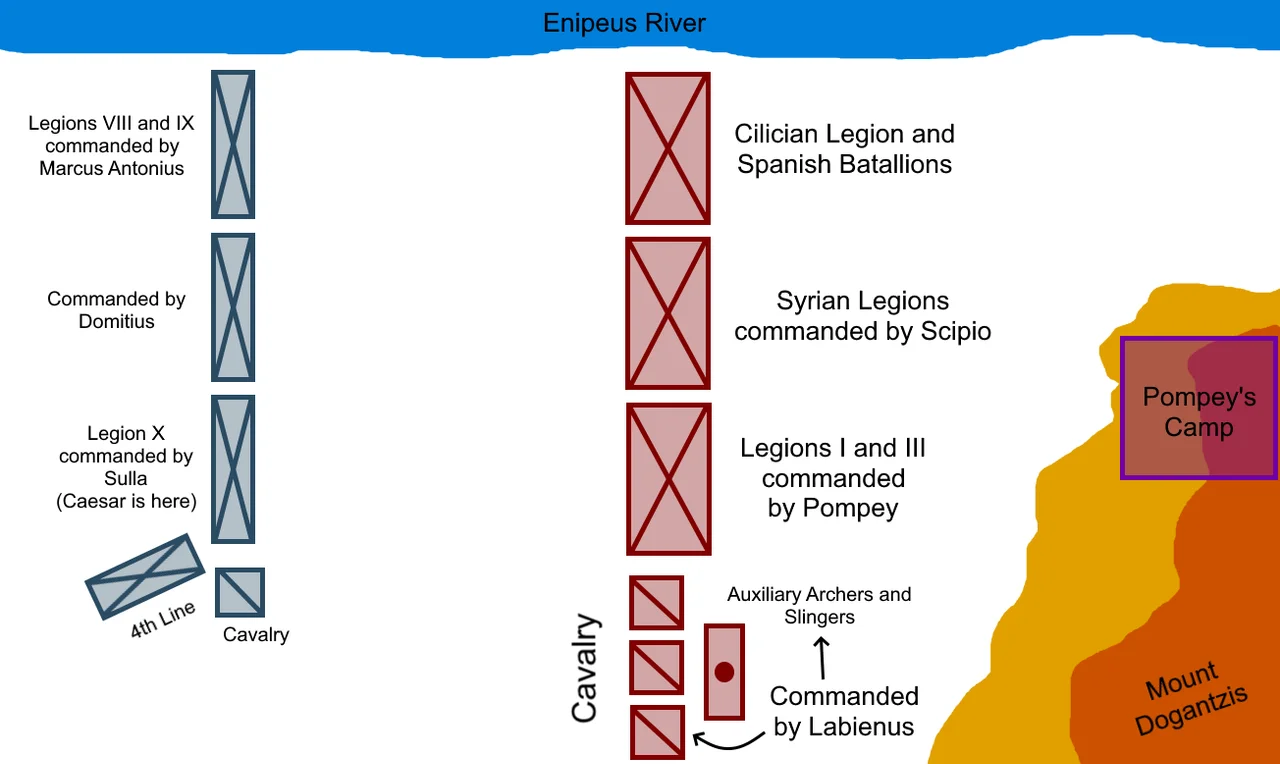
Both generals deployed in the traditional three lines. Pompey anchored his right on the Enipeus River, where the stream protected that flank, and concentrated almost his entire cavalry — his decisive weapon — on the left, under Labienus. The cavalry's task was to sweep around Caesar's right flank, roll up his infantry from behind, and end the battle in an afternoon. It was a sound plan. Pompey's advisers believed it was foolproof.
Caesar saw it coming. He thinned his already-stretched third line further to create a secret fourth line on his right — infantry disguised as a cavalry screen, given precise instructions to leap forward and thrust their pila upward into the faces of Pompey's charging horsemen rather than throwing them. It was an unconventional order, and everything depended on discipline. When Pompey's cavalry charged and drove Caesar's horsemen back, Caesar revealed the fourth line. The Pompeian cavalry panicked, suffered heavy casualties, and fled to the hills. Caesar's cavalry wheeled around their exposed flank. Then Caesar ordered his battle-hardened third line — held in reserve until this moment — to advance.
The Afternoon the Republic Died
Pompey's left wing collapsed. Watching from behind his own lines, Pompey saw his cavalry in flight, his infantry breaking, and the battle turning against him in a matter of hours. He retreated to his camp, ordered auxiliaries to defend it, and — in one of antiquity's most dispiriting exits — stripped off his general's cloak, gathered his family and gold, and slipped away disguised as an ordinary citizen.
The fighting and its aftermath were brutal. Ancient sources give Caesarean losses as perhaps 1,200 men; Appian estimates Pompeian losses at 6,000. These figures are contested and should be read with caution — ancient accounts of battles notoriously inflated enemy casualties and minimized friendly ones. What is not in doubt is that thousands of Roman soldiers died on those fields, killing other Romans, in a civil war that neither side had initially wanted. Caesar, in his own account of the war, would later praise his centurions by name and quietly question why Pompey had not ordered a charge at the outset. He said nothing, in the sources that survive, of satisfaction at the scale of Roman deaths.
Aftermath: Flight, Murder, and a Changed World
Pompey fled to Egypt, where he hoped for sanctuary from the young Ptolemy XIII, whom he had once supported. He never reached the shore alive. Ptolemy's advisers, calculating that a defeated Roman was a dangerous liability, had him killed as he stepped from his boat on 28 September 48 BC. Caesar arrived days later, learned of the murder, and — according to various ancient accounts — wept, though historians have long debated whether the tears were genuine grief, political theater, or some mixture of both.
Others sought Caesar's mercy rather than flight. Marcus Junius Brutus — who would later become his most famous assassin — crossed marshlands to reach Caesar's camp at Larissa and was received graciously. Caesar burned Pompey's correspondence unread, then announced a general pardon for all who asked. It was a calculation as much as a gesture: the war was not over, and he needed allies.
The Battle of Pharsalus did not end the civil war; fighting continued for years. But it broke Pompey's moral authority. Former clients across the Roman world began aligning with Caesar, some from genuine belief that the gods had shown their favor, others from pragmatic self-preservation. The Republic stumbled on for a few more years before Caesar's dictatorship, his assassination in 44 BC, and the eventual rise of Augustus ended it entirely.
A Contested Ground
Even the precise location of the battle remains debated. Caesar himself, in his *Commentarii de Bello Civili*, names almost no specific places. Four ancient writers — including Frontinus, Eutropius, and Orosius — locate the battle specifically at 'Palaepharsalus' (Old Pharsalus), not at the town of Pharsalus itself. Scholar John D. Morgan argued persuasively in his definitive study that the battle most likely occurred north of the Enipeus River, near the modern village of Krini, some six miles north of present-day Farsala. Today the flat fields of the Thessalian plain give little clue to what happened there. Wheat grows where legions fought. The plain is quiet, the sky wide, and the Enipeus — the same stream that protected Pompey's right flank — still runs through it.
From the Air
The battlefield lies at approximately 39.30°N, 22.38°E, in the flat Thessalian plain south of Larissa. Approaching from Nea Anchialos Airport (LGBL, roughly 60 km northeast), the terrain opens into an immense agricultural basin bounded by low hills. At 3,000–5,000 feet the Thessalian plain is clearly legible: the Enipeus River (Enipeas) threads across it from west to east, and the modern town of Farsala sits on a low ridge to the south. The probable battlefield, near the village of Krini, lies several kilometers north of the river — look for the junction of the old Larissa–Pharsalus highway and the low hill to the east of Krini. Clear visibility is common in summer; the plain stretches uninterrupted to the mountain ranges on the western horizon.
Nearby Stories
- Lake Plastiras 4 km away
- Dimini 8.2 km away
- Evrytania 9.6 km away
- Archaeological Museum of Lamia 16 km away
- Oreus 22 km away
- Meteora: The Monasteries Built on Impossible Pillars 24 km away
- Tempi Train Crash 37 km away
- Battle of Potidaea 83 km away