
Black Stone
Touched by Adam, according to one tradition. Placed by Abraham, according to another. Set into the rebuilt Kaaba by the 35-year-old Muhammad in 605 CE, five years before his first revelation, with all the clan leaders holding the corners of a cloth so that none could claim the honor alone. Whatever its origin, the Black Stone - al-Hajar al-Aswad - has been handled, kissed, and venerated by more human beings than almost any other object on earth. It sits today in the eastern corner of the Kaaba, encased in a silver frame, polished smooth by so many hands that the rock underneath has become its own evidence of devotion. Muslim theologians are careful to say it has no divine power of its own. Its importance is historical, devotional, witness-bearing - not sacred in itself. And yet.
What It Looks Like
The stone is not one rock. It is several pieces cemented together, surrounded by a silver frame fastened to the Kaaba's outer wall with silver nails. In the 10th century, an observer described it as one cubit - about 46 centimeters - in length. The 18th-century Spanish traveler Ali Bey el Abbassi, disguised as a pilgrim, recorded it as 110 centimeters high. Muhammad Ali Pasha reported it as 76 centimeters long by 46 wide. A fragment removed by Muhammad Ali in 1817 and examined by the Austrian consul-general in Egypt, Ritter von Laurin, had a pitch-black exterior and a silver-grey, fine-grained interior embedded with tiny cubes of a bottle-green material. A few white or yellow spots appear on its face. The silver frame around it has been replaced many times over the centuries as it wore down from constant handling. Worn frames were carried back to Istanbul, where they are kept today among the sacred relics of the Topkapi Palace.
Before Islam
The Kaaba existed long before the Prophet. It was a site of pilgrimage for the Nabataeans of northern Arabia and the southern Levant, who traveled there once a year. The Black Stone was already venerated - set into one wall of a shrine that allegedly held 360 idols of the Meccan gods. Across the ancient Mediterranean, aniconic stones called baetyls marked places where the sacred world met the ordinary. The word comes from Bethel, the place where Jacob had his dream of angels climbing a ladder. In South Arabia, a city called Ghaiman kept a red stone associated with its deity. A Kaaba at al-Abalat, near Tabala south of Mecca, kept a white one. Mountains, trees, and stones attracted worship in this part of the world long before anyone wrote down why. The scholar Aziz Al-Azmeh has suggested that the name ar-Rahman - the Merciful, one of the names of God in Islam, cognate to Ha'Rachaman in Jewish prayer - was used for astral gods in pre-Islamic Mecca, and may have been associated with the Black Stone. Muhammad himself, according to tradition, called it the right hand of al-Rahman.
The Prophet Sets the Stone
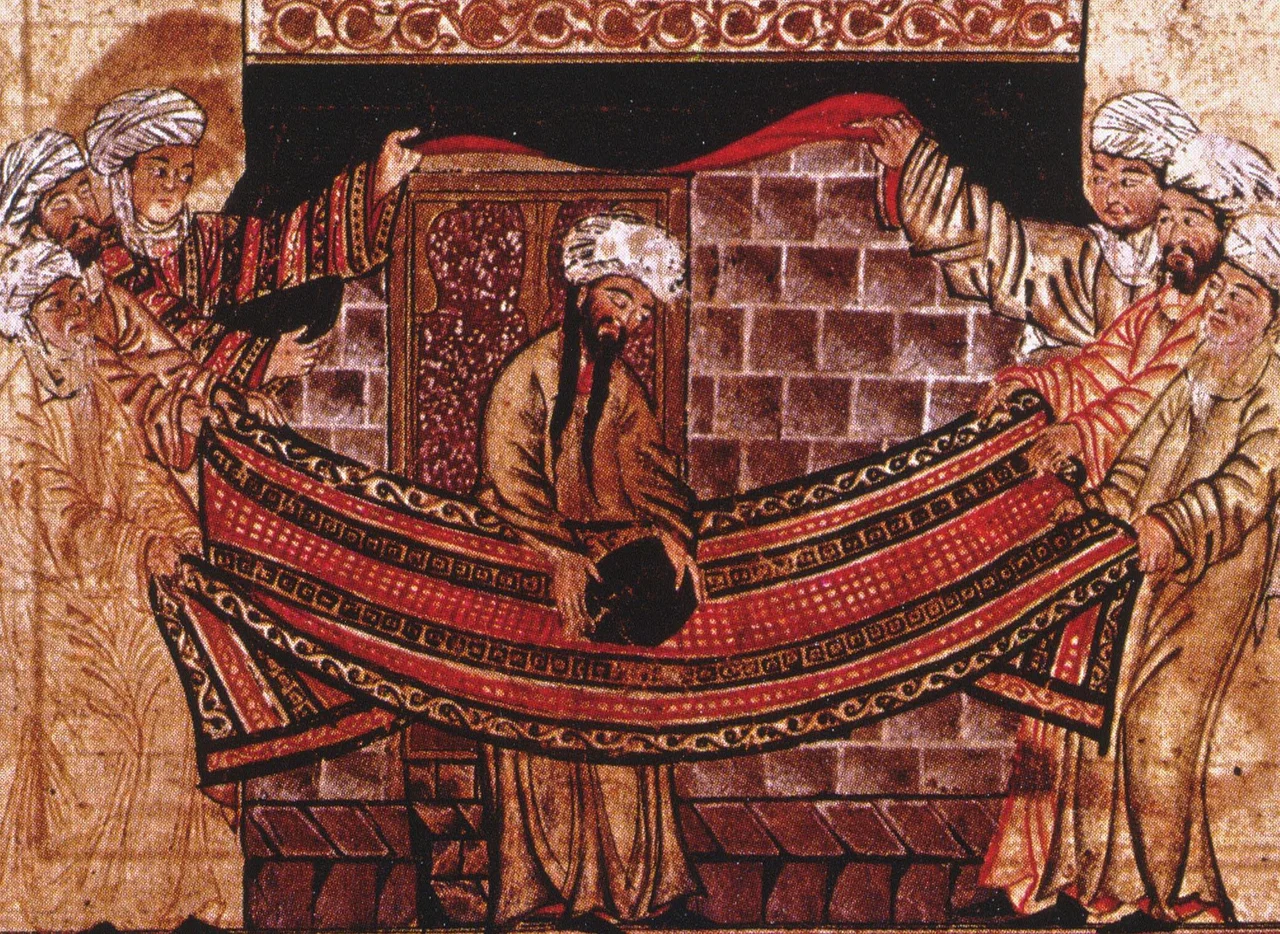
A story preserved in Ibn Ishaq's biography of Muhammad tells how the stone returned to its place in the rebuilt Kaaba. The clans of Mecca had renovated the structure after a fire. When the time came to replace the Black Stone, the clans quarreled. Each wanted the honor of setting it back. They agreed to wait for the next man to come through the gate and let him decide. That man was Muhammad, then 35 years old and not yet a prophet. He asked for a cloth, placed the stone in its center, and had each clan leader hold a corner. Together they carried the stone to its place. Then he lifted it himself and set it into the wall. The story, whatever its literal accuracy, captures something the Islamic tradition wants to remember: that before Muhammad spoke to God, he spoke to quarreling clans, and found a way to honor each without diminishing any.
Stolen, Shattered, Returned
The most traumatic episode in the stone's history came in the 10th century. In 930, the Qarmatians - a Shia Ismaili sect in control of eastern Arabia - raided Mecca during the Hajj, killed many pilgrims, and carried the Black Stone back to their capital. They held it for twenty-two years. According to the historian al-Juwayni, they eventually returned it in 952, wrapped in a sack and thrown into the Great Mosque of Kufa with a note: By command we took it, and by command we have brought it back. The abduction broke the stone into seven pieces. The custodians of the Kaaba commissioned Meccan goldsmiths to construct a silver frame to hold the fragments together, and the stone has been in a similar frame ever since. The Qarmatian leader Abu Tahir, according to Qutb al-Din, met a terrible end - afflicted with a gangrenous sore, his flesh eaten away by worms, a death recorded by chroniclers who wanted his story to carry a warning.
The Ritual and the Science
During the tawaf - the seven counterclockwise circuits of the Kaaba that pilgrims perform during Hajj and Umrah - kissing the Black Stone, or touching it, or raising a hand toward it while saying Allahu Akbar, is traditional at the start of each circuit. Modern crowds make actual kissing nearly impossible, and pointing has become accepted. Some scholars note that the stone functions simply as a marker for counting circuits. One tradition holds that the Stone was originally pure and dazzling white, and turned black by absorbing the sins of those who touched it. Another tradition says it was an angel guarding Adam in the Garden of Eden, turned into stone as punishment when Adam ate the forbidden fruit. As for what it actually is, scientists have offered various hypotheses: basalt, agate, natural glass, stony meteorite, tektite from a meteorite impact. In 1980, Elsebeth Thomsen of the University of Copenhagen proposed it might be impactite from the Wabar meteorite field, 1,100 kilometers east in the Rub' al Khali desert. Later analysis of Wabar suggests that impact may have been more recent than once thought. The Natural History Museum in London thinks the Black Stone may be a pseudometeorite - a terrestrial rock mistaken for one. The stone itself, as Muslim theologians have patiently explained for centuries, does not care which is true. It is the touch of hands across fourteen centuries that matters. The rock only holds that witness.
From the Air
The Black Stone is set into the eastern corner of the Kaaba, in the Masjid al-Haram in central Mecca, at approximately 21.423 N, 39.826 E. King Abdulaziz International Airport (OEJN) in Jeddah is about 70 km west. Critical: the airspace and ground around Mecca are strictly restricted to Muslims only, and controlled no-fly zones apply to the Haram area. This is a ceremonial coordinate for reference. Visibility is typically good but summer heat and dust can reduce it significantly. The Masjid al-Haram itself is visible from altitude as a massive walled complex in the center of Mecca, surrounded by high-rise hotels and the Abraj Al Bait towers.
Nearby Stories
- Al-Balad, Jeddah 23 km away
- Jeddah Tower 33 km away
- Battle of Turubah 123 km away
- Red Sea Rift 143 km away
- Ghadir Khumm 159 km away
- Al-Baha 162 km away
- Thee Ain 206 km away
- Hejaz 214 km away