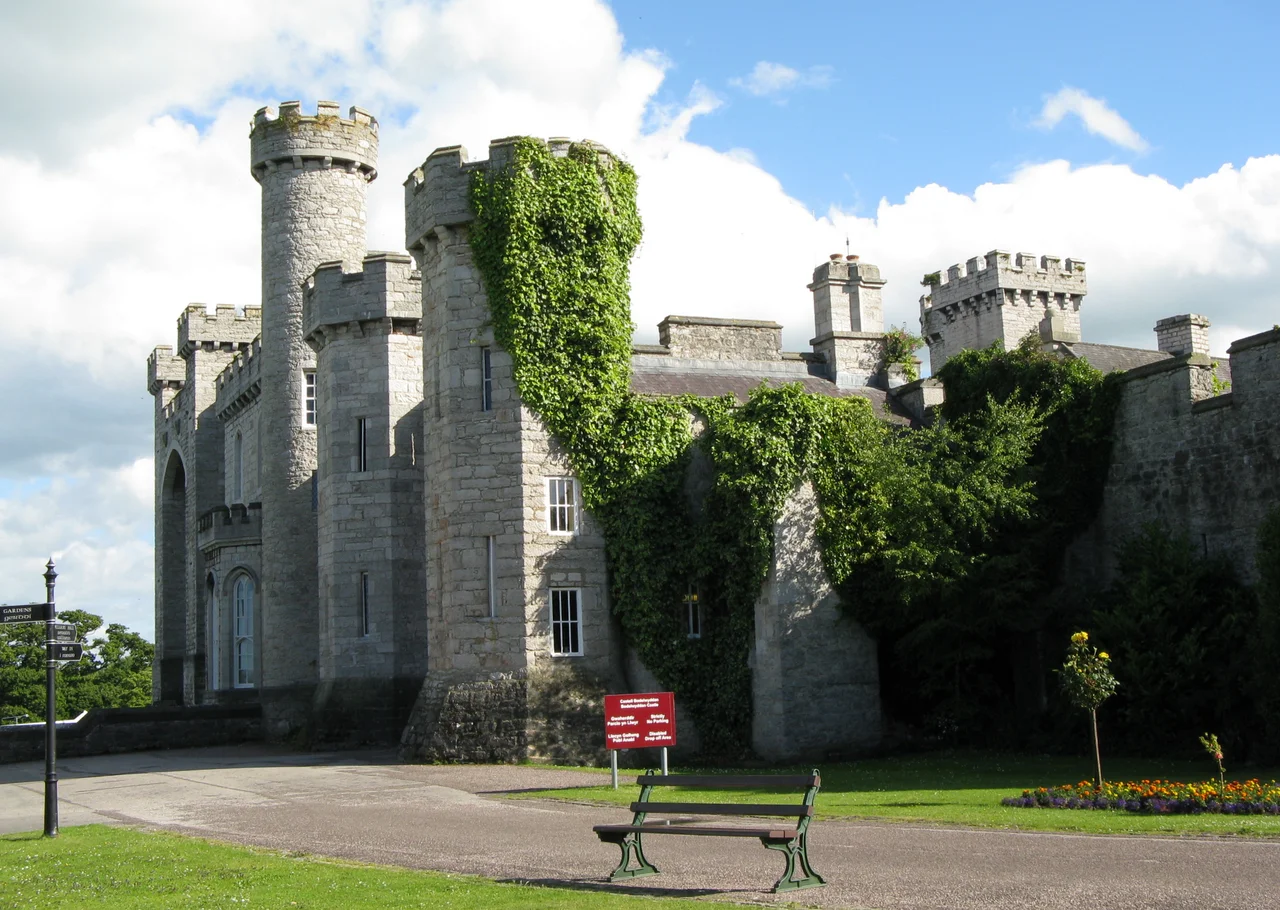

Bodelwyddan Castle
Joseph Hansom is best known for inventing the Hansom cab, the small two-wheeled horse-drawn taxi that defined Victorian London streets. Hansom was also an architect, and one of his most dramatic projects sits in the Vale of Clwyd at Bodelwyddan: a 15th-century manor house that he and Edward Welch remade in the early 1830s into what the architectural historians later called 'wildly dramatic and owing nothing to its predecessors.' Gothick turrets, castellated walls, an entrance staircase with detailing that looks more theatrical than defensive. The original manor under all the Hansom flourish was built around 1460 by the Humphreys family of Anglesey. Five centuries later, the castle is empty - closed since 2019, the National Portrait Gallery's loans long since withdrawn, the Williams-Wynn family seat reborn as a Victorian gentleman's romance and now waiting for its next chapter.
Five Centuries of Owners
Bodelwyddan began around 1460 as a fortified manor house built by the Humphreys family of Anglesey. In 1690 Sir William Williams, who had served as Speaker of the House of Commons from 1680 to 1681, bought the property from the Humphreys. The Williams-Wynn family - one of the great Welsh landowning dynasties, with seats across north Wales - held Bodelwyddan for the next 200 years. The castle was first remodelled in 1805 in a Greek Revival style. Then between 1830 and 1832 Sir John Hay Williams commissioned Joseph Hansom and Edward Welch to refurbish and extend the house into the castellated Gothick style that survives today. They added the curtain walls, the corner turrets, the dramatic entrance arch and the medieval-looking knight figure on the north-east facade (which dates from about 1840, despite looking five hundred years older). The Williams family's heraldic crossed-foxes appear in the Gothic Revival ceilings of the principal rooms. Further refurbishment came in the 1880s under Sir Herbert Williams-Wynn, the 7th Baronet, who inherited from an heirless cousin.
The Hospital and the Trenches
When the First World War began the castle became a recuperation hospital for wounded soldiers. The grounds, with their large parkland and formal gardens, were used by soldiers based at the nearby Kinmel Camp for trench warfare training - practice trenches dug into Welsh soil before the men shipped to France to dig real ones. Traces of these training trenches can still be seen in the grounds, faint earthworks among the trees. Kinmel Camp itself, a few miles away near Rhyl, was a vast Canadian-army staging area that in 1919 became the site of the Kinmel Park Riots, when Canadian soldiers waiting impatiently for ships home tore the camp apart. Wounded soldiers came back to Bodelwyddan to convalesce among the formal gardens that Thomas Hayton Mawson had designed in 1910. By 1920 the cost of maintaining the castle had become too much for the Williams-Wynn family. They leased Bodelwyddan to Lowther College, a girls' private school founded by Florence Lindley in 1896 at Lytham St Annes in Lancashire. Lowther bought the castle outright in 1925.
The National Portrait Gallery in Wales
In the 1980s, after Lowther College closed, Clwyd County Council bought the site with the aim of opening the castle as a visitor attraction. The interior was restored by Roderick Gradidge, an architectural historian who specialised in Victorian buildings, and the historic house was opened to the public under the management of Bodelwyddan Castle Trust, an independent charity. The Trust forged a remarkable partnership with the National Portrait Gallery in London and the Royal Academy of Arts: objects from the national collections came north to Bodelwyddan for display, turning the castle into the National Portrait Gallery's only outpost outside London. The portrait gallery opened in 1988 and was named Museum of the Year in 1989. For nearly thirty years North Walians, schoolchildren on field trips, and tourists driving the A55 between Chester and Holyhead could see paintings normally kept on St Martin's Place in central London. The arrangement ended in 2017 when Denbighshire County Council cut the funding and the NPG withdrew the loans.
Closed and Waiting
Denbighshire County Council decided to sell the site in 2017. In February 2019 the 99-year lease was still listed for sale, valued at around GBP 1 million. By June 2019 the Bodelwyddan Castle Trust announced the historic house had closed. By August the grounds and attractions were also closed. The independently operated Bodelwyddan Castle Hotel - leased to the Rank Organisation in 1994 and run by Warner Leisure Hotels - continued to operate from its own buildings within the domestic yard of the estate. The hotel did not own the castle, but in 2017 Warner had considered purchasing the site. The 16th-century church of St Margaret of Antioch sits adjacent to the castle grounds - the Marble Church, locals call it, named for the fourteen varieties of marble used in its interior. Its 60-metre spire is the most visible landmark for miles along the A55. From the castle gardens, the church is the view; from the church, the castle is the backdrop. They were built for each other, in a sense - the Williams-Wynn family financed both. The castle now sits closed, the gardens occasionally accessible, the trenches of 1915 still faintly visible in the grass.
From the Air
Bodelwyddan Castle sits at 53.26N, 3.50W, just south of the A55 expressway between St Asaph and Abergele in the Vale of Clwyd. From the air, the most striking landmark of the area is not the castle but St Margaret of Antioch's church next door - the 'Marble Church' - whose 60-metre limestone spire is visible for miles along the North Wales coast. The castle itself sits in extensive parkland with formal gardens and the surviving training-trench earthworks. Nearest airports are Hawarden (EGNR, ~22nm east) and Caernarfon (EGCK, ~22nm west). Cruise at 1,500-2,500 ft AGL to see the coast at Rhyl, the Clwydian hills inland, and Kinmel Camp's former site north of Abergele.
Nearby Stories
- Carnedd Llewelyn 7 km away
- Tarporley 9.7 km away
- Battle of Winwick 14 km away
- RAF Shawbury 16 km away
- Cymer Abbey 17 km away
- New Brighton Lifeboat Station 19 km away
- Battle of Oswestry 20 km away
- Celtic Array 52 km away