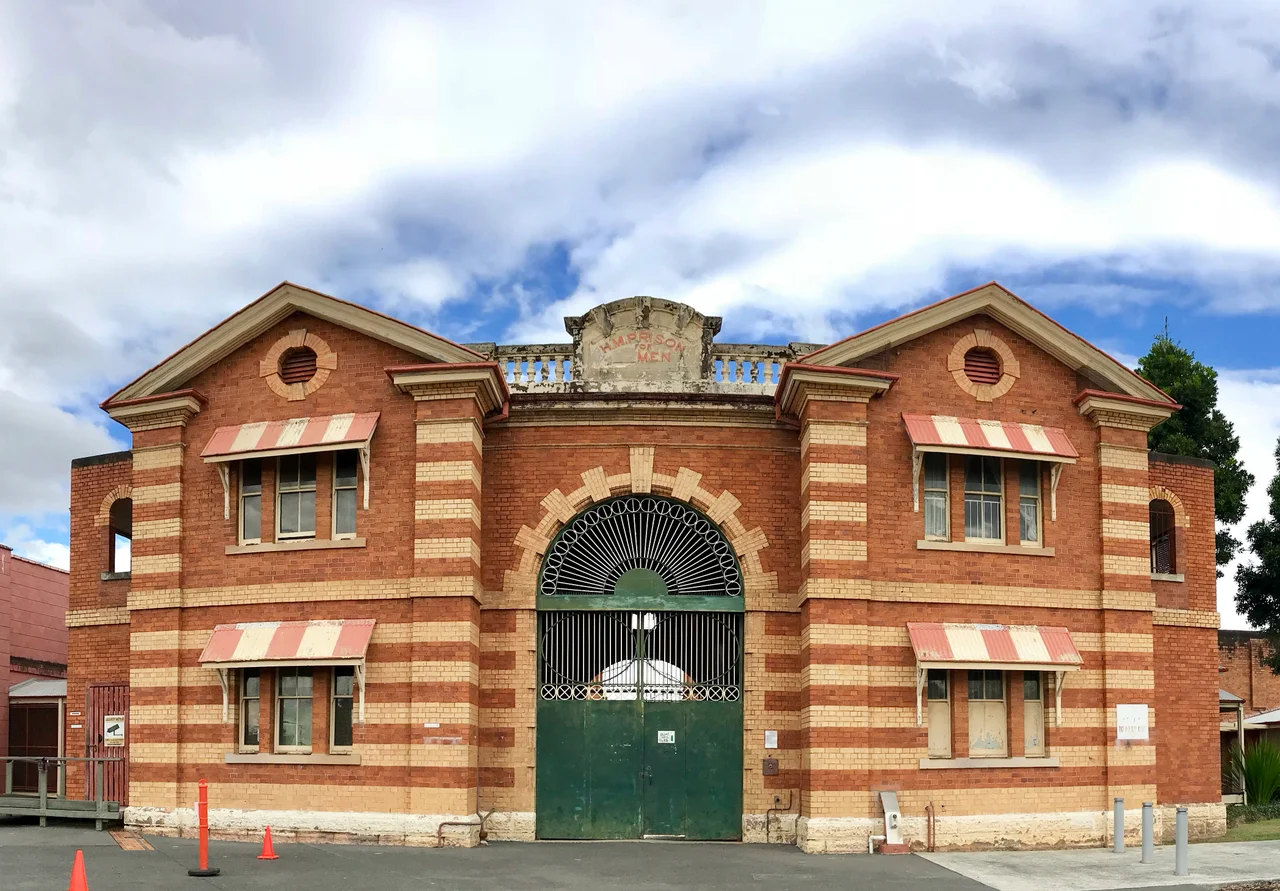

Boggo Road Gaol
The name sounds almost gentle. 'Boggo' is said to come from the boggy ground that swallowed the road in wet weather - or, by another account, from an Aboriginal word for two leaning trees that once marked the track. There was nothing gentle about what stood at the end of it. Behind the high brick walls on Annerley Road in Dutton Park, Queensland locked away its prisoners for more than a hundred years, from the first cellblock in 1883 until the last division closed in 1992. Forty-two men and women went from these cells to the gallows. By the end, the place was a national byword for squalor - and the people inside made sure the country knew it.
Built From a Demolished Jail
The first cellblock opened on 2 July 1883, raised by the builder Robert Porter from the very bricks of the demolished Petrie Terrace jail - one prison cannibalised to build the next. It held 57 cells. In 1903 a second prison went up alongside it to hold women, a building that would change purpose more than once over the decades. The district had been known as Boggo Scrub since the 1850s, and though the thoroughfare was officially renamed Annerley Road in 1903, the old name clung stubbornly to the jail. For Queensland, this was the main prison: the place where the colony, and then the state, sent those it had condemned or simply wished to forget.
The Condemned
Forty-two prisoners were hanged within these walls, and the records of their executions fill columns of old newspapers - the triple execution, the double execution, name after name. Among them was Ellen Thomson, the only woman ever legally hanged in Queensland. Convicted with John Harrison of murdering her husband near Port Douglas, she went to the gallows on 13 June 1887, protesting her innocence to the last. 'I never shot my husband,' she said from the scaffold, 'and I am dying like an angel.' She was buried in the South Brisbane Cemetery. Whatever the truth of the cases that brought them here, these were people who met their deaths in this yard - and the gallows beam survives as a sober reminder of an age when the state took lives as punishment.
Rooftops and Hunger Strikes
By the 1970s the jail had become an open scandal. The cells of the No. 2 prison had no sanitation of any kind, and washing facilities were scarce - conditions a century behind the times. The prisoners refused to suffer in silence. Through the decade they staged hunger strikes, climbed onto the rooftops in protest, and rioted against the treatment they endured. The disturbances kept Boggo Road in the headlines and made it notorious across Australia. These were not idle acts: they were the demands of men insisting they be treated as human beings, and they did more than any official report to force the question of whether the place should exist at all. Among those who passed through was Debbie Kilroy, who later founded the prisoner-rights organisation Sisters Inside.
The Walls That Remain
Number 2 Division closed in 1989; the larger 1960s sections were later demolished, and the women's prison, which ran until 2000, came down in 2006. What survives is the heritage-listed division built in 1903 - the only intact jail in Queensland still reflecting the penological thinking of the nineteenth century - which was listed on the Queensland Heritage Register in 1993. After years shut during the redevelopment of the surrounding land into the Boggo Road Urban Village, the old jail reopened to the public in December 2012, offering guided tours and the ghost tours that seem to attach themselves to every former prison. Tours were paused again from March 2022 to allow for nearby Cross River Rail construction and the associated Boggo Road precinct works; no reopening date has been confirmed as of 2026. Beneath the theatre, though, the brickwork still carries the weight of everyone who was held here against their will.
A Prison in the Imagination
Few Australian jails loom as large in the culture. Boggo Road stood in for the fictional prison of the soap opera Prisoner, and the punk band The Chats put a 1989 riot to music in a song called 'Boggo Breakout'. It runs through Trent Dalton's novel Boy Swallows Universe, later a Netflix series, in which the young narrator breaks in to visit his mother and tries to repeat the legendary escape of Slim Halliday, a real inmate famous for his attempts to get out. The fascination is understandable, but it is worth remembering what sits beneath the stories: real prisoners in real cells with no plumbing, real protests born of genuine misery, and forty-two real people who never walked back out the gate. Boggo Road endures because it refuses to let Queensland forget how it once treated those it locked away.
From the Air
Boggo Road Gaol stands on Annerley Road in Dutton Park, an inner southern suburb of Brisbane, at approximately 27.495°S, 153.028°E - roughly 3 km south of the central business district, close to the Brisbane River as it loops south around the city and beside the Eastern Busway corridor. From the air the surviving brick division and its walled yard sit within a redeveloped urban precinct; the river's southern bend and the nearby city skyline are the clearest navigational references. Brisbane Airport (YBBN) lies about 13 km to the north-east; Archerfield (YBAF) is roughly 8 km to the south-west. Best seen at lower altitudes over the inner-south suburbs in clear conditions.
Nearby Stories
- Redcliffe Peninsula 2.7 km away
- Tamborine National Park 12 km away
- Cressbrook Homestead 27 km away
- Main Range National Park 31 km away
- 2010-2011 Queensland Floods 38 km away
- Cape Byron 96 km away
- Cape Byron Light 126 km away
- HMS Porpoise (1799) 588 km away