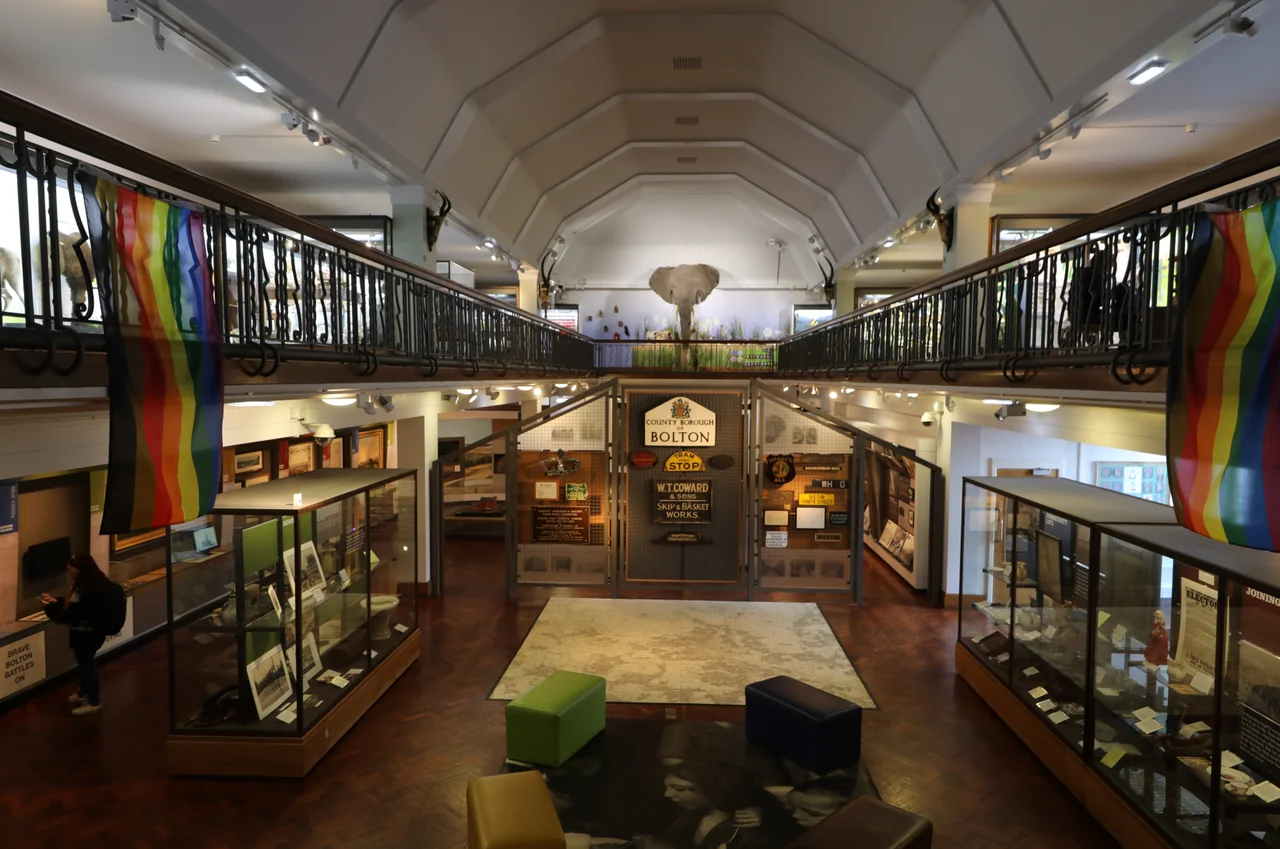

Bolton Art Gallery, Library & Museum
A bequest of five thousand pounds, signed by a Bolton doctor in 1876, set off a chain of events that ended with mummies in Lancashire. Samuel Taylor Chadwick never lived to see his museum open. But within a generation, his money had built one of Britain's most surprising provincial collections - more than ten thousand archaeological objects, sixty thousand pressed plants, and one of the country's oldest public aquariums - all of it crammed into the curved sandstone arc of Le Mans Crescent, near Bolton Town Hall.
A Bequest That Took Eight Years
The story begins in 1852, when Bolton adopted the Libraries and Museums Act and opened a small library in Victoria Square. There were no museum collections yet - just a hopeful basement. The first donation, in 1853, was a box of fossils. By 1876, the holdings had grown enough that townspeople agitated for a proper museum, but the council refused to fund one. Then Chadwick died, leaving the bequest with a single condition: the money must be used to build a Museum of Natural History in Bolton Park, and admission must be free. Construction took years. The Chadwick Museum finally opened at Queens Park in 1884 with three floors of displays. William Waller Midgley, hired the previous year as Bolton's first professional curator, would lead it for decades. When meteorological instruments arrived in 1885, the council gave him a second title: Observator.
How Egypt Came to Lancashire
Bolton's textile mills needed cotton, and cotton meant Egypt. In the late nineteenth century, the town's industrialists helped fund excavations along the Nile through the Egypt Exploration Fund, and their cut of the finds came home to Lancashire. By the time the collection was consolidated into the new Civic Centre at Le Mans Crescent in 1939 - designed by Bolton architects Bradshaw, Gass and Hope - the Egyptology holdings rivalled those of much larger cities. Today the archaeological collection runs to more than ten thousand objects, one of the largest regional collections in the United Kingdom. The British Archaeology holdings alone contain roughly four thousand items dating from the Mesolithic through the post-medieval, including the entire contents of two absorbed museums, Silverdale and Castleton. Bolton also holds the geological estate of Caroline Birley and Humphrey Spender's social-documentary photographs of Mass Observation Britain.
The Aquarium in the Basement
Few visitors expect to find fish tanks behind a civic library entrance, but Bolton has run one of Britain's oldest public aquariums for generations. The 2018 refurbishment, funded by a 3.8 million pound grant, modernised the displays without surrendering the aquarium's strange charm. The sculpture collection is similarly unexpected: roughly fifty pieces gathered during the 1950s and 1960s, mostly mid-century British bronzes, with works by Henry Moore, Barbara Hepworth, and Jacob Epstein. Outside the main building, the museum still operates Hall i' th' Wood, a Grade I listed timber-framed manor donated by Lord Leverhulme in 1899 as a shrine to Samuel Crompton, inventor of the spinning mule. Smithills Hall, opened as a museum in 1963, completes the trio of buildings.
Outing the Past
In March 2019, the museum hosted the OUTing the Past Festival, which dramatised an 1891 visit by Bolton's Eagle Street College - a circle of working-class Whitman enthusiasts - to the American poet himself. That summer, the renovated temporary gallery hosted the British Museum's touring exhibition Desire, Love, Identity, with local objects added to set Bolton's LGBT history alongside the national story. The displays remembered the town's first LGB youth group meeting Princess Anne, the founding of Bolton Pride, and figures like the music-hall male impersonator Vesta Tilley. For a museum built on a Victorian doctor's bequest about natural history, it was a long way from the basement of stuffed birds - but somehow, also, a direct line from Chadwick's original instruction that admission be free, for everyone, forever.
From the Air
Located at 53.5774 degrees north, 2.4316 degrees west, in the centre of Bolton roughly 11 miles north-west of Manchester city centre. Le Mans Crescent is a distinctive curved civic block visible adjacent to the larger rectangular mass of Bolton Town Hall. The nearest major airport is Manchester (EGCC), about 17 miles south. Liverpool (EGGP) lies 30 miles to the south-west. The West Pennine Moors rise immediately to the north of town, with Winter Hill's transmitter mast a useful landmark. Recommended viewing altitude is 2,500 to 4,000 feet AGL in good visibility.
Nearby Stories
- National Science and Media Museum 0.2 km away
- Jodrell Bank Observatory 3.2 km away
- Siege of Lathom House 5.6 km away
- Chester Zoo 6.2 km away
- Whalley Abbey 8.9 km away
- Haddon Hall 10 km away
- Wentworth Castle 16 km away
- Blackpool 16 km away