
Bridgewater Canal
One horse could haul thirty long tons of coal at a walking pace, and that simple ratio rewrote the economy of northern England. Before the Bridgewater Canal opened in 1761, the same horse on a packhorse trail could manage about two and a half tons. The third Duke of Bridgewater, sitting on top of valuable Worsley coal seams that flooded as fast as he could pump them out, did the maths. He visited the Canal du Midi in France. He hired a self-taught millwright named James Brindley. And he gambled an enormous fortune on a project that would take canal boats over a river on a stone aqueduct, into a hillside through a working coal mine, and into Manchester at a price that halved the cost of fuel almost overnight.
The Duke's Problem
Francis Egerton, third Duke of Bridgewater, was twenty-three years old when he turned to his coal mines for income. His Worsley pits sat above the Middle Coal Measures, where the seam ran beneath a permeable sandstone that funnelled groundwater into the workings. The pits flooded constantly. Getting coal out meant winding it up to the surface, packing it onto horses, and trekking eight miles into Manchester, or floating it down the Mersey and Irwell Navigation, which charged what the duke considered extortionate rates and froze or flooded with the seasons. Brindley had recently fitted a successful pumping system at the Wet Earth Colliery nearby. The duke brought him in, and after a six-day survey Brindley proposed something audacious: cut a canal directly into the hillside, drain the mines into the canal itself, and float the coal out at constant grade with no winding.
Over the Irwell
Brindley moved into Worsley Old Hall and spent forty-six days walking the route. The hardest problem was the River Irwell. To reach Manchester, the canal had to cross it. Bridges over rivers were ordinary work; a navigable trough carrying boats over a navigable river was not. Brindley's answer was a stone aqueduct at Barton-upon-Irwell, thirty-nine feet above the river surface. A contemporary observer wrote that when finished, it would be the most extraordinary thing in the kingdom, if not in Europe: boats going underground in some places, over a navigable river in others, without communicating with its waters. The duke's act of Parliament passed in 1759. The canal opened from Worsley to Manchester in 1761. There were no locks in Brindley's main line, a quiet demonstration of his skill at finding the contour. Coal arriving at the Manchester wharf cost roughly half what it had a year before.
Underground at Worsley
The Worsley end of the canal was not a terminus but an entrance. Inside the hillside, Brindley and the duke's agent John Gilbert drove tunnels through the coal itself, eventually building forty-six miles of underground waterway on four separate levels linked by inclined planes. Specialised narrow boats called M-boats, also nicknamed Starvationers for their exposed ribs, were loaded at the coalface and floated out onto the surface canal. As the canal passes through Worsley today, the water still runs bright orange, stained by iron oxide leaching from the abandoned underground workings. The colour has become so familiar that the local council has launched a multimillion-pound scheme to remove it. The mines themselves stopped production in 1887. The orange has not.
Canal Mania
What Bridgewater proved, more than any earlier waterway, was that a private investor could pay for a canal and earn the money back. Between 1761 and 1796, Parliament approved hundreds of canal acts. The boom came to be called Canal Mania. By 1776 the Bridgewater itself had been extended to the Mersey at Runcorn, where a flight of ten locks, contemporaries called it the wonder of their time, dropped boats ninety feet down to the river through three-meter falls. By 1795 a second extension ran the other way, from Worsley through Boothstown and Astley Green to Leigh, opening up the coalfields north of Manchester. The canal made a profit every single year that the Bridgewater Trustees managed it. Even after the Liverpool and Manchester Railway opened in 1830 and triggered a fierce price war, the canal held its traffic and adapted, eventually buying its old rival the Mersey and Irwell.
The Canal Today
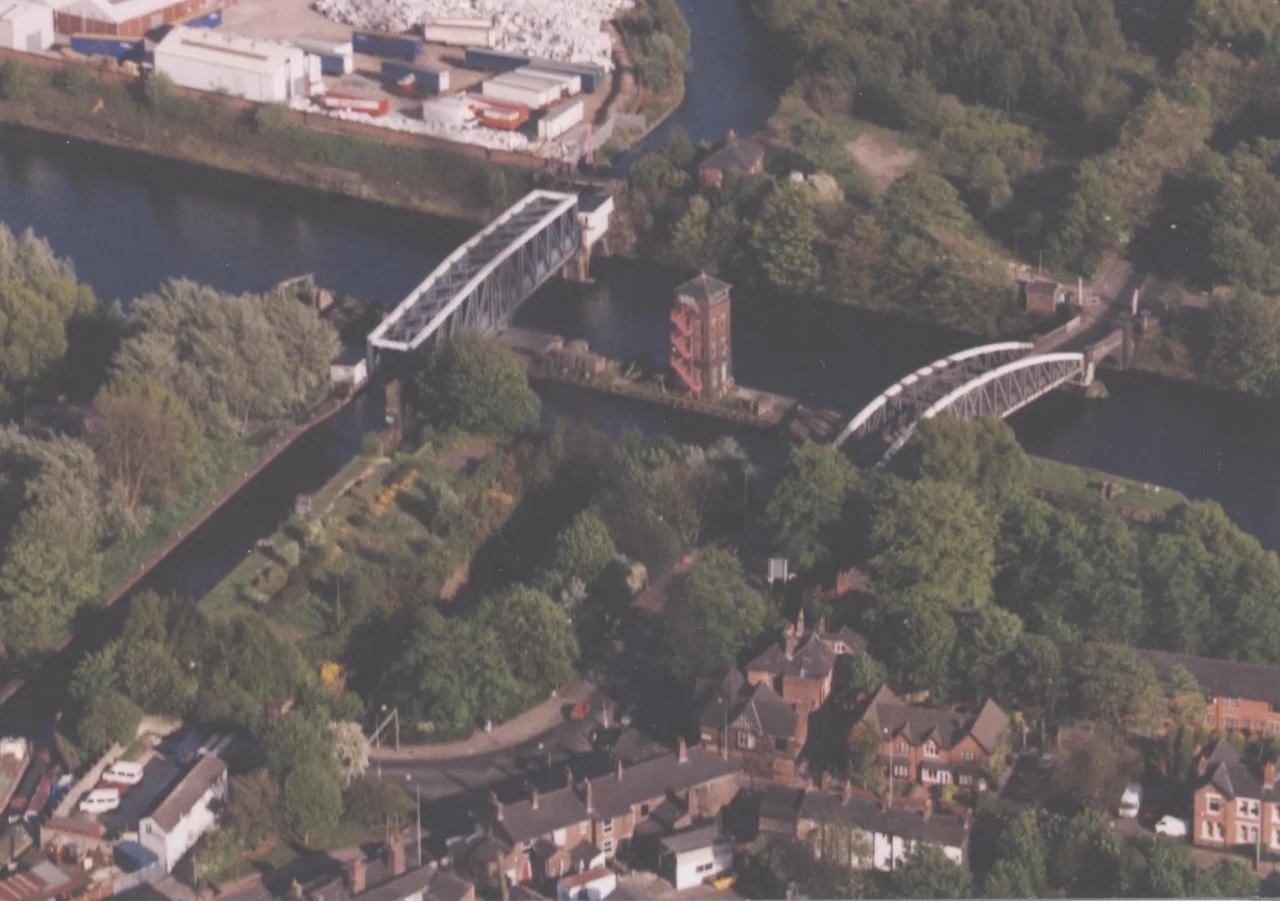
The Bridgewater is one of the very few major British canals that was never nationalised. It passed from the trustees to the Manchester Ship Canal Company in 1885, then to the Peel Ports group in the early 2000s, and remains privately owned today. The original Barton Aqueduct was demolished when the Ship Canal was cut beneath it in the 1890s; in its place, the Barton Swing Aqueduct, a 235-foot iron trough that pivots on a central island to let ocean ships pass below, has been performing the same trick for more than a century. Commercial cargo ran until 1975, when the last load of grain from Liverpool reached the Manchester BOCM mill. Pleasure boats have used the canal since 1952, and it now forms one leg of the Cheshire Ring leisure route. A breach near the River Bollin on New Year's Eve 2024 closed the navigation at Dunham; the orange water at Worsley keeps flowing.
From the Air
The canal runs roughly 41 miles across Greater Manchester and Cheshire. Headline coordinates 53.483N, 2.517W mark the Worsley basin. Manchester Airport (EGCC) lies 7 nm to the south and Liverpool John Lennon (EGGP) about 23 nm west. At 2,500 ft, follow the canal east from Runcorn past the Barton Swing Aqueduct (a recognisable iron trough crossing the Manchester Ship Canal), into central Manchester at Castlefield, then northwest through Worsley to Leigh. The orange-stained water at Worsley is visible from the air on clear days. Lancashire weather: low ceilings common, prevailing southwesterly winds.
Nearby Stories
- Delamere Forest 4.5 km away
- Macclesfield Canal 4.7 km away
- Top Withens 6 km away
- Moel Famau 13 km away
- Hoylake Lifeboat Station 14 km away
- Whalley Abbey 15 km away
- Brindley Water Mill 18 km away
- Piel Castle 30 km away