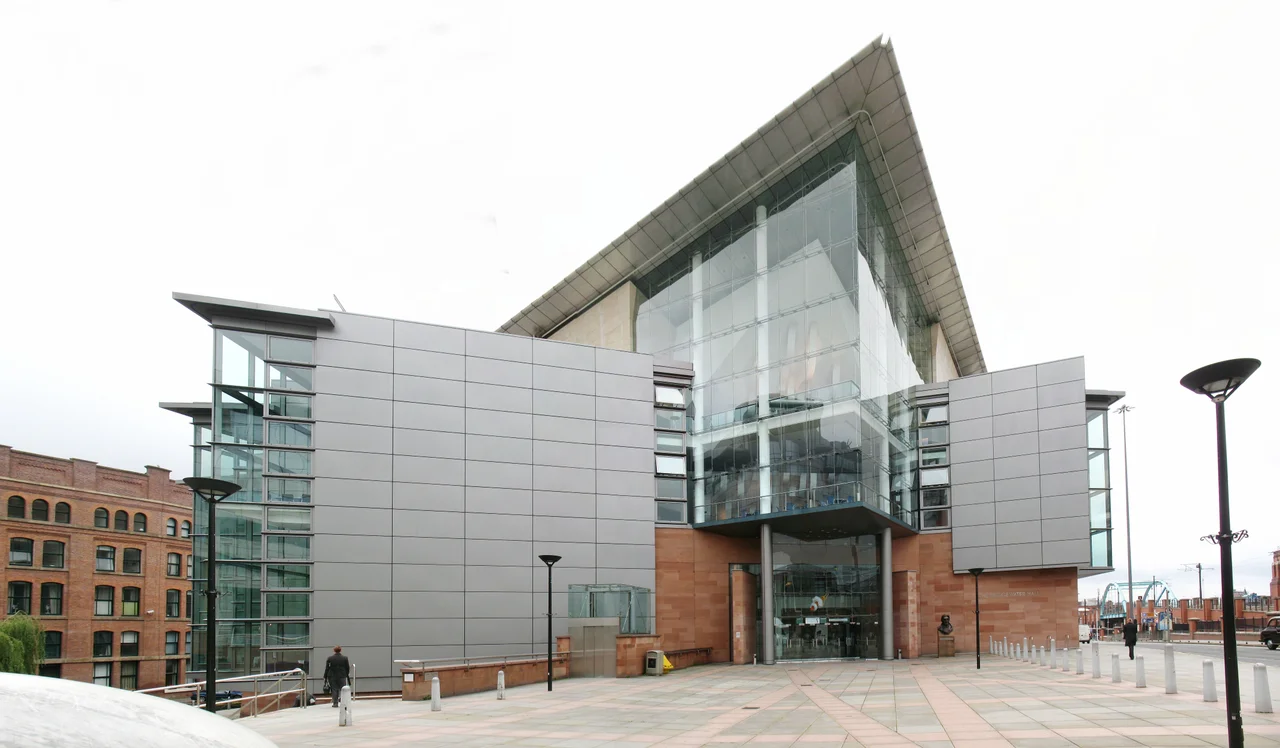

Bridgewater Hall
The whole building is floating. Manchester's Bridgewater Hall, all twenty-six thousand five hundred tonnes of it, rests on 280 GERB isolation bearings - rows of vertical steel springs between concrete piers. Above the springs sits one of the most acoustically pure concert halls in Britain. Below them, a tram of the Manchester Metrolink passes every few minutes, and Lower Mosley Street traffic rumbles past the front door. None of it reaches the audience. The Bridgewater Hall is the first concert hall in the world built with this technology, and it was deliberately designed that way - because the venue it replaced, the bombed-out Free Trade Hall, had been ruined by the rumble of buses on Peter Street.
Why the Free Trade Hall Had to Go
The Hallé Orchestra had played in Manchester's Free Trade Hall since 1858. After the building was gutted in the Blitz of December 1940 and rebuilt in the 1950s, the acoustics never quite recovered, and the audience facilities aged badly. Throughout the 1970s and 1980s, the city floated proposals to build something new. Nothing happened. Then, in 1988, the Central Manchester Development Corporation was formed to spend European Regional Development Fund money on regenerating a decaying city centre, and the concert hall finally became a real project. Construction began in 1993. The first concert took place on 11 September 1996. Queen Elizabeth II and the Duke of Edinburgh officially opened the building on 4 December that year. By then Manchester had also survived the IRA's June 1996 bomb in Corporation Street, and the Bridgewater Hall stood as part of a wider statement that the city was rebuilding itself, modern and confident.
The Floating Auditorium
Rob Harris of Arup Acoustics designed the sound. RHWL drew the architecture, and John Laing built it. The auditorium itself sits on the GERB bearings, completely separated from the surrounding building structure. The rear wall is dominated by the Marcussen and Son organ, all wood and burnished metal - the largest instrument installed in the United Kingdom for a hundred years at the time of construction. The whole thing cost about 42 million pounds and won the 1998 Civic Trust Special Award. The hall sits on a specially constructed arm of the Rochdale Canal, its name a nod to the third Duke of Bridgewater, whose own canal of 1761 helped start the Industrial Revolution in Manchester. The plaza outside, Barbirolli Square, holds Kan Yasuda's Ishinki Touchstone, an 18-tonne block of polished Carrara marble installed in August 1996 with money from the Arts Council, Lottery Fund, Manchester Airport, and the city council.
Home of the Hallé
The Hallé moved across the city centre from the Free Trade Hall when the new building opened. Founded in 1858 by Charles Hallé - a German-born pianist who fled the 1848 revolutions and made Manchester his home - the orchestra had played continuously for nearly a century and a half. Joining them at Bridgewater Hall were the Hallé Choir and, from September 2002, the Hallé Youth Orchestra and Youth Choir, for musicians under nineteen. The BBC Philharmonic uses the hall as its main concert venue; Manchester Camerata performs there regularly. A statue of Sir John Barbirolli, the Hallé's legendary mid-century conductor, was placed beside the main entrance in 2000 - sculpted by Byron Howard - watching the audience arrive for the orchestra he led from 1943 until 1968.
More Than Music
Two hundred and fifty performances a year fill the calendar, but the hall does more than concerts. Manchester Metropolitan University has held its graduation ceremonies there every July since the early 2000s. The Open University holds one of its degree ceremonies in the hall annually. Conferences, presentation evenings, charity events all flow through. The springs do not know the difference. Whether the room above is filled with Mahler's Eighth Symphony or three thousand parents watching their children collect honours degrees, the building floats - quiet, isolated, indifferent to the trams below.
From the Air
Located at 53.4753 degrees north, 2.2458 degrees west, on Lower Mosley Street in central Manchester adjacent to the Rochdale Canal. The hall is a distinctive curved-roof modern building at the south-western corner of Manchester Central (formerly G-Mex). The nearby Beetham Tower (47 storeys) is a useful landmark visible from far up the M62. Manchester Airport (EGCC) is 8 miles south. Manchester City Airport (Barton, EGCB) is 5 miles west. The Pennines rise to the east. Recommended viewing altitude is 2,000 to 3,500 feet AGL given busy Manchester airspace - check Manchester CTR boundaries.
Nearby Stories
- National Science and Media Museum 0.2 km away
- Jodrell Bank Observatory 3.2 km away
- Siege of Lathom House 5.6 km away
- Chester Zoo 6.2 km away
- Whalley Abbey 8.9 km away
- Haddon Hall 10 km away
- Wentworth Castle 16 km away
- Blackpool 16 km away