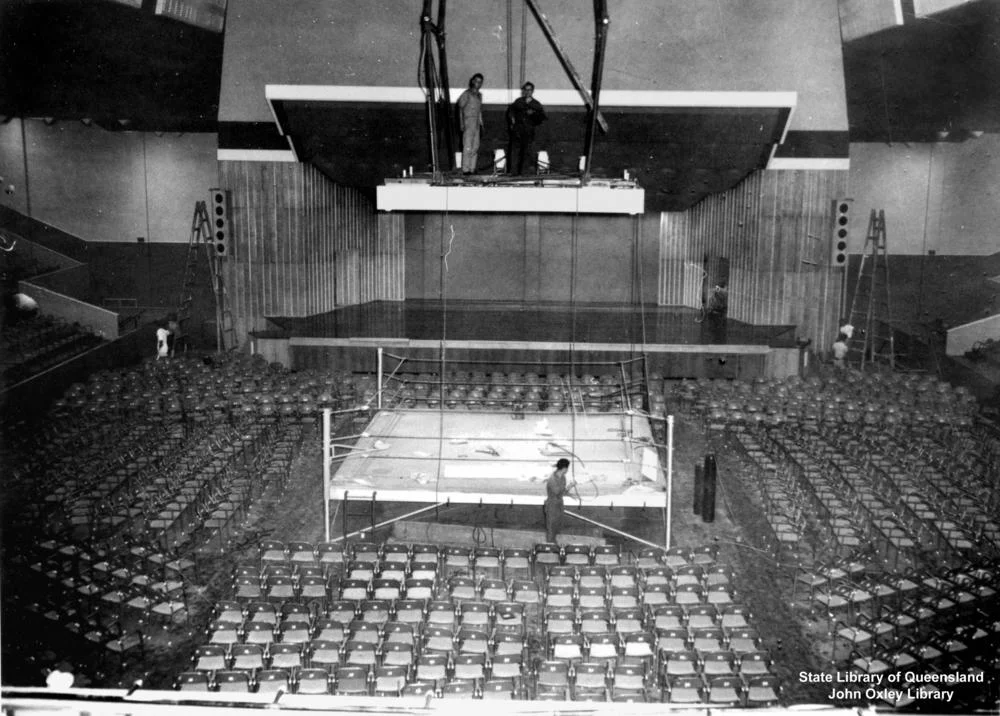

Brisbane Festival Hall
On the night of 29 June 1964, four young men from Liverpool walked onto a stage on the corner of Albert and Charlotte Streets, and Brisbane lost its mind. The Beatles played the first of four concerts at Festival Hall that week — two shows each on 29 and 30 June — to a hall jammed with thousands of screaming fans who could barely hear the band over their own voices. It was the loudest moment in the long life of a plain brick box that, for most of the twentieth century, was where this city came together to roar. The building is gone now. The memory of those nights is not.
The House of the Fights
Before it was a concert hall, it was a fight venue. The site opened in 1910 as Brisbane Stadium, a boxing and wrestling arena where the working city bought tickets to watch men trade blows under hot lights. A teenage Billy Unwin, later remembered as a kind of Queensland underdog hero, won the state amateur title here in 1917. The old stadium was demolished in 1958 and rebuilt for the Centenary of Queensland, reopening in April 1959 as Festival Hall, named after London's Royal Festival Hall and built in the same clean postwar style. Boxing carried on. Australian champion Hector Thompson, the Brisbane Bomber, headlined cards here, and the hall staged the boxing for the 1982 Commonwealth Games. For generations of Brisbane fight fans, this was the room where reputations were made.
Every Band That Mattered
As television thinned the boxing crowds, music filled the hall instead. With room for around four thousand people, Festival Hall became the city's main indoor stage, and the roll call of who played there reads like a history of modern popular music. Led Zeppelin and Bob Dylan. Johnny Cash and Ray Charles. AC/DC, The Ramones and Bob Marley. Queen closed their Night at the Opera tour here in April 1976. Later came Nirvana, U2, Radiohead and Bjork. The Czech Philharmonic and the Bolshoi Ballet appeared in its earlier years, and homegrown acts from the Bee Gees and the Easybeats to Powderfinger took its stage. For decades, if a touring act came to Brisbane, it came to Festival Hall, and a Brisbane teenager's first real concert was very likely under that roof. The Beatles nights set the template: thousands of fans, many of them young women, packing the hall to a fever pitch that the band could barely be heard above.
Sold Off in Lots of Three
By the turn of the century the hall was old, plain and sitting on valuable inner-city land. Its last concert, by Michael Franti and Spearhead, took place in August 2003, and the doors closed for good at the end of that month. The building was sold, demolished, and replaced by an apartment tower called Festival Towers. There was no grand farewell, just the practical end of a working venue. In a detail that captures the city's affection for the place, the seats were sold off as souvenirs in lots of three, so that fragments of Festival Hall went home to live in lounge rooms and sheds across Brisbane.
A Room People Still Miss
Festival Hall was never beautiful. It was a big, boxy, acoustically blunt shed, and people loved it precisely for that. The sightlines were close, the air got hot and thick, and the noise of a packed house had nowhere to go but back down onto the crowd. That intimacy is the thing the tower that replaced it can never give back. To stand on this corner today is to stand on the spot where the Beatles once played to a sea of screaming faces, where boxers bled and crowds bellowed, and where, for nearly a century, Brisbane came to feel like a city of half a million all in one room together.
From the Air
Brisbane Festival Hall once stood at the southern corner of Albert and Charlotte Streets in the Brisbane CBD, near 27.471 degrees south, 153.027 degrees east; the site is now occupied by the Festival Towers high-rise, which makes a useful landmark in the dense city grid beside the Brisbane River. The nearest airport is Brisbane Airport (YBBN / BNE), roughly 13 km to the north-northeast, with Archerfield (YBAF) about 11 km southwest for light aircraft. CBD high-rises and frequent summer thunderstorms can limit visibility; clear, stable winter air gives the cleanest look down the city blocks.
Nearby Stories
- Redcliffe Peninsula 2.7 km away
- Tamborine National Park 12 km away
- Cressbrook Homestead 27 km away
- Main Range National Park 31 km away
- 2010-2011 Queensland Floods 38 km away
- Cape Byron 96 km away
- Cape Byron Light 126 km away
- HMS Porpoise (1799) 588 km away