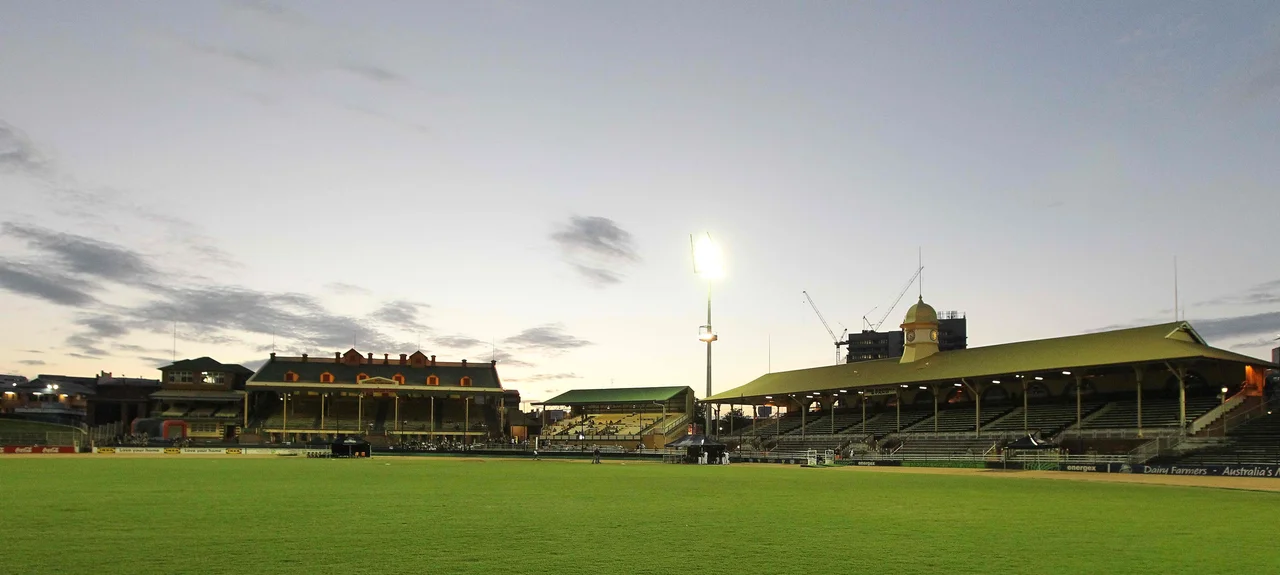

Brisbane Showgrounds
For ten days each August, the smell of fairy floss and frying batter drifts across Bowen Hills, prize cattle are led around a sawdust ring, and Brisbane children clutch Bertie Beetle showbags and strawberry sundaes. This is the Ekka, the Royal Queensland Show, and these grounds have hosted it almost every year since 1876. It is the moment the bush and the city meet: farmers haul their best animals and produce down from the country, and a coastal capital gets a yearly reminder of the land that feeds it. Behind the cheerful chaos lies a site whose history runs far deeper, and darker, than the show itself.
Barrambin, Before the Fences
Long before any pavilion stood here, the Turrbal people knew this ground as Barrambin and camped at its waterholes. In the 1840s, as many as four hundred Turrbal would gather around what colonists renamed York's Hollow. The arrival of the British was brutal: in 1846 police dispersed the camp and killed at least three people, and in 1849 soldiers of the 11th Regiment drove the people off again, wounding several. The same waterholes that had sustained Aboriginal life for generations were soon handed to newly arrived European immigrants, and by 1860 the Turrbal could no longer live there. The festive grounds of today rest on a place of dispossession, and it is worth pausing on that fact amid the showbags and sideshow lights, because the people who lost this ground were here first, and were here a very long time.
A Garden of Useful Things
The colonial reinvention of the site began in 1863, when it became part of the Queensland Acclimatisation Society's grounds. The Society's mission was practical and ambitious: to import, trial and spread plants and animals that might make money in Queensland. In these paddocks they experimented with mango and olive trees, ginger, sugar cane and choko vines, helping lay the foundations of the colony's commercial agriculture. To showcase all this, the newly formed National Association staged a grand Intercolonial Exhibition in August 1876. It was an enormous success, drawing crowds estimated in the tens of thousands at a time when Brisbane's entire population was barely twenty thousand. The agricultural show had been born, and it has returned almost every year since.
Where Bradman Began Badly
For decades the Showgrounds doubled as Brisbane's great sporting arena. The Australian football and rugby codes, soccer internationals, baseball, tennis and cricket all unfolded on this turf. It hosted Brisbane's first-ever Test match, in 1928, which happens to be where a young Don Bradman made his Test debut, scoring just 18 and 1 as Australia slumped to a 675-run defeat, the heaviest loss by runs in the country's history. The boy who would become the greatest batsman of all time began, here, with a failure. The ground's attendance record belongs to rugby league: more than forty thousand packed in on 6 July during the 1946 Great Britain Lions tour, with thousands more locked outside the gates.
Saturday Nights and Dagwood Dogs
The Showgrounds always had a wilder side. From 1926 it was Brisbane's home of dirt-track speedway, and for half a century the summer Saturday nights belonged to roaring speedcars and motorcycles. Future Formula One world champion Jack Brabham was among the drivers who slid around its 425-metre track before the cars moved on in the early 1980s. Through all of it, the Ekka has remained the constant. Its strawberry sundaes, sold since the 1950s and now raising money for medical research, its Bertie Beetle bags and its Wednesday People's Day public holiday are woven into Brisbane childhoods. Added to the Queensland Heritage Register in 2003, the grounds still do what they have done for nearly 150 years: once a year, bring the whole state together in one paddock.
From the Air
The Brisbane Showgrounds occupy a large block in Bowen Hills, just north of the CBD, around 27.450 degrees south, 153.033 degrees east. The open arena and pavilions stand out against the surrounding inner-city density, with the Exhibition rail line cutting across the site and the Clem7 road tunnel running unseen beneath it. Brisbane Airport (YBBN / BNE) is about 11 km to the north-northeast; Archerfield (YBAF) lies roughly 12 km to the southwest. During the August show the grounds blaze with lights and crowds at night, an unmistakable marker; clear, dry winter skies that month usually give excellent visibility over inner Brisbane.
Nearby Stories
- Redcliffe Peninsula 2.7 km away
- Tamborine National Park 12 km away
- Cressbrook Homestead 27 km away
- Main Range National Park 31 km away
- 2010-2011 Queensland Floods 38 km away
- Cape Byron 96 km away
- Cape Byron Light 126 km away
- HMS Porpoise (1799) 588 km away