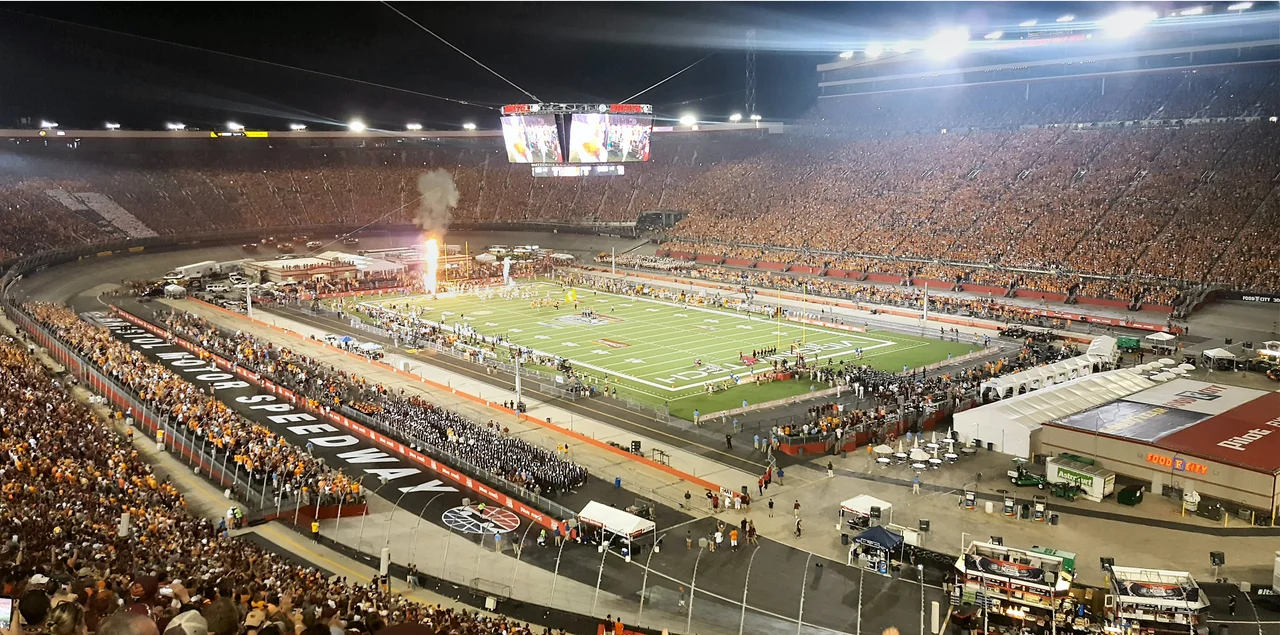

Bristol Motor Speedway
Forty engines hit full throttle inside a concrete bowl, and the noise has nowhere to go. It bounces off thirty-degree banked walls, hammers back from the upper grandstands, slams into the next lap as the leaders come around. At Bristol Motor Speedway, sound becomes a physical thing - fans on the back row can feel the change in air pressure when the pack thunders by. They call it the Last Great Colosseum for a reason.
Built on a Dairy Farm
On January 17, 1961, a recreation-business entrepreneur named Larry Carrier announced he was going to build a racetrack near Bristol, Tennessee. His first site, in Piney Flats, was rejected by local ministers. So Carrier moved five miles south and put the track on a former dairy farm. The initial plans, drawn on paper bags with partners R. G. Pope and Carl R. Moore, called for a 20,000-seat, 100-acre facility next to U.S. Route 11E. The first ticket was sold to Tennessee Ernie Ford in March 1961. The track officially opened that July for a half-mile paved speed record attempt by driver Tommy Morgan, then immediately hosted practice for the 1961 Volunteer 500.
The Half-Mile That Got Steeper
The current measured length is 0.533 miles - barely longer than half a mile - but the banking is the punchline. Turns range from 24 to 28 degrees today, but during the track's rough-racing era from 1969 onward, the banking ran 30 degrees in the corners, with straightaways tilted 20 degrees. For years, Bristol marketed those turn corners as 36 degrees; they were finally measured honestly at 30 in 2007. Lap speeds passed 100 mph within months of the 1969 reconfiguration. After a 1992 dispute over yet another rough asphalt resurface, Carrier had the entire racing surface paved in concrete - the change that defined Bristol's modern hard-edged identity. It remains the only NASCAR track with two pit road lanes instead of one.
Bruton Smith Builds the Colosseum
In January 1996, Speedway Motorsports founder Bruton Smith bought the track for $26 million. Local fans feared he would pull a NASCAR weekend and move it to his new Texas Motor Speedway, but Smith went the opposite way: expansion. Capacity jumped from 81,000 when he bought it to over 160,000 at its peak. By April 1997, Bristol had passed Neyland Stadium as the largest sports arena in Tennessee. The Kulwicki Tower, finished in 2000, added 12,000 seats. In April 2016, Smith finished Colossus TV - a 30-by-63-foot video screen hanging center-track, billed as the world's largest permanent center-hung outdoor digital display. Current capacity, after some reductions, sits at 146,000.
Football, Baseball, and a Game of Tag
The infield has hosted things racing never imagined. On September 10, 2016, the Battle at Bristol packed the place for an NCAA football game between Tennessee and Virginia Tech - the Volunteers won 45-24 in front of the largest crowd ever to watch a college football game at the time. A week later, East Tennessee State beat Western Carolina 34-31 on the same field. On August 2, 2025, the Atlanta Braves beat the Cincinnati Reds 4-2 in the MLB Speedway Classic, the first regular-season Major League Baseball game ever played in Tennessee. In 2021, YouTuber MrBeast staged a $500,000 game of tag between ten people across the empty grandstands. Hurricane evacuees, COVID-19 vaccine clinics, even a temporary high school for students displaced by black mold - the track keeps finding ways to fill a 146,000-seat bowl when the engines aren't running.
Night Race
The Bass Pro Shops Night Race, run since 1961 and held at night since 1978, is the event that built Bristol's reputation. The half-mile under floodlights, drivers running door-to-door at 130 mph, tempers fraying after 400 laps of contact - it became unmissable. Sellouts ran 55 races deep before the streak finally ended in 2010. The spring race, currently the Food City 500, was first run on October 22, 1961. From 2021 to 2023, NASCAR covered the concrete with dirt to run an experimental dirt race - then returned to the original concrete surface that made Bristol famous.
From the Air
Bristol Motor Speedway sits at 36.52N, 82.26W in Sullivan County, TN, at roughly 1,500 ft MSL adjacent to U.S. Route 11E. Recommended viewing altitude 4,000-6,000 ft for the full bowl outline. Nearest commercial airport is Tri-Cities Regional (KTRI) about ten miles north - the primary hub for race weekends. Bristol/Steele Creek Park (private/limited use); Virginia Highlands (KVJI) at Abingdon is a useful GA alternate to the northeast. The track sits in the Tennessee Valley with mountain ridges (Holston Mountain to the east at 4,280 ft) generating significant terrain effects in westerly flow. Race weekends generate heavy local VFR traffic - expect TFRs.
Nearby Stories
- David Crockett Birthplace State Park 3.6 km away
- Big Stone Gap, Virginia 20 km away
- Avery County, North Carolina 21 km away
- Emory and Henry University 23 km away
- Hawkins County, Tennessee 30 km away
- Moravian Falls, North Carolina 37 km away
- Tazewell County, Virginia 44 km away
- North Wilkesboro Speedway 57 km away