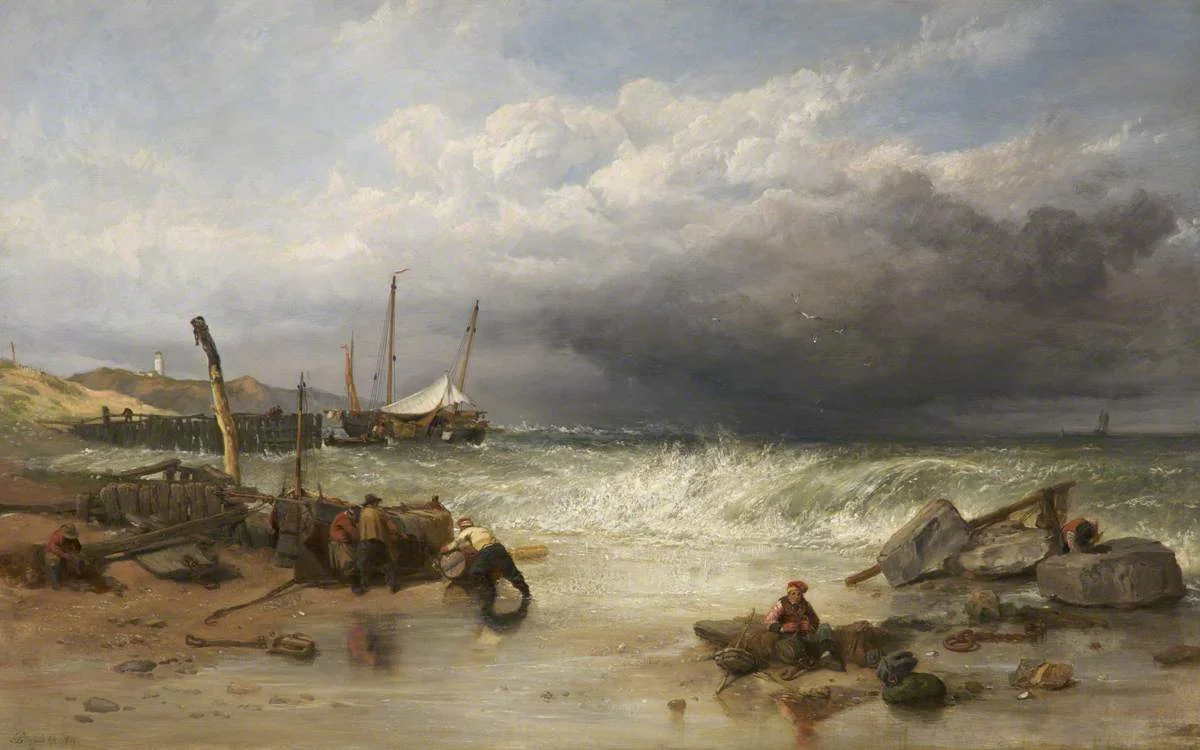
_-_On_the_Coast_of_Brittany_-_107.1901_-_Bury_Art_Museum.jpg)
Bury Art Museum
Thomas Wrigley made his fortune from paper. He died in 1880, but in 1897 - the year of Queen Victoria's Diamond Jubilee - his children offered the town of Bury something extraordinary: more than two hundred oil paintings, watercolours, prints, and ceramics, including works by J. M. W. Turner, John Constable, Edwin Landseer, and George Clausen. There was one condition. Bury had to build somewhere worthy to house them. The town agreed. Four years later, on 9 October 1901, the Earl of Derby opened the present building, designed by the Manchester firm of Woodhouse and Willoughby.
The Wrigley Bequest
Wrigley belonged to the generation of Lancashire industrialists who made improbable fortunes from cotton, paper, and iron in the middle of the nineteenth century - and then turned, sometimes uneasily, to collecting art. His taste was Victorian in the best sense: narrative paintings of dogs and children, English landscapes in sunlight and rain, sea pieces from the Channel coast. Turner's Calais Sands at Low Water of 1830 shows fisherwomen - the poissards - gathering bait at the receding tide line, the light low and watery. Constable's Hampstead Heath, from around 1820, is one of his small but characteristic studies of the open ground he loved. Landseer's A Random Shot, of 1848, depicts a fatally wounded deer with a starving fawn beside it: sentimental to modern eyes, but earnestly serious to its Victorian audience.
The Lowry Scandal
Donations followed the museum's opening, including a substantial gift from James Kenyon, the town's Member of Parliament. By the 2000s the collection ranged from Joseph Noel Paton's Dante Meditating through twentieth-century works by Victor Pasmore and Edward Burra. In 2006, the council made a decision it would come to regret: it sold L. S. Lowry's painting The Riverbank at auction to plug a hole in the social services budget. The proceeds covered the shortfall. The cost was higher. The Museums, Libraries and Archives Council stripped Bury of its accredited museum status, and the public reaction was bitter. Lowry had lived and worked nearby, in Pendlebury just down the road, and the Riverbank had been part of the museum's identity for decades. The episode became a national case study in why councils should not sell art to balance books.
Renamed and Renewed
The buildings were restored and reopened in 2005, and the institution was renamed Bury Art Museum in 2011, dropping the older title of Bury Museum and Art Gallery. The recent renovations carry a strange, knowing humour about what now counts as collectable: among the modern artefacts on display are iPods and an iRobot vacuum cleaner. The frieze on the upper galleries is one of the building's joys, a procession of allegorical figures rendered in plasterwork. The grand staircase rises through the centre of the building under a glazed lantern. The galleries themselves, top-lit by skylights, give the Wrigley paintings the steady northern light they were painted to be seen in.
A Sculpture Centre
In its present form the museum styles itself the Bury Art Museum and Sculpture Centre, reflecting a growing emphasis on contemporary three-dimensional work alongside the Victorian paintings. The town of Bury sits at the northern edge of Greater Manchester, where the Pennines begin to roll. It was once a market town, then a cotton town, then a town that famously hosted Britain's most extensive collection of Lowry-related controversy. The museum it built around Wrigley's bequest is small by national standards. But for those willing to make the trip up the East Lancashire Railway or the Metrolink tram, the rooms hold paintings that would headline a far larger institution - hung as the donor wanted them, in the town he chose to leave them to.
From the Air
Located at 53.5917 degrees north, 2.2989 degrees west, in Bury town centre about 9 miles north of Manchester. The museum is housed in a Grade II listed late-Victorian building with a distinctive stone frontage on Moss Street. Bury's Edwardian market hall and the converging Metrolink tram lines are useful landmarks. Manchester Airport (EGCC) is 16 miles south-south-east. Liverpool (EGGP) is 35 miles south-west. The West Pennine Moors rise immediately to the north and west, with Holcombe Hill's Peel Tower a prominent feature. Recommended viewing altitude is 2,500 to 4,000 feet AGL.
Nearby Stories
- National Science and Media Museum 0.2 km away
- Jodrell Bank Observatory 3.2 km away
- Siege of Lathom House 5.6 km away
- Chester Zoo 6.2 km away
- Whalley Abbey 8.9 km away
- Haddon Hall 10 km away
- Wentworth Castle 16 km away
- Blackpool 16 km away