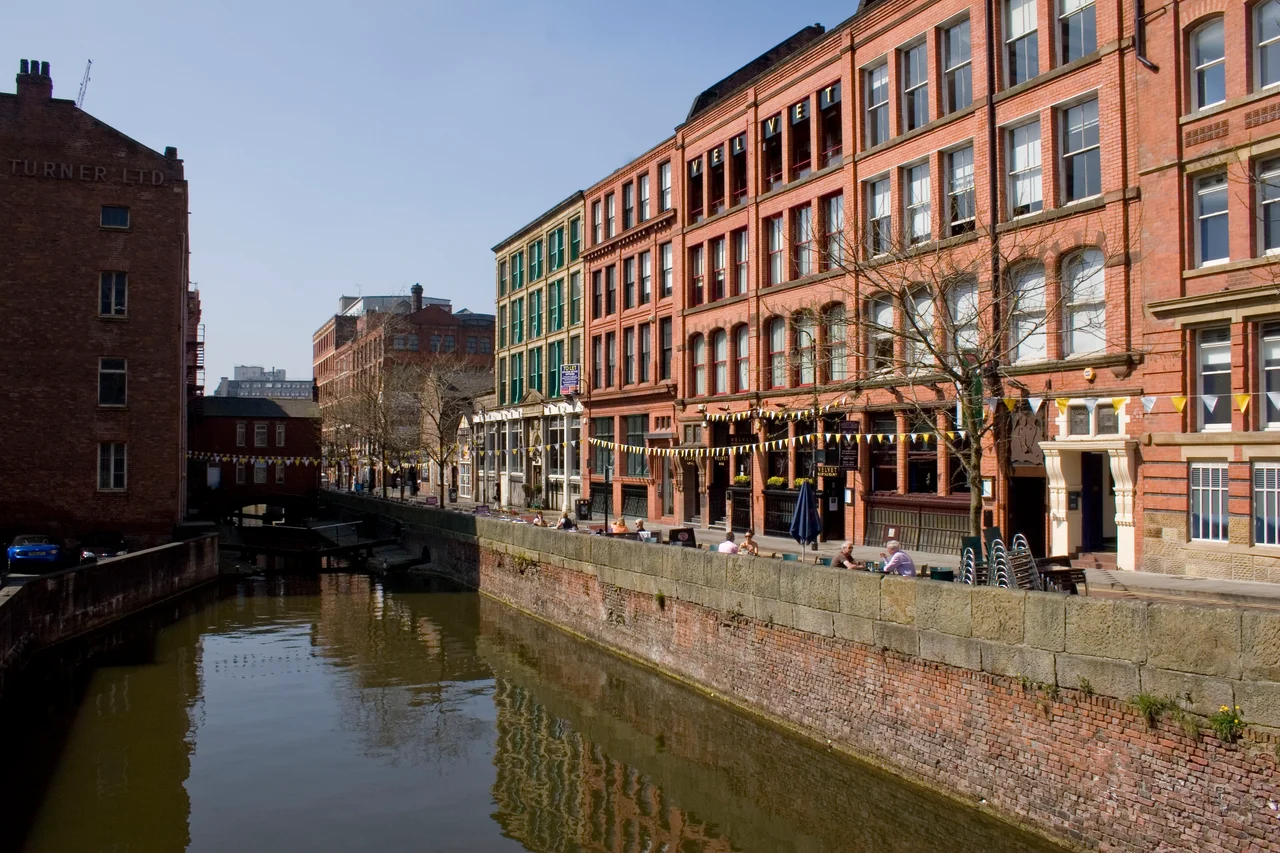

Canal Street (Manchester)
"We had no homeland, no part of the city. We needed somewhere... We willed the village into existence." That was Ian Wilmott, a gay Labour councillor, speaking about the late 1980s, when Section 28 was making its way onto the statute book and Manchester's Chief Constable, James Anderton, was publicly accusing gay people of swirling in a cesspit of their own making. Canal Street, then a strip of disused warehouses beside the Rochdale Canal, became the place a community refused to be told it could not exist. Today it is the centre of one of Europe's most established gay villages - though, as residents will quickly tell you, it is more complicated than the postcard.
Industrial Backwater to Meeting Place
The street took its present shape when the Rochdale Canal was cut through Manchester in 1804, a trade artery for coal and cotton. Pubs and small businesses grew up along the canal to serve the boatmen working the locks. By the 1950s the canal was almost dead - lorries had taken its trade - and the surrounding area, full of disused cotton warehouses, was a red-light district by night. The very things that made the area dangerous made it useful for gay men looking for somewhere to meet at a time when the law itself made meeting a crime. The canal was dark. The streets were unwatched. Oxford Road and Piccadilly stations were a short walk away. People came. They came at risk. The shadows that protected them also let in the predators who knew they could find isolated victims with no recourse to police.
Plate Glass and Defiance
What changed the street was the deliberate decision, in the late 1980s, to stop hiding. Carol Ainscow, a gay property developer, and her business partner Peter Dalton bought a garage repair building on Canal Street and turned it into a bar with large plate-glass windows facing the street - the first in the area to do so. "I felt sick of having to knock on doors and hide," Ainscow said. The visibility was the point. As Section 28 was passed in 1988, banning local authorities from "promoting" homosexuality, hundreds of people came together in opposition, and Manchester City Council leaned in: it bought Sackville Street Gardens in 1990, supported what would become Manchester Pride, and eventually became the first UK council to support civil partnerships. New bars opened along the canal - Via Fossa, Velvet, Eden, AXM. By the late 1990s Canal Street was the heart of what was widely called the most successful gay village in Europe.
Queer as Folk to Hen Parties
The 1999 television series Queer as Folk brought Canal Street to a wider audience. Russell T Davies set the show here; the city's image as Britain's queer capital was fixed for a generation. But popularity brought its own problems. By the early 2010s campaigners were arguing about whether the village remained meaningfully gay. Hen parties from across the north of England were turning up for cheap drinks and the perceived novelty. Door policies tightened, sometimes turning away LGBT people they were meant to welcome. In 2013 Simon Brass, a gay man, was thrown into the canal by a gang of muggers and left to drown. In 2015, Peter Tatchell warned that to de-gay Canal Street would be a backward step: "As a society the need for specific gay districts may decline but we are not there yet." The closure of Manto, one of the founding bars, after twenty-two years on the street, felt to many like the end of an era.
The Village at a Crossroads
By the late 2010s, 800 upmarket homes were planned for development overlooking Canal Street, and bar owners feared a future of noise complaints from new residents who had moved into a famously loud street and then been startled to discover it was loud. Critics noted a "lack of consultation" and developer documents calling the area "Portland Village" rather than its actual name. In 2020 Manchester City Council launched a strategic review, and in 2024 it released Manchester's Gay Village Action Plan, written with consultancy HATCH, which committed to maintaining, preserving, and improving the LGBT quarter through ongoing collaboration with the community. Whether that is enough to keep the village from being smoothed into a generic nightlife strip remains to be seen. The people who built it know what they built, and why. Their work is not finished.
From the Air
Located at 53.4778 degrees north, 2.2356 degrees west, in central Manchester, immediately east of Princess Street and west of Sackville Gardens. Canal Street runs along the west bank of the Rochdale Canal in a tight rectangle bounded by Minshull Street to the north and Princess Street to the south. The Beetham Tower (47 storeys) is a useful landmark visible from far up the M62. Manchester Airport (EGCC) lies 8 miles south. The Pennines rise to the east. Recommended viewing altitude is 2,000 to 3,500 feet AGL given Manchester's busy controlled airspace; check Manchester CTR boundaries.
Nearby Stories
- National Science and Media Museum 0.2 km away
- Jodrell Bank Observatory 3.2 km away
- Siege of Lathom House 5.6 km away
- Chester Zoo 6.2 km away
- Whalley Abbey 8.9 km away
- Haddon Hall 10 km away
- Wentworth Castle 16 km away
- Blackpool 16 km away