
Carlisle Cathedral
Walk in through the south door at Carlisle and the building does something disorienting. The nave is too short. It runs only two bays before it stops, as if the architect lost interest halfway. The reason is sitting in the walls of the castle half a mile away. In 1646, during the English Civil War, the Scottish Presbyterian Army occupying Carlisle pulled down most of the cathedral's nave and carted the stone off to reinforce Carlisle Castle. The truncation is permanent. What you see now is what survived - the squat Norman south transept, two bays of nave used as the Chapel of the Border Regiment, and beyond it a choir crowned by the largest window in the Flowing Decorated Gothic style anywhere in England.
An Augustinian Foundation
Carlisle was begun in 1122, during the reign of Henry I of England, as a community of Canons Regular following the strict reformed rule of the Abbey of Arrouaise in France. Most English cathedral monasteries were Benedictine. Carlisle is one of only four in the country to have been Augustinian. The first prior was Athelwold, an Englishman, and when the church was raised to cathedral status in 1133 - on the creation of the new Diocese of Carlisle - he became its first bishop. He held the office until 1155. A hundred years later, in 1233, the cathedral community was joined by a Dominican friary and a Franciscan friary, both founded close by; the medieval city was a layered religious complex by the time Edward I held court here in 1307. The cathedral was already being refurbished by then in the new Gothic styles, and would go on being refurbished, restored and patched for the next seven hundred years.
A Window the Size of a Wall
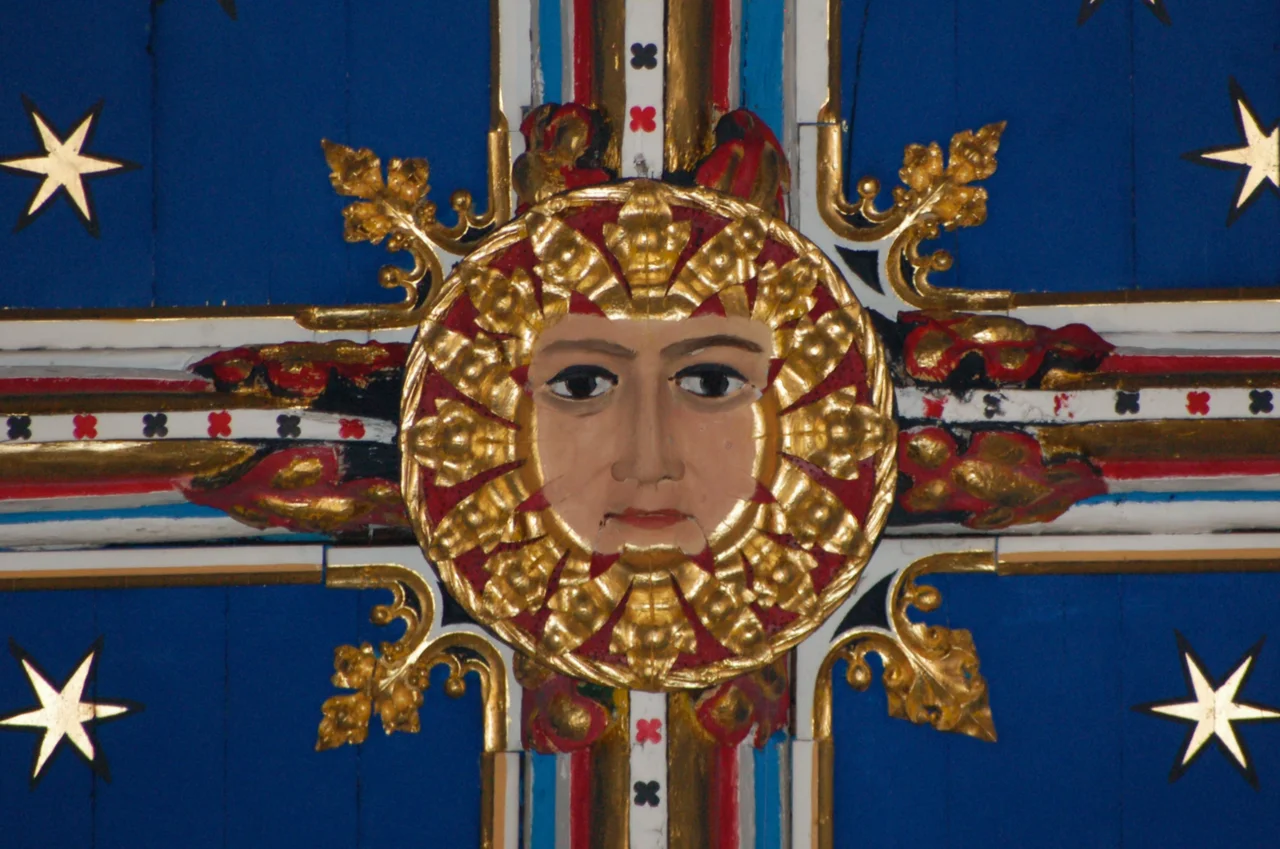
The east window is the cathedral's prize. It fills the end wall of the choir with stone tracery curving in the Flowing Decorated style of the early fourteenth century - large lights at the bottom, smaller subdivisions branching outward, the whole composition unfolding like a frost crystal. It is the largest such window in England. Much of the tracery still holds original medieval glass; the brighter scenes in the main lights are nineteenth-century Victorian replacements. Above your head as you stand below it, a fourteenth-century wooden barrel ceiling arcs over the choir, restored and repainted in 1856 to a new design by Owen Jones, the great Victorian colourist. The misericords on the choir stalls - carved tip-up seats made of black oak, designed to give weary canons a discreet rest during long offices - show scenes of St Anthony the Hermit, St Cuthbert, St Augustine, the twelve apostles, and a robust selection of bestiary creatures. Some of the canopy pillars are scorched. Monks who fell asleep during the night offices, the guidebooks say, dropped their candles.
A Civil War Wound
The smallness of Carlisle as a cathedral - second only to Oxford among England's ancient cathedrals - is partly historical accident. It was never as rich as Durham or Lincoln. But the brutal abbreviation of the nave is specific damage from a specific war. The cathedral served two functions for centuries: it was the seat of the Bishop of Carlisle, and it was the parish church for Carlisle St Mary's, a parish covering part of the city and a wide stretch of the country beyond. When the Scottish army took the stone in 1646, the parish congregation kept using what was left of the nave as their parish church anyway. The claustral buildings around the cloister - the western range that held the stores - vanished in the same demolition. The fratry (the canons' refectory), the gatehouse of 1527, the Prior's Tower and the deanery all survive as Grade I or Grade II* listed remnants of the lost priory. A new extension by the architects Feilden Fowles was begun in 2019; the cathedral continues to add to itself.
Music in Black Oak
Music has been part of Carlisle since the foundation. The Choir was set up in 1133 with four laymen and six boy choristers helping the canons; the 1545 Cathedral Statutes asked for four lay clerks and six choristers, the boys to be 'of tender age with sonorous voices and apt at chanting.' The present choir has sixteen choristers and six lay clerks, and since the closure of the cathedral's Choir School in 1935 the children have been drawn from local schools instead. There is now also a choir of sixteen girl choristers, who alternate with the boys to sing Evensong daily except Saturday and Choral Eucharist on Sundays. The present organ was built by Henry Willis in 1856 - innovative for its date - and then extended in 1875 to take 32-foot pipes, again in 1906 by Harrison and Harrison, repositioned in 1930, classicised in 1962 by J. W. Walker & Sons, and finally restored toward its original Victorian tone by David Wells in 1997. Four manuals, seventy-two stops. Notable organists have included Sir Sydney Nicholson, founder of the Royal School of Church Music. Buried in the cathedral are bishops back to Robert de Chauncy in 1278; outside, a Sir Robert Lorimer memorial from 1916 commemorates the men of the Border Regiment who did not come home from the First World War.
From the Air
Carlisle Cathedral sits at 54.89 degrees north, 2.94 degrees west, in the centre of Carlisle just south of Carlisle Castle and within the line of the old city walls. From altitude the cathedral and castle together form a tight, easily-spotted pair on the north-west side of the city, where the Caldew joins the Eden. Carlisle Lake District Airport (EGNC) is about 5 nautical miles east; Newcastle (EGNT) lies roughly 50 nm east, Glasgow Prestwick (EGPK) about 60 nm north-west. Best photographed from low altitude on a clear winter morning when the red sandstone glows and the cathedral's stubby nave and tall choir reveal their unusual proportions.
Nearby Stories
- Workington Lifeboat Station 3.8 km away
- Caerlaverock Castle 4.9 km away
- Once Brewed 9.1 km away
- Castlerigg Stone Circle 10 km away
- Morton Castle 17 km away
- Battle of Otterburn 18 km away
- Brough, Cumbria 18 km away
- Kielder Observatory 24 km away