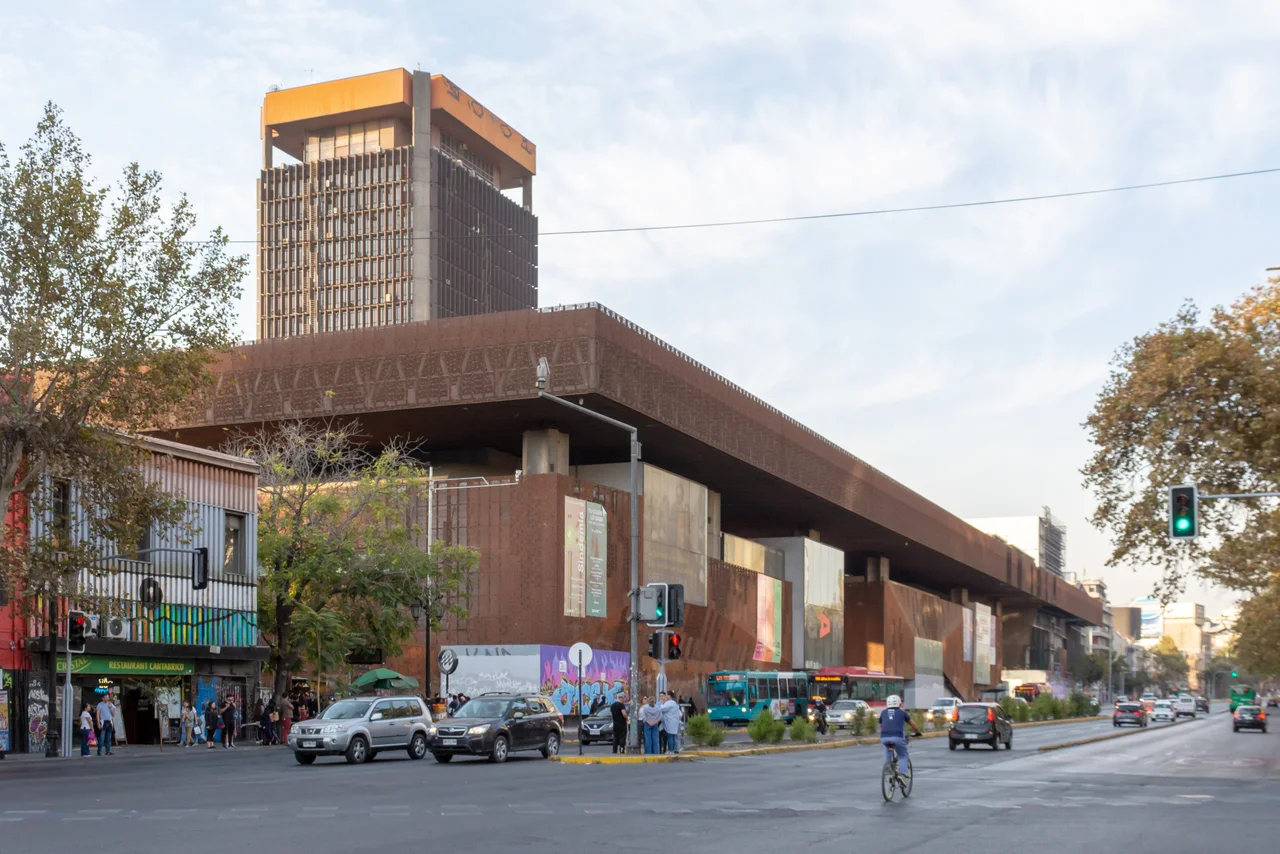

Centro Cultural Gabriela Mistral
Few buildings in Santiago have lived as many lives as this one. It went up in 275 days, raised by thousands of volunteers who poured concrete in shifts around the clock. It hosted a global summit, then a parade of artists, then the machinery of a dictatorship that ran the country from its offices. It burned. And then, against the odds, it became what its first builders had imagined - a house for music, dance, and theater open to anyone who walks in off the Alameda. The Centro Cultural Gabriela Mistral, known to everyone in Santiago simply as the GAM, wears all of those lives at once.
Built Against the Clock
In 1972, Chile won the right to host the third United Nations Conference on Trade and Development - UNCTAD III - and needed somewhere to put it. The government of Salvador Allende decided to build a convention center and a 22-story tower from nothing, and to do it fast. What followed became national legend. Construction crews and several thousand volunteers worked in relays, and the complex rose in just 275 days. When it opened, the cultural wing was named for Gabriela Mistral, the Chilean poet who in 1945 had become the first Latin American to win the Nobel Prize in Literature. The inaugural celebration spilled onto the Alameda outside, where the folk group Quilapayun played to the crowd. For a brief season, the building was exactly what it claimed to be: a gathering place.
The Building the Junta Took
That season ended on 11 September 1973, when the military overthrew Allende's government. The junta closed the cultural center and moved in. Renamed the Diego Portales Building after a 19th-century statesman, the complex became the seat of the regime's power - the place where decrees were drafted and the country was governed by men who had taken it by force. For more than a decade, a building conceived as an open house for the arts operated instead as a fortress of authority. The irony was not lost on the city around it. When democracy returned at the end of the dictatorship, the tower became the headquarters of the Ministry of National Defense, and the structure kept its grey, official weight - a building most Santiaguinos walked past without ever being allowed inside.
Fire and Resurrection
In early 2006, a fire tore through parts of the building. Rather than simply repair the damage, the government of Michelle Bachelet asked a harder question - what was this place actually for? The answer was to give it back. Architects rebuilt roughly 22,000 square meters with a new philosophy of transparency, opening the structure to the street with glass and light where the dictatorship had favored concrete and control. In September 2010 it reopened, rechristened the Centro Cultural Gabriela Mistral. The renaming was deliberate. By reaching past the dictatorship's name to the one its first builders had chosen, the city reclaimed the building's original purpose and the volunteers' original hope.
What Lives There Now
Today the GAM is one of Santiago's busiest cultural hubs, programming contemporary theater, dance, and music alongside rotating visual arts. Skateboarders carve across its plazas, students sprawl on its steps, and exhibitions fill halls that once held a dictatorship's offices. The weathered Cor-Ten steel of the original UNCTAD structure still stands beside the lighter additions, so that the building reads almost as a timeline you can walk through - utopian ambition, authoritarian seizure, fire, and recovery, all legible in a single facade. The volunteers who once worked through the night to raise it could not have foreseen the decades of seizure and silence that followed, but the building they imagined eventually won out. For a country that has spent decades reckoning with its own past, few addresses say more in fewer words.
From the Air
The GAM sits in central Santiago at roughly 33.44 degrees south, 70.64 degrees west, fronting the Avenida Libertador Bernardo O'Higgins - the broad east-west boulevard locals call the Alameda - a short distance east of Cerro Santa Lucia. Santiago lies in a basin ringed by the Andes, whose snow-capped wall to the east is the dominant visual landmark on a clear day. The nearest major airport is Comodoro Arturo Merino Benitez International (SCEL), about 15 km northwest of the city center; the smaller Eulogio Sanchez airfield (SCTB) in La Reina sits to the east. Smog frequently pools in the basin in winter, cutting visibility, so the cleanest views of the city grid and the surrounding mountains come after rain or wind clears the air.
Nearby Stories
- Paine Memorial 21 km away
- 1947 BSAA Avro Lancastrian Star Dust accident 23 km away
- Battle of Chacabuco 31 km away
- La Campana National Park 36 km away
- Puente del Inca 44 km away
- Casa de Isla Negra 62 km away
- Santa Cruz, Chile 103 km away
- Pierre Auger Observatory 172 km away