
Chetham's Library
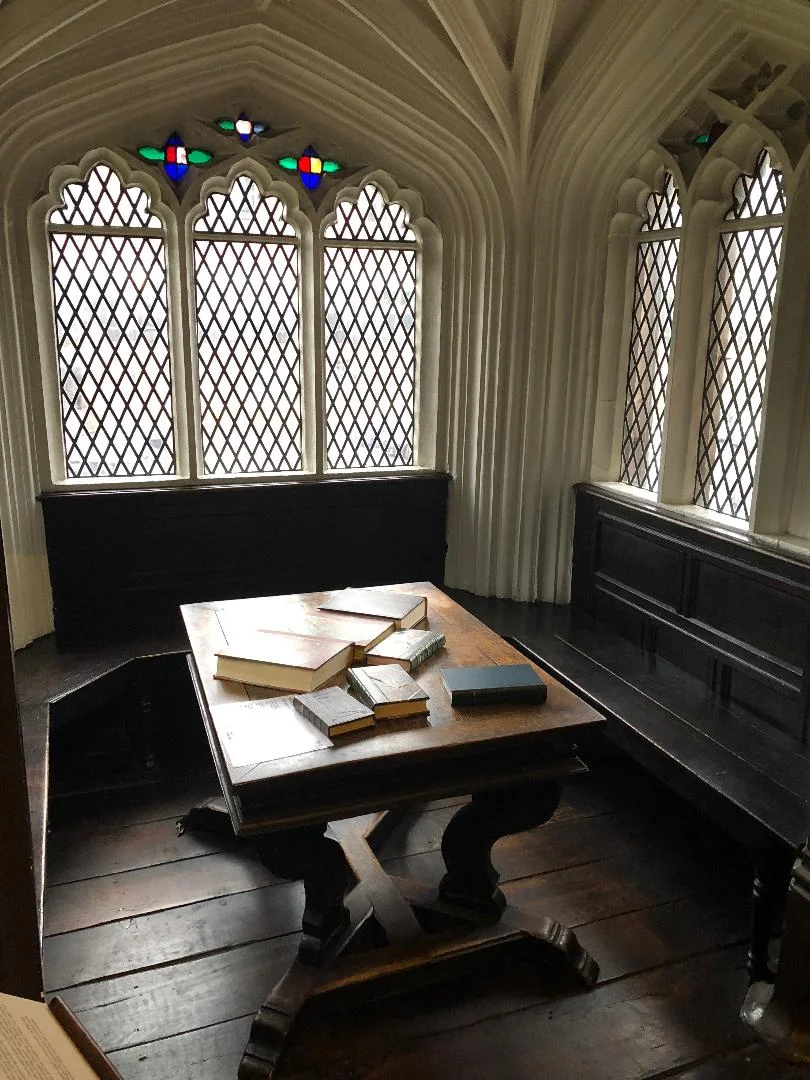
There is a window seat in a fifteenth-century sandstone building near Manchester Cathedral where Karl Marx and Friedrich Engels worked together in the summer of 1845, reading economic and political texts and arguing through the foundations of what would become The Communist Manifesto three years later. The table they used is still there. So are most of the books Engels was reading. Chetham's Library, founded in 1653 under the will of cloth merchant Humphrey Chetham, is the oldest free public reference library in the English-speaking world - and one of the strangest survivals in Britain, a medieval manor house repurposed as a Puritan charity school that quietly preserved itself through every revolution since.
Manor House to College to Library
The site began as the manor house of Manchester, sitting on a sandstone bluff at the confluence of the Irwell and the Irk. In 1421 Thomas de la Warre, lord of the manor and rector of the parish church, obtained a licence from Henry V to refound the church as a collegiate foundation and donated his manor house as accommodation for the warden, eight fellows, four clerks, and six choristers. Manchester Free Grammar School was built between the church and the college between 1515 and 1518. Henry VIII's Reformation dissolved the college in 1547. Queen Mary refounded it briefly as Catholic; Queen Elizabeth dissolved it again. In the English Civil War the buildings became a prison and arsenal. By 1653 the college sat empty when Humphrey Chetham's executors bought it with his bequest, intending it to be both a free library and a blue coat charity school for poor boys.
Humphrey's Instruction
Chetham (1580 to 1653) had made a Lancashire fortune in cloth and money-lending. His will of 1651 stipulated that the library should be "for the use of schollars and others well affected" - meaning anyone seriously interested - and instructed the librarian "to require nothing of any man that cometh into the library." Free admission, in 1653, for everyone. No subscription, no test of class, no entry charge. The twenty-four feoffees Chetham appointed set out to build a collection that would cover the whole range of available knowledge and rival the college libraries of Oxford and Cambridge. Three hundred and seventy years later the library holds more than 100,000 printed volumes, 60,000 of them published before 1851, including a copy of the Nuremberg Chronicle annotated by Thomas Gudlawe in the late fifteenth century. Over a thousand manuscripts include forty-one medieval texts.
Marx and Engels at the Window
When Friedrich Engels moved to Manchester in 1842 to work for his father's textile firm, he found a city already groaning under the conditions that would produce his Condition of the Working Class in England, published in 1845. He researched much of it at Chetham's. When Karl Marx visited Manchester in the summer of 1845, the two friends used the library's resources together. The alcove window where they worked is a quiet corner overlooking the gardens. The books they consulted - Engels was particularly interested in agricultural statistics, English economics, Wakefield on colonization - are mostly still on the shelves. It is one of those moments where world history happened to pass through a small English provincial library and politely sit down at a table, and the library, recognising none of the importance, simply kept on doing what it had always done: lending books to whoever showed up.
Music School Above, Library Below
Alfred Waterhouse extended the buildings in 1878. J. Medland Taylor added more between 1883 and 1895. Manchester Grammar School moved to Fallowfield in the 1930s, leaving its old block half-empty, and after wartime bomb damage destroyed parts of the medieval complex, the remaining buildings became Chetham's School of Music in 1969 - now one of the leading specialist music schools in Britain. The library itself sits inside the same Grade I listed building. Walk through the gateway from Long Millgate, past students carrying cellos, and you find a reading room of fifteenth-century timber and seventeenth-century oak panelling, where the catalogue still uses paper slips and the librarian will quietly hand you a book that was annotated by a fifteenth-century German printer or read by Engels in 1844. The window seat is unmarked. You only know it is the right one if someone tells you.
From the Air
Located at 53.4867 degrees north, 2.2442 degrees west, in central Manchester immediately north of Manchester Cathedral and Manchester Victoria railway station. The medieval sandstone buildings are clustered around an inner courtyard on Long Millgate. The Cathedral spire and Victoria station's distinctive curved roof are useful landmarks. Beetham Tower (47 storeys) lies 0.5 miles south-west. Manchester Airport (EGCC) is 9 miles south. Manchester City Airport (Barton, EGCB) is 6 miles west. Recommended viewing altitude is 2,000 to 3,500 feet AGL given busy controlled airspace; check Manchester CTR boundaries.
Nearby Stories
- National Science and Media Museum 0.2 km away
- Jodrell Bank Observatory 3.2 km away
- Siege of Lathom House 5.6 km away
- Chester Zoo 6.2 km away
- Whalley Abbey 8.9 km away
- Haddon Hall 10 km away
- Wentworth Castle 16 km away
- Blackpool 16 km away