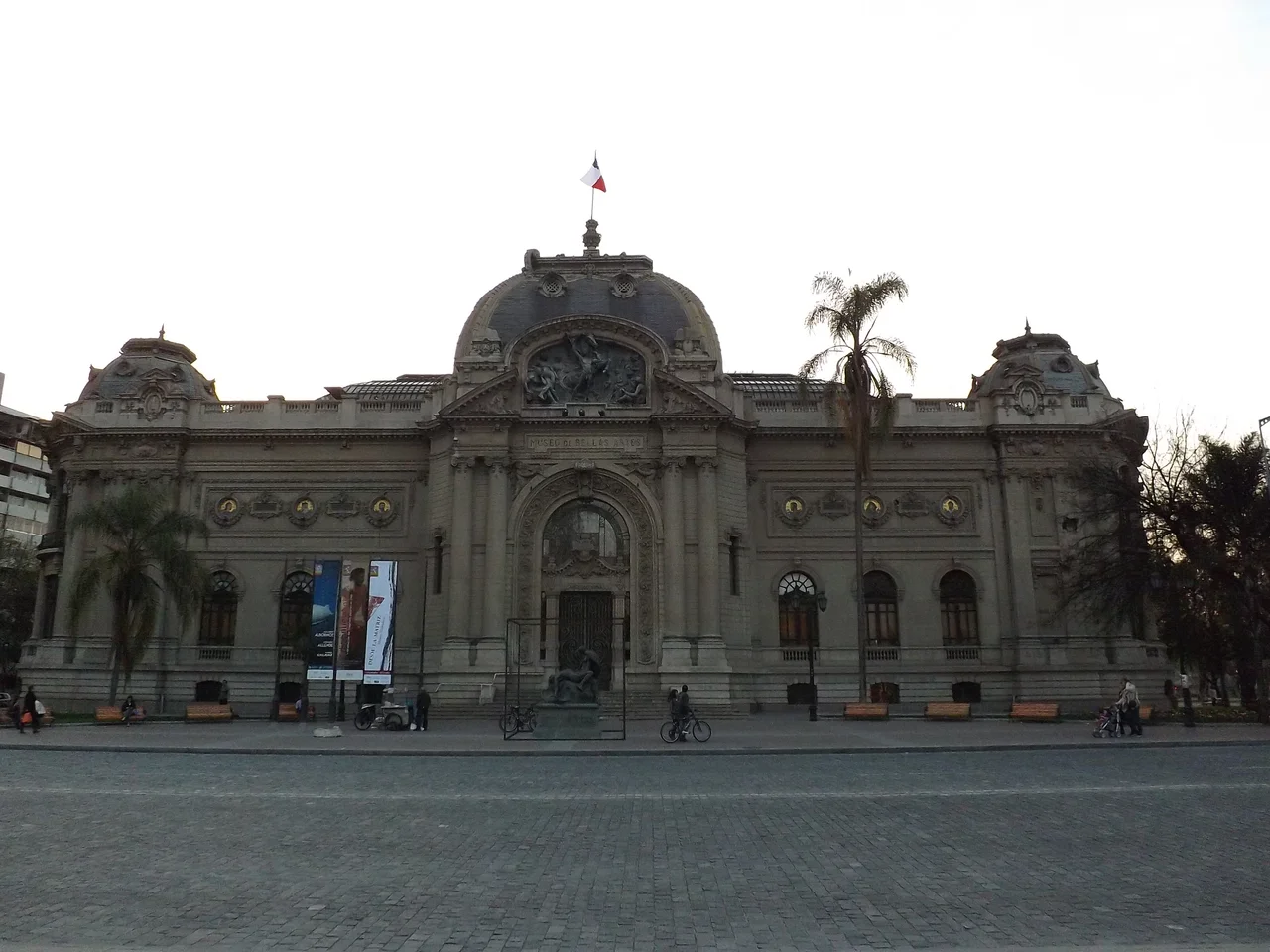

Chilean National Museum of Fine Arts
Step into the central hall and look up. Nearly two and a half tons of glass arch overhead, a vast dome that floods the gallery floor with daylight and lets the weather become part of the building. On a bright Santiago morning the marble glows; under cloud it turns silver. The cupola was designed and built in Belgium, then shipped across the Atlantic and around Cape Horn to reach Chile in 1907, three years before this palace opened its doors. It still does exactly what its makers intended - it makes the act of looking at art feel like standing inside the light itself.
The Oldest of Its Kind
The Museo Nacional de Bellas Artes was founded on 18 September 1880 as the Museo Nacional de Pinturas - the National Painting Museum - making it the oldest art museum in South America. Its creation was a deliberate act of nation-building. President Anibal Pinto, the minister Manuel Garcia de la Huerta, the soldier Marcos Segundo Maturana, and the sculptor Jose Miguel Blanco worked together to establish it, and the painter Juan Mochi became its first director. For its first years the collection moved between borrowed spaces, including a building nicknamed 'the Parthenon' that the Artistic Union had raised for its annual exhibitions. A young republic was deciding that art belonged at the center of its identity, and it built the institutions to prove it.
A Palace for a Centennial
In 1901 the government resolved to give the museum a home worthy of the collection, and chose the Chilean architect Emile Jequier to design it. The result, the Palacio de Bellas Artes, opened on 21 September 1910 as part of the International Exposition marking 100 years of Chilean independence. Jequier looked to Paris - the layout and facade echo the Petit Palais, and the grand central entrance borrows a famous trick of false perspective from Borromini's work at Rome's Palazzo Barberini. The style blends Neoclassical and Second Empire forms with Baroque Revival flourishes and Art Nouveau detail, the whole thing held together by an iron-and-glass skeleton weighing some 115,000 kilograms. It was, and remains, one of the most ambitious buildings the city had ever raised.
Reading the Stone
The building rewards slow attention. The floor plan turns on a single axis - you enter on a central line, climb a grand staircase, and the whole composition unfolds symmetrically around you. High in the great hall, two carved angels hold a shield above a balcony, rising from a pair of caryatids sculpted by the Catalan artist Antonio Coll y Pi. The palace sits in the Parque Forestal, a green ribbon laid out by Jorge Enrique Dubois, who had trained in the gardening school of Versailles - so the approach through the trees was composed as carefully as the facade. Directly behind the museum stands the Museum of Contemporary Art of the University of Chile, sharing the same monumental structure.
Surviving the Ground Itself
Chile is one of the most seismically active countries on Earth, and the museum has felt it. The great earthquake of 1960 - the most powerful ever recorded anywhere, at magnitude 9.5 - damaged the building. In the rebuilding, engineers seismically upgraded the structure, and that decision paid off half a century later. When the magnitude 8.8 earthquake struck central Chile in 2010, the palace held: the damage was confined to fallen ornamental elements on the exterior, while the galleries and the great glass dome came through intact. The museum has stood in its 'Palace' ever since 1910, gathering Chilean and South American art under that imported Belgian sky.
From the Air
The museum sits in central Santiago at roughly 33.44 degrees south, 70.64 degrees west, set within the green band of the Parque Forestal along the Mapocho River, just north of the historic core. Santiago fills a basin enclosed by the Andes, whose snow line to the east is the clearest navigational landmark. The nearest major airport is Comodoro Arturo Merino Benitez International (SCEL), roughly 15 km to the northwest. Winter brings smog that settles in the basin and reduces visibility; the sharpest views over the city and the surrounding cordillera follow rain or strong wind. From above, the long rectangular palace and the dark ribbon of riverside parkland help orient you within the dense downtown grid.
Nearby Stories
- Paine Memorial 21 km away
- 1947 BSAA Avro Lancastrian Star Dust accident 23 km away
- Battle of Chacabuco 31 km away
- La Campana National Park 36 km away
- Puente del Inca 44 km away
- Casa de Isla Negra 62 km away
- Santa Cruz, Chile 103 km away
- Pierre Auger Observatory 172 km away