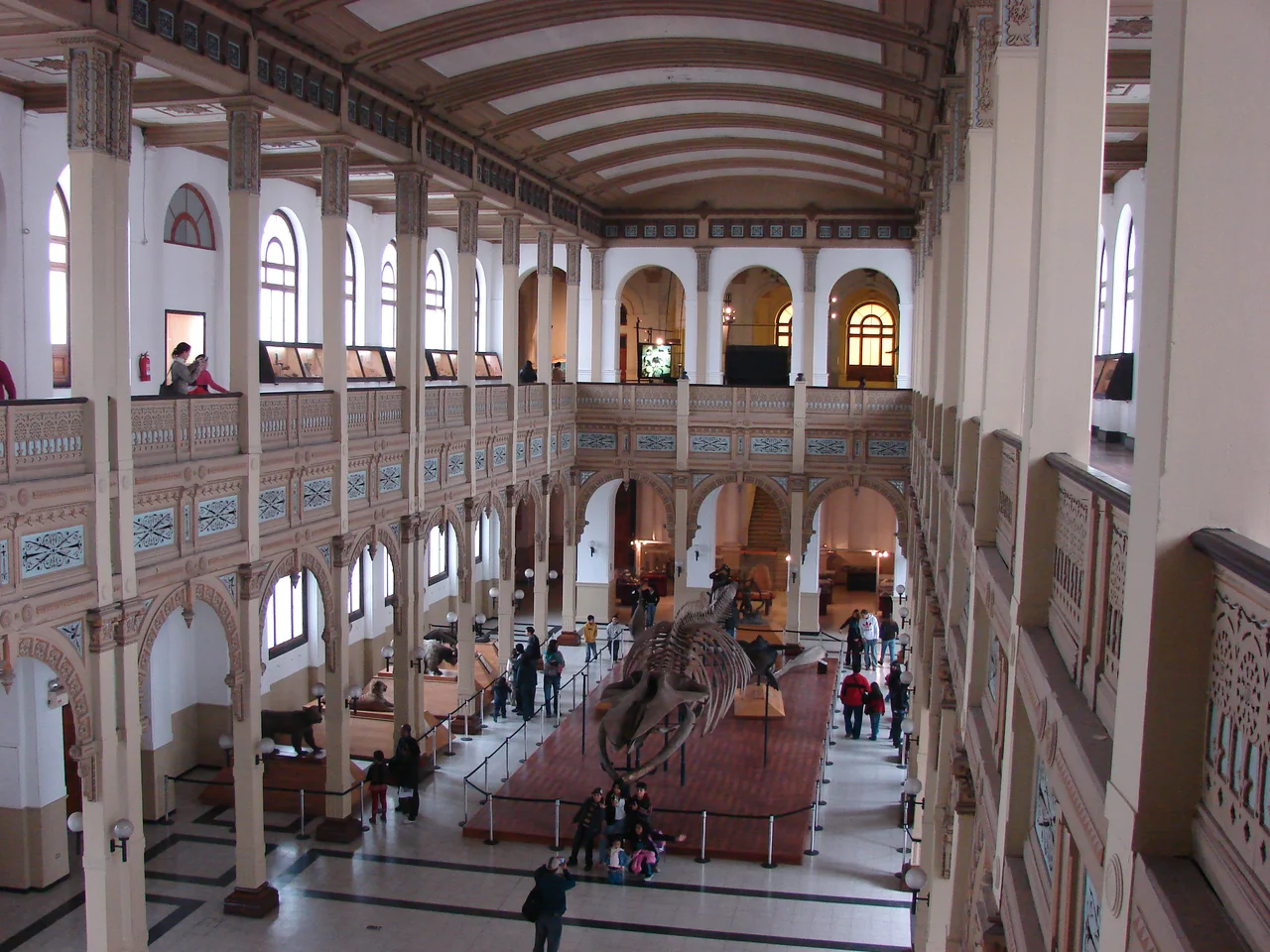

Chilean National Museum of Natural History
In 1939, a young Austrian woman named Grete Mostny stepped off a ship in a country she had never seen, carrying a doctorate, a few belongings, and the knowledge that the laws of her homeland now classified her as an enemy. She had fled the Nazi regime because her mother's family was Jewish. Fifteen years later, she would take charge of the very mummy that has become the heart of this museum, and eventually she would run the whole institution. The Chilean National Museum of Natural History gathered her in as it has gathered so much else: the strange, the displaced, the irreplaceable.
A Palace Built for a Single Year
The building was never meant to be a museum. It rose in 1875 as a grand pavilion for the Chilean International Exhibition, a temporary showcase of a young republic eager to prove itself to the world. The exhibition ended, the crowds left, and the palace remained, standing in the green expanse of Quinta Normal Park. The museum itself was older still, founded in 1830 by the French naturalist Claudio Gay, who had been hired by the Chilean government to catalogue the biology and geography of a nation still defining its own borders. It is the oldest natural history museum in South America, and it wears that age openly. Earthquakes in 1906 and 1927 cracked its walls. The great quake of 2010 closed it entirely until 2012, and even now the second floor waits for repairs the first floor long ago received.
The Whale in the Hall
Walk through the entrance and the scale announces itself immediately. Suspended in the Central Hall hangs the skeleton of a sei whale, seventeen meters of pale bone arcing overhead like the ribs of an upturned ship. Beyond it, the collections fan out across disciplines and continents. There are minerals from the nitrate boom that once made the Atacama the richest desert on Earth, fossil dragonflies with wingspans no living insect can match, and a Carnotaurus, the horned predator that hunted across Cretaceous Patagonia. There is Chilean timber, Easter Island artifacts, and the finest public collection of rongorongo in existence, the undeciphered glyphs of the Rapanui that no living person can read. The museum holds the threads of a continent's deep time, and it does not arrange them gently.
The Boy Who Climbed to the Sky
In February 1954, climbers on Cerro El Plomo, a peak rising above Santiago, found a child seated in the snow at 5,400 meters. He was an Inca boy, roughly eight years old, his hair plaited into more than two hundred small braids, his face painted in red and ochre stripes. Five centuries of cold and dry mountain air had preserved him almost perfectly. He had been part of a capacocha ceremony, carried on a pilgrimage of hundreds of kilometers and left on the summit as an offering, sedated with chicha and coca before the end. When the find reached the museum, it was Grete Mostny who secured it. The original now rests in a climate-controlled room, hidden from view since 1982 to protect him; a replica stands in his place. He is treated not as a specimen but as what he was: a child, given to a mountain by people who believed the mountains were holy.
Older Than the Pharaohs
Elsewhere in the collection lie the oldest deliberately preserved human bodies on Earth. The Chinchorro people of Chile's northern coast began mummifying their dead around seven thousand years ago, some two thousand years before anyone in Egypt thought to do the same. They removed organs and flesh, rebuilt the bodies with clay, reeds, and animal hair, and painted them. They did this for adults, but also, strikingly often, for infants and unborn children. In late 2016, researchers passed fifteen of these mummies, women and children, through CAT scanners, hoping the layers of preparation might reveal how a fishing culture on the edge of the world's driest desert came to grieve so elaborately. These were not curiosities. They were people whose families could not bear to let them simply vanish.
What the Museum Keeps
Behind the public halls lies the quieter, more painstaking work that defines any great collection. The herbarium holds 3,700 plant species, ninety percent of the type specimens for Chilean flora, the reference points against which all later identifications are measured. Human remains are stored individually, each on its own ventilated support, each catalogued with a care that treats the dead as the dignified responsibility they are. Grete Mostny, who chose Chilean citizenship in 1946 rather than return to a Europe that had tried to erase her, eventually directed this entire institution and died in Santiago in 1991. The museum she helped shape still does what it has done for nearly two centuries: it holds what would otherwise be lost, and it holds it well.
From the Air
The museum sits in Quinta Normal Park at 33.44°S, 70.68°W, in the western reaches of central Santiago. Look for the large green rectangle of the park amid the dense urban grid, with the neoclassical pavilion at its eastern edge. The Andes rise sharply to the east, and Cerro El Plomo, where the Inca child was found, is visible on clear days at roughly 5,400 meters. Santiago sits in a basin around 520 meters elevation, frequently capped by haze in winter; a recommended viewing altitude of 4,000 to 6,000 feet AGL gives a clear read of the park against the city. Nearest major airport is Comodoro Arturo Merino Benítez International (SCEL), about 12 nautical miles to the northwest. Smaller traffic uses Eulogio Sánchez (SCTB) to the southeast.
Nearby Stories
- Paine Memorial 14 km away
- Viña del Mar International Song Festival 28 km away
- Battle of Chacabuco 29 km away
- Cerro El Plomo 30 km away
- Casa de Isla Negra 30 km away
- Paso Internacional Los Libertadores 49 km away
- Pichilemu 92 km away
- Uruguayan Air Force Flight 571 113 km away