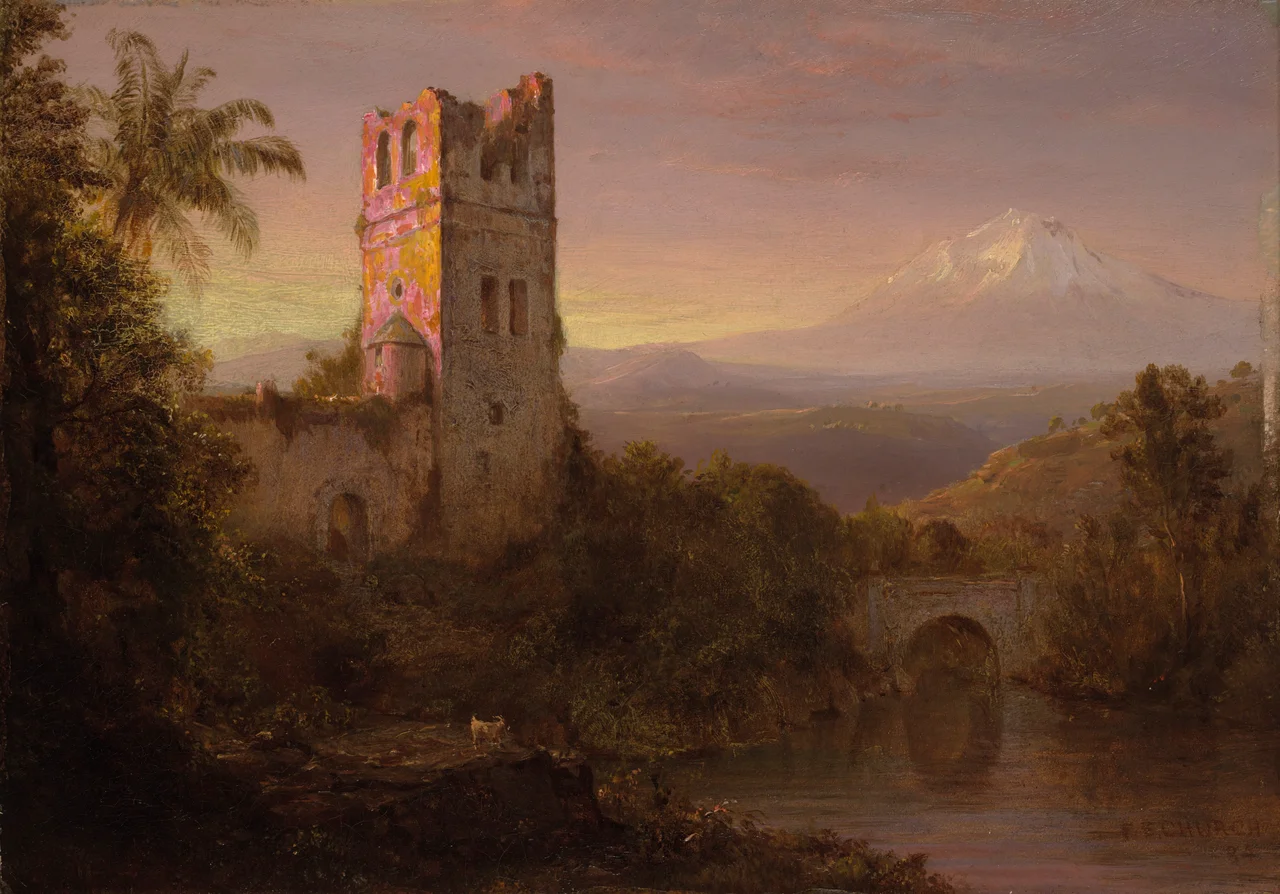

Chimborazo
The Earth is not a sphere. It bulges at the equator and flattens at the poles - an oblate spheroid rather than a globe - and the bulge is substantial enough to change what 'highest' actually means. Measured from sea level, Mount Everest wins by 2,585 meters. Measured from the actual center of the Earth, Chimborazo wins by 2.1 kilometers. The summit of this Ecuadorian volcano, sitting one degree south of the equator, reaches 6,384.4 kilometers from the planet's core. Everest, much farther north and much higher above sea level, reaches only 6,382.3. It is the closest place in the world to outer space that your feet can stand on - and because the equatorial bulge also reduces gravity slightly, it is about one percent easier to jump there than at the poles.
What the Bulge Does
The Earth's shape is the consequence of its own spin. Over billions of years, rotation has thrown the equatorial regions outward by about 21 kilometers more than the poles. Chimborazo sits at 1.5 degrees south - essentially on the bulge - while Everest sits near 28 degrees north where the bulge is much reduced. Despite being 2,585 meters lower in elevation above sea level, Chimborazo's summit is 2.1 kilometers farther from the center of the Earth than Everest's. It is, in that specific and technical sense, the highest point on the planet. The Peruvian peak Huascaran, nearby and slightly farther from the equator, comes in a very close second. Because centrifugal force and distance from center both reduce gravity, Chimborazo's summit actually has about 1 percent less gravitational pull than the poles - though because Huascaran rises steeply above its surroundings with local gravity anomalies in its favor, Huascaran's summit is technically the place on Earth with the smallest gravitational force.
A Volcano Stacked on a Volcano
Geologically, Chimborazo is a double stratovolcano - one volcanic edifice built on top of another - and it shows four distinct summits. The highest is the Whymper summit at 6,263 meters, named for the English climber who reached it first. Next is Veintimilla at about 6,234 meters. Politecnica rises to 5,820. The fourth, Nicolas Martinez at 5,570 meters, was named for the father of Ecuadorian mountaineering. The volcano is currently inactive, its most recent eruption estimated at around AD 550. It is ice-capped year-round, though the glacier cover is retreating rapidly. The mountain is featured on the Ecuadorian coat of arms, where it stands for the beauty and richness of the Ecuadorian Sierra - a symbolism the country has never thought to update.
The Climbers and the Ice
The story of climbing Chimborazo runs through three centuries. In 1802, Alexander von Humboldt attempted to climb the peak with Aime Bonpland and Carlos Montufar. They suffered altitude sickness badly and turned back at an estimated 5,875 meters - at the time, the highest elevation any European had documented. Incas had reached higher points on other Andean mountains long before, as the frozen bodies at Llullaillaco would eventually prove. In 1831, Jean-Baptiste Boussingault and Colonel Hall pushed to approximately 6,006 meters. And on January 4, 1880, Edward Whymper - the Matterhorn pioneer - became the first to stand on the true summit, together with his Italian guides the Carrel cousins. Many critics doubted him, so Whymper climbed Chimborazo a second time later the same year by a different route, the Pogyos, with Ecuadorians David Beltran and Francisco Campana. On the mountain's eastern Integral route, high up at 5,310 meters, climbers in 2003 discovered the wreck of a Saeta Air Ecuador Vickers Viscount that had vanished with 59 people aboard in 1976.
The Hieleros of Chimborazo
For centuries, local men climbed Chimborazo's ice field to mine ice. They were called hieleros - from the Spanish hielo, meaning ice - and their route took them up to high camps where they would cut blocks from the glacier with simple tools, wrap them in dry paramo grass, and carry them down the mountain on the backs of mules. The ice went to the markets of Guaranda and Riobamba. In earlier centuries, it traveled even farther, reaching coastal towns like Babahoyo and Vinces where a block of mountain ice was the only refrigeration available. Industrial refrigeration has almost killed the trade - a handful of hieleros still work the mountain more out of tradition than necessity, and documentary filmmakers tend to find them when there are still some left to find. Climate change is retiring the trade on its own. The ice that fed the coast for generations is melting faster than the mules can carry it down.
The Mountain in the Imagination
Chimborazo has a way of making writers lose their footing. Simon Bolivar wrote a prose poem titled 'Mi delirio sobre el Chimborazo' - 'My Delirium on Chimborazo' - in which the Liberator imagines himself carried up the mountain by the spirit of time. Ralph Waldo Emerson used Chimborazo in his essay 'The Poet' as a metaphor for the creative genius who 'must stand out of our low limitations'. The British poet Walter J. Turner gave the mountain one of the most-memorized couplets in colonial-era verse: 'Chimborazo, Cotopaxi, / They had stolen my soul away.' Rafael Salas painted it around 1870-1880 from the Ecuadorian lowlands. More recently, David Weber's novel The Armageddon Inheritance imagines Chimborazo as the location of a massive planetary defense installation, and an episode of American Dad sent its family to Ecuador to climb the mountain after they could not afford Everest - making careful use of the equatorial-bulge trivia the episode runs on. People write about Chimborazo because it has the strange distinction of being both a very old idea and a very new one: a mountain the Inca worshipped and a mountain modern astronomy helps us understand. The farthest point from the center of the Earth, visible on a clear day from almost anywhere in central Ecuador.
From the Air
Peak at 1.47S, 78.82W, summit elevation 6,263m (20,548ft) - the highest point in Ecuador. Maintain significant terrain clearance; Chimborazo's mass and ice-cap make it a weather-maker that can generate its own clouds even on otherwise clear days. Best approaches from Quito (SEQM) 90nm north or Guayaquil (SEGU) 100nm southwest, in early morning before afternoon cloud buildup. The mountain is visible from most of central Ecuador. Riobamba (SERO) is the nearest airport, 30km southeast. Unique navigational note: this is the point on the planet closest to outer space, 2.1km farther from Earth's center than Mount Everest.
Nearby Stories
- Ventanas 5.3 km away
- Babahoyo 9.6 km away
- Sangay National Park 11 km away
- Pailón del Diablo 15 km away
- Llanganates National Park 21 km away
- Andean Highlands (Ecuador) 27 km away
- Buena Fe Canton 37 km away
- Alausí Canton 50 km away