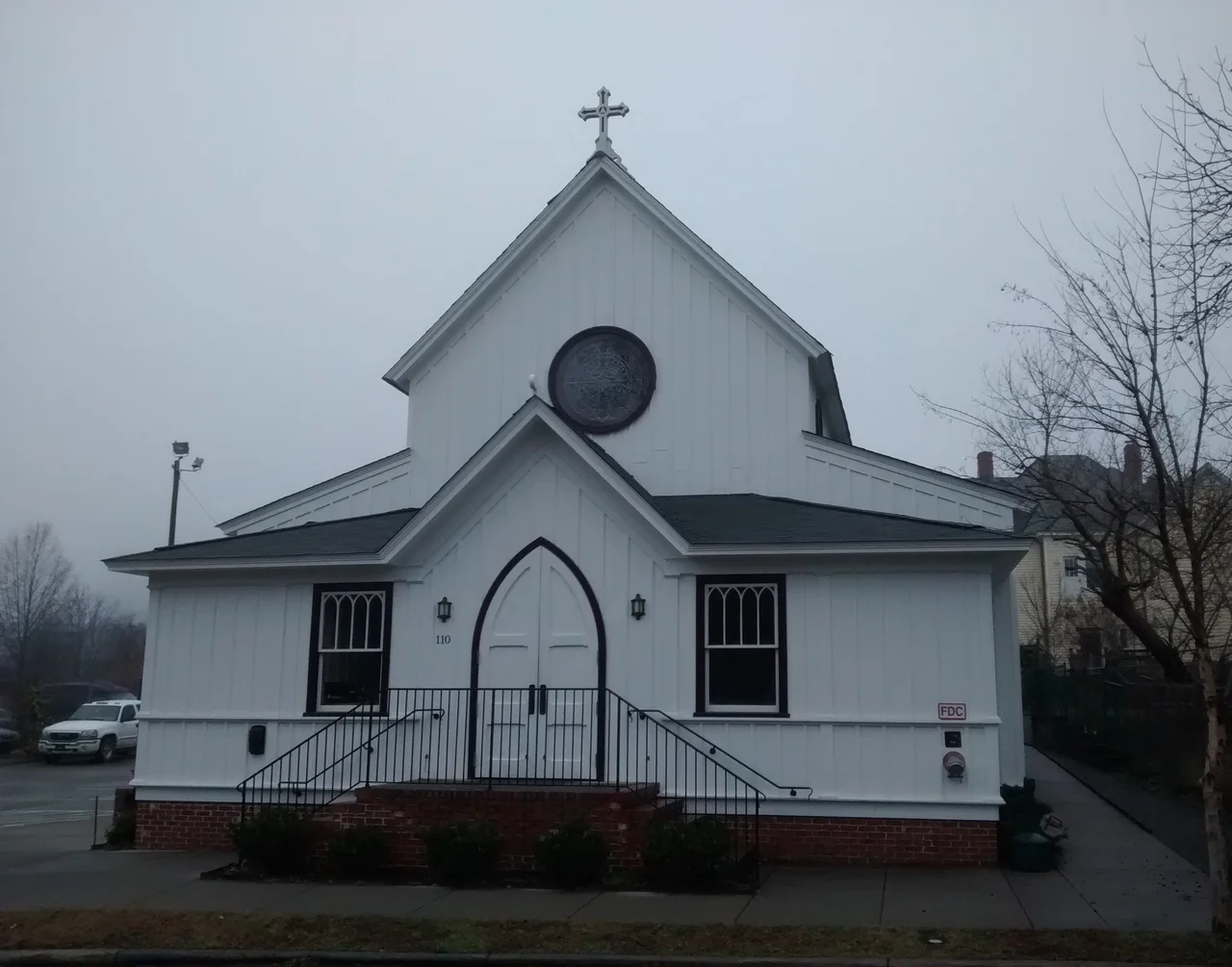

Church of the Good Shepherd
The argument was about pews. In Christ Church, Raleigh's first Episcopal parish, wealthy families paid annually for the right to sit in the better seats, and the poorer congregants were pushed to the back and the balcony. A faction said this was a quiet form of second-class citizenship inside the house of God. By the first days of 1874, the disagreement had broken the parish in two. The Reverend Edward R. Rich conducted the new congregation's first service in Tucker Hall on Fayetteville Street that February. They called themselves the Church of the Good Shepherd, and they meant the name as a statement.
Born From a Schism, Built in Stone
The breakaway parish moved fast. Within a year they had a sanctuary on East Street, designed by the painter and clergyman Johannes Adam Simon Oertel and first used on Easter Day, 1875. The little wooden chapel served them for a quarter century. By the 1890s, they had outgrown it. On All Saints' Day, November 1, 1899, the cornerstone of the present building went down before a crowd of government officials, college presidents, and parishioners. New York architect Robert W. Gibson drew up a sanctuary of North Carolina and New Hampshire granite roofed with native pine. The first services in the new space were held on Easter Day, May 17, 1914. The original chapel, now called All Saints Chapel, was rolled half a mile down East Street in 2006 to its current site near Historic Oakwood, where it still hosts weddings.
The Pro-Cathedral That Almost Was
For a few years in the mid-1890s, Good Shepherd carried the title of pro-cathedral of the Diocese of North Carolina. The bishop wanted it to become the permanent cathedral, and Rev. Isaac McKendree Pittenger, brought down from Long Island, was meant to lead that elevation. But the diocesan convention never produced enough votes. By late 1895, the title quietly fell away. The congregation kept building anyway, dedicating the new granite church as a memorial to the recently deceased Bishop Theodore B. Lyman. Inside, more than seventy stained glass windows installed between 1914 and the 1970s tell the New Testament in chronological order, from the Annunciation to the Ascension, with rose windows at both transepts and pieces from J&R Lamb Studios threaded throughout.
St. John's Guild, the Library, and a Hospital
Rev. Rich did not see his parish as a building. He saw it as an obligation. In October 1877, forty men from Good Shepherd founded the St. John's Guild to expand education, music, and public health in Raleigh. Two months later, on December 12, the guild opened the city's first free public library in the Holleman Building on Fayetteville Street. It closed in 1880 for lack of money. The hospital was more durable. The guild's St. John's Hospital, founded 1878, grew through the 1880s and 1890s. After the tanner John Rex's bequest came due, the guild sold the hospital to the Rex trustees in 1893; Rex Hospital opened in May 1894. Today UNC Rex Healthcare is one of the largest hospital systems in the state, with its roots in forty men answering a parish priest's call to do something useful.
Soup, Stained Glass, and the Long Argument
By 1979, Raleigh's homelessness crisis was visible. Boarding houses and low-cost motels were being torn down for gentrification, and shelters were few. The parish vestry approved a three-thousand-dollar trial grant. The Shepherd's Table Soup Kitchen opened in April 1980. In the first fourteen days it fed 473 people. Through the early 1980s it served about a thousand meals a month, mostly from donations. Today the kitchen is still operating. Inside the sanctuary, the Casavant Frères organ installed in 1982 has two manuals, twenty-seven ranks, and 1,346 pipes. The supper clubs include groups for young families and for the LGBTQ community. The parish that split in 1874 over who got to sit where has spent 150 years working out what that argument actually meant.
From the Air
The Church of the Good Shepherd stands at 35.780°N, 78.641°W, on the eastern edge of downtown Raleigh just west of the Historic Oakwood neighborhood. Its granite walls and steep roof are visible from low pattern altitudes around Raleigh Executive Jetport (KTTA, 25 miles southwest) and Raleigh-Durham International (KRDU, 12 miles northwest). From 2,500 feet AGL on a clear morning, the church and its larger neighbor Holy Name of Jesus Cathedral mark the religious corner of the downtown skyline.
Nearby Stories
- Sanford, North Carolina 7.6 km away
- Wilson, North Carolina 12 km away
- Cherry Hospital 13 km away
- Campbell University 19 km away
- North Carolina Tornado Outbreak of April 2014 21 km away
- Neuse River 23 km away
- Coal Glen Mine Disaster 26 km away
- Alamance County, North Carolina 27 km away