
Clem Jones Tunnel
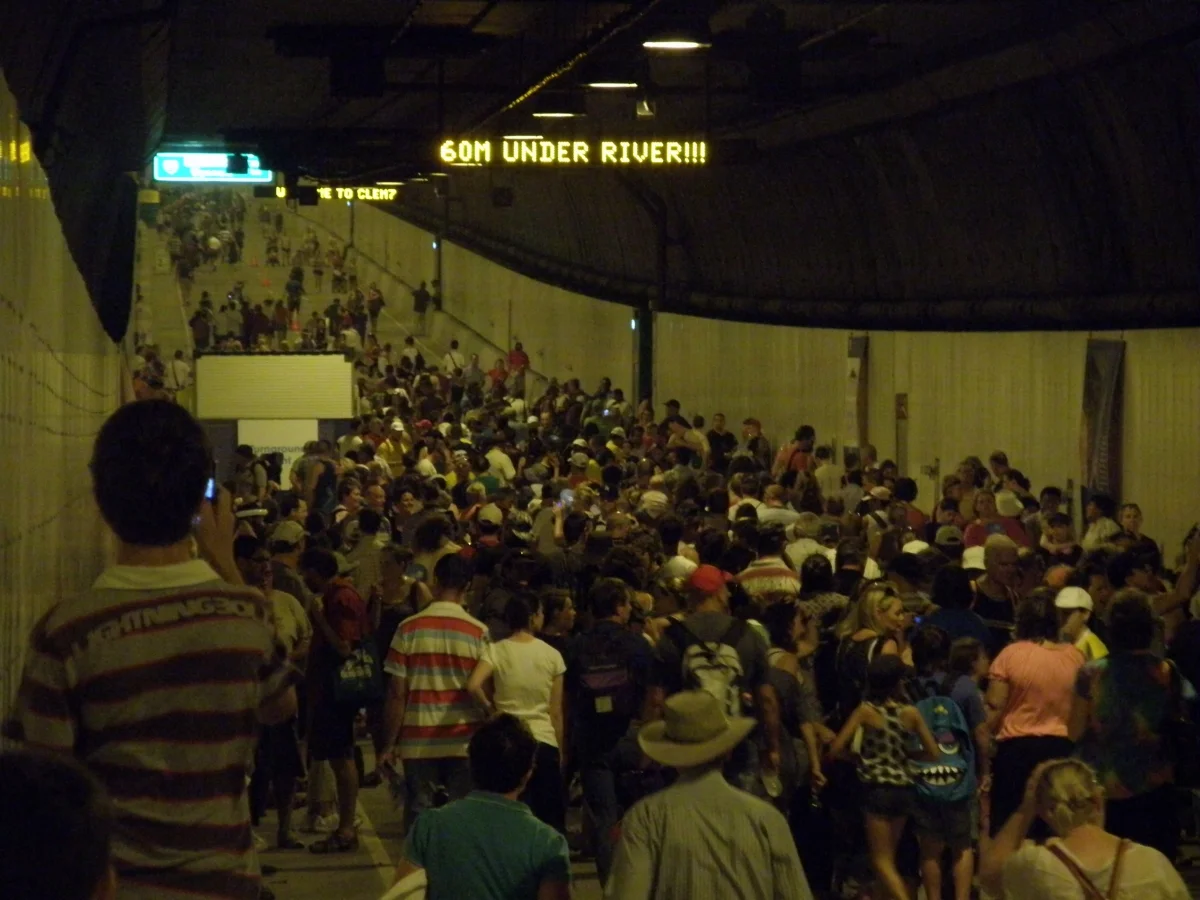
Just after midnight on 16 March 2010, the last barrier lifted and traffic flowed the full length of the CLEM7. Brisbane finally had its first major road tunnel beneath the river, 6.8 kilometres of motorway burrowed under the city at a cost of A$3.2 billion. It was an engineering triumph, finished on schedule and within budget. It was also, within a year, a financial catastrophe. The cars the forecasts had promised never came, and the company that built the tunnel collapsed under a mountain of debt.
Florence and Matilda
Two enormous machines did the digging, and Brisbane gave them names. Florence and Matilda were purpose-built double-shield boring machines, each costing A$50 million, and each had to chew through Brisbane tuff, the hard volcanic rock that underlies the inner city. They began at the northern end in late 2007 after the first borer arrived that July. The drilling was difficult and the rock unforgiving, but the machines pressed on, grinding out 3.5 million tonnes of spoil that travelled out by conveyor, into silos, and away by truck. Florence broke through in April 2009; Matilda followed in May. The finished tunnel ran in twin tubes, two lanes each way, linked by 41 cross-passages every 120 metres in case of emergency.
The Forecast That Failed
The numbers were the problem. Traffic consultants predicted around 60,000 vehicles a day at opening, ramping toward 100,000 by 2012. RiverCity Motorway, the private operator, had borrowed heavily against those projections, and the whole business case rested on them. Reality arrived fast and cold. A free trial period drew curious drivers, and a record 34,705 vehicles passed through on a single August day in 2010. But once the tolls began, the traffic thinned to barely 22,000 a day, less than half what had been promised. There was no ramp-up, no gradual climb toward the forecast. RiverCity slashed the toll to two dollars hoping to lure motorists back. It was not enough. Brisbane drivers had simply weighed the price against the eight minutes saved and kept to the free roads above. Shares listed at 46 cents sank toward two cents, and the investors who had bought into the dream watched their money evaporate.
Into Receivership
On 25 February 2011, less than a year after the tunnel opened, RiverCity Motorway was placed into receivership, unable to pay the interest on roughly $1.3 billion in debt. The asset itself was written down savagely, from billions to a few hundred million. For the ordinary shareholders there would be no dividend and no recovery. The tunnel worked exactly as designed and saved drivers an average of eight minutes, but a road that functions perfectly can still ruin the people who financed it. The CLEM7 became a textbook case, studied alongside Sydney's troubled tunnels as a warning about what happens when traffic forecasts meet human habit.
A Second Life Underground
The road did not close; only its owners changed. In December 2013, Queensland Motorways acquired the tunnel for $618 million from the receivers, a fraction of what it had cost to build. The following year Transurban Queensland took over, and the CLEM7 settled into ordinary working life as part of Brisbane's motorway network, carrying steadily more traffic as the city grew around it. The tunnel takes its name from Clem Jones, the long-serving lord mayor who reshaped Brisbane in the postwar decades. Its ventilation stacks rise red and purple above the streets, colours chosen to echo the poinciana and jacaranda trees that bloom across the city each year, a quiet flourish on a project whose story is otherwise written in spreadsheets and debt. The engineering was a success and the financing a disaster, and the CLEM7 remains both at once: a useful road, and a cautionary tale.
From the Air
The Clem Jones Tunnel runs beneath the Brisbane River between Woolloongabba and Bowen Hills, centred near 27.4634 degrees south, 153.0354 degrees east. From the air the tunnel itself is invisible, but its red and purple ventilation stacks (43 metres at Woolloongabba, 36 metres at Bowen Hills) and the broad sweep of the Brisbane River mark its line. The Story Bridge sits just downstream as a navigation landmark. Brisbane Airport (YBBN) lies about 12 kilometres to the north-east; Archerfield (YBAF) is roughly 10 kilometres to the south-west. Best viewed from 2,000 to 3,000 feet in the clear, dry air of a Brisbane winter morning.
Nearby Stories
- Redcliffe Peninsula 2.7 km away
- Tamborine National Park 12 km away
- Cressbrook Homestead 27 km away
- Main Range National Park 31 km away
- 2010-2011 Queensland Floods 38 km away
- Cape Byron 96 km away
- Cape Byron Light 126 km away
- HMS Porpoise (1799) 588 km away