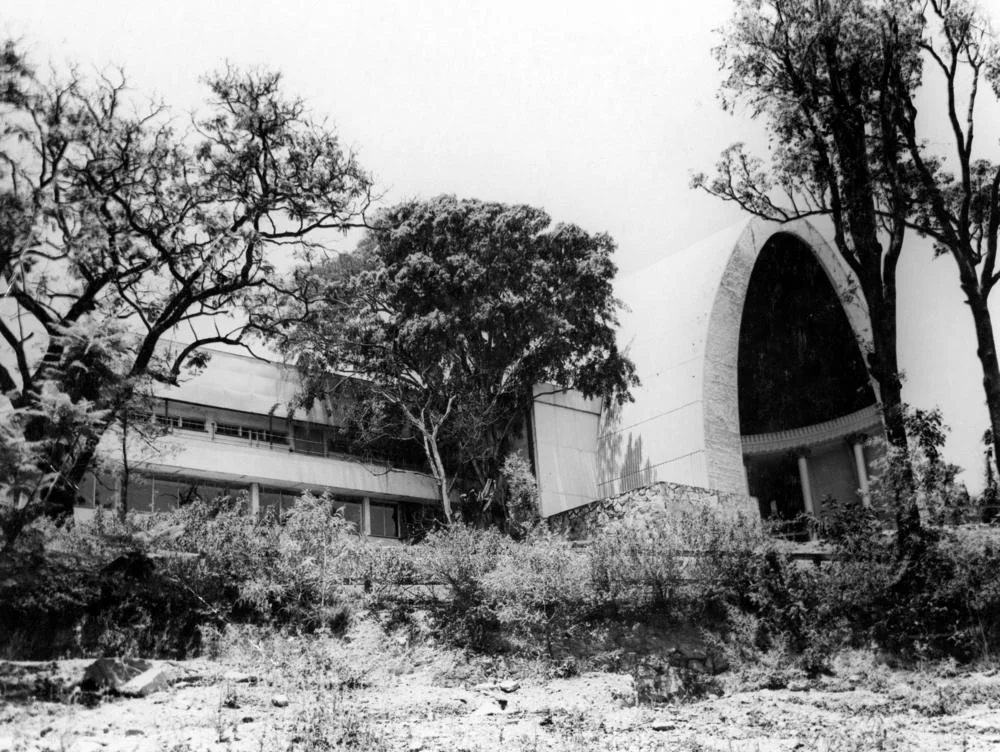

Cloudland
At four in the morning on 7 November 1982, demolition machines climbed a hill in Bowen Hills and tore down a Brisbane landmark before most of the city had woken. In less than an hour, Cloudland was gone. For more than forty years its great white arch had crowned Montpelier Heights, visible for miles, the doorway to a sprung dance floor where generations of Brisbane had waltzed, jived, and fallen in love. There was no demolition permit. The building carried a National Trust listing. None of it mattered. By breakfast there was rubble where the ballroom had stood.
The Floor That Moved
What people remembered most was the floor. The dancing area sat on huge metal coil springs set beneath the bearers, so that the close-fitting boards flexed and bounced as couples moved across them. The boards ran the length of the hall and were not even nailed down. Dancers could feel the floor breathe under their feet. Above them hung chandeliers and domed skylights; private alcoves framed the edges, and a tiered upper circle looked down on the stage. Opened in August 1940 and built of Queensland timber, Cloudland had been intended as the centrepiece of a Luna Park amusement ground. The fun park never fully arrived, but the ballroom became the largest dance hall in Australia, and the most beloved.
A Stage for Everyone
For decades the music never stopped. Resident orchestras played formal balls through the 1940s and 1950s, debutantes were presented under crossed swords, and graduation dances spilled into the small hours. The University of Queensland even sat its examinations here, students bent over papers where dancers had whirled the night before. In the 1960s a Brisbane promoter named Ivan Dayman turned Cloudland into a pop powerhouse, hanging a great mirror ball over the floor and running midnight-to-dawn dances with rising stars. Then came rock and roll. AC/DC played here on their TNT tour in November 1975. The Clash arrived in February 1982. Skyhooks, Cold Chisel, INXS, Split Enz, Madness and Echo and the Bunnymen all crossed that bouncing stage. A teenage talent quest had once featured three local brothers who would become the Bee Gees.
The Midnight Demolition
The men who pulled Cloudland down were the Deen Brothers, a wrecking crew the Queensland government and developers turned to for jobs that invited protest. Three years earlier the same crew had levelled the historic Bellevue Hotel, also under cover of darkness, despite public outcry, during the long premiership of Joh Bjelke-Petersen. Cloudland fell into the same pattern: a heritage building reduced to debris before anyone could mount a defence. There had been no permit, and the National Trust listing counted for nothing against a pre-dawn start. It became a symbol of an era when Queensland's past was treated as an obstacle to be cleared, demolished first and argued about later. Midnight Oil, who had played the hall many times, set the loss to music in their song Dreamworld, a furious lament for what greed had erased.
What the Hill Remembers
Apartments stand on the crest of Montpelier Heights now, and the funicular railway that once carried dancers up the steep slope is a memory dismantled back in 1967. Yet Cloudland refused to disappear entirely. A sculpture in Cowlishaw Street, the Cloudland Memorial Arch, echoes the shape of the lost entrance. A ballet bearing the ballroom's name premiered at the Brisbane Festival in 2004 and has since toured Europe. In 2009 a Fortitude Valley nightclub borrowed the name, and the state declared Cloudland one of Queensland's cultural icons. The building is gone, but in a city that lost it carelessly, the memory has only sharpened. Ask anyone in Brisbane old enough to have danced there, and watch their face change.
From the Air
Cloudland once stood on the crest of Montpelier Heights in Bowen Hills, near 27.4477 degrees south, 153.041 degrees east, on a hilltop roughly 150 feet above the surrounding streets. The ballroom is long gone, replaced by apartments, but the elevated ridge a little north-east of the Brisbane city centre still rises clearly above Fortitude Valley. The Brisbane River loops just to the south and west. Brisbane Airport (YBBN) is about 11 kilometres north-east; Archerfield (YBAF) lies roughly 13 kilometres south-west. Best appreciated from 2,000 to 2,500 feet on a clear winter morning, picturing a white arch that was once visible for miles.
Nearby Stories
- Redcliffe Peninsula 2.7 km away
- Tamborine National Park 12 km away
- Cressbrook Homestead 27 km away
- Main Range National Park 31 km away
- 2010-2011 Queensland Floods 38 km away
- Cape Byron 96 km away
- Cape Byron Light 126 km away
- HMS Porpoise (1799) 588 km away