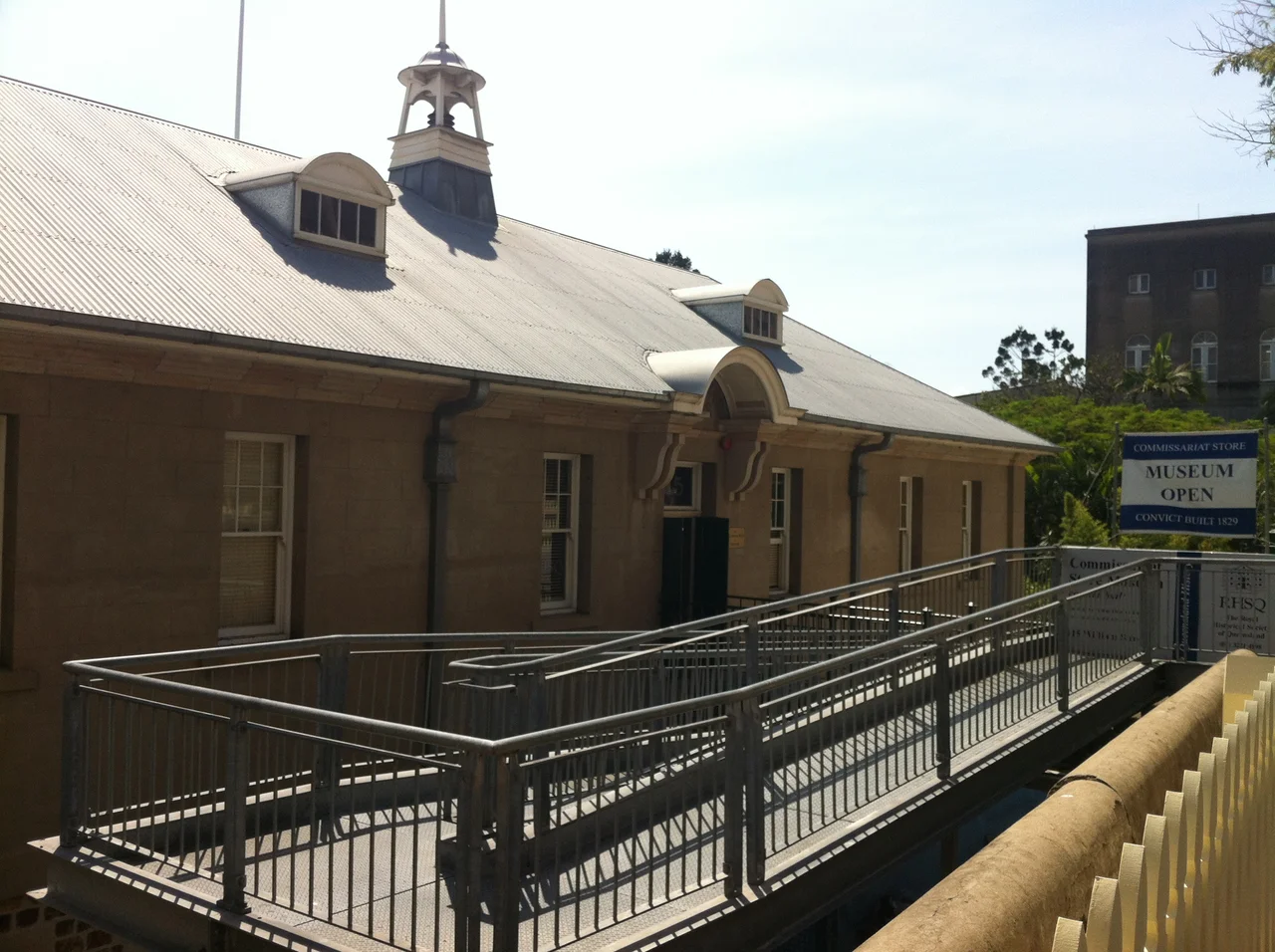

Commissariat Store, Brisbane
Stand on William Street and look at the squat stone building above Queens Wharf Road, and you are looking at work done by hand in 1829 by men who had no choice in the matter. The Commissariat Store is one of only two buildings left in Queensland from the convict era, and the oldest still in use. Convicts of the Moreton Bay penal settlement quarried its stone, hauled it up from the river, and laid it course by course. Nearly two centuries later, the store they built outlived the prison, the colony, and the empire that ordered it into being.
Built by Unfree Hands
The store rose between 1828 and 1829, and the labour behind it was hard and deliberately punishing. The heavy excavation fell to the Gaol Gang, convicts assigned the worst work as punishment within a settlement already built on punishment. These were transported men, sent to the far side of the world for crimes that ranged from theft to defiance, and at Moreton Bay under Commandant Patrick Logan their days were long and brutal. The skilled stonework needed expertise, so stonemasons and quarrymen were sent up from Sydney to direct it. The stone itself came from the Kangaroo Point cliffs, Brisbane tuff hauled across the river, with sandstone from Oxley Creek for the footings and sills. Lime for the mortar was burned from oyster shells gathered at Amity Point.
The Only Way In
For the penal settlement, this riverside spot was the front door. Every barrel of flour, every tool, every new arrival came in by ship to the wharf below, then up the steep bank along the line of what is now Queens Wharf Road. A crane at the jetty's end swung goods ashore, and the store received them. The windows were small, unglazed and barred, the roof clad in ironbark shingles, the whole form plain and heavy in the Georgian manner, a building that announced authority without ornament. When free settlement replaced the prison, the store simply kept working. From the 1850s it sheltered new immigrants who arrived faster than the barracks could hold them, a door cut into its northern side so families could enter without passing through the goods floor. The flow of people through this one building, convicts, then settlers, then officials, traces the whole early story of the city.
Bread or Blood
A building this old gathers history in its walls. In 1866, during a bitter economic depression, unemployed and hungry Brisbane workers marched in what became known as the Bread or Blood riots. A crowd tried to force its way into the store, which stood for the government and its grip on the essentials of life. The walls held. Over the following decades the building kept adapting: a third storey of brick was added in 1913 to give it a William Street address, an electric lift went in the next year, and government departments came and went through its rooms. Beneath the floorboards, archaeologists would later find thousands of fragments of nineteenth-century Brisbane, ceramic, glass and bone, a buried record of everyone who passed through.
The Keepers of the Stone
Since 1977 the Commissariat Store has belonged to the Royal Historical Society of Queensland, which keeps a museum, the Welsby Library and its collection within the old walls; the society has even taken the building's riverside face as its emblem. A careful restoration around the turn of the millennium repaired the stonework and reversed clumsier twentieth-century changes. The store is sometimes called the birthplace of Queensland, and it stands today amid the most cohesive group of colonial government buildings in the state. But its deepest significance is simpler and harder. It is a thing that convict hands made, still standing, still in use, a stubborn witness to the men whose labour built a city they were never free to enjoy.
From the Air
The Commissariat Store sits on William Street in the Brisbane central business district, near 27.4733 degrees south, 153.0243 degrees east, on the ridge above a sharp bend of the Brisbane River. From the air, locate the tight loop of the river that wraps the city centre; the store stands on the western bank within the cluster of older government buildings near the Queen's Wharf precinct. Brisbane Airport (YBBN) lies about 13 kilometres to the north-east, and Archerfield (YBAF) roughly 9 kilometres to the south-west. Best viewed from 2,000 to 3,000 feet in clear conditions, with the river and the heritage rooftops as your markers.
Nearby Stories
- Redcliffe Peninsula 2.7 km away
- Tamborine National Park 12 km away
- Cressbrook Homestead 27 km away
- Main Range National Park 31 km away
- 2010-2011 Queensland Floods 38 km away
- Cape Byron 96 km away
- Cape Byron Light 126 km away
- HMS Porpoise (1799) 588 km away