
Crabtree Jones House
When the developers came in 2012, the Crabtree Jones House had been sitting on its hill for two hundred years. Built between 1808 and 1811 by Nathaniel "Crabtree" Jones, planter and politician, the Federal-style frame house had outlasted three British monarchs, Sherman's army, and the city that grew up around it. What it could not outlast was the apartment plan the new owners wanted to build on its acre. So Preservation North Carolina did something usually reserved for lighthouses and covered bridges. They lifted the house, drove it half a mile down the road, and set it back down in a 1960s subdivision next to the Jones family cemetery.
Two Hundred Years on Crabtree Hill
The Jones land traced back to a 1740s grant from the Earl of Granville to Francis Jones. The family wanted high ground away from Crabtree Creek, and Nathaniel Jones built his new house on one of the steepest hills around, forty feet above the surrounding fields and a hundred feet above the creek that gave him his nickname. When the house was finished around 1808, the new city of Raleigh, chartered in 1792, was barely visible. Jones served as county sheriff, state congressman, and was among the original Raleigh landowners. He held lot number 201. Dendrochronology in 2014 confirmed the front of the house was built in 1808-09 and the stairwell completed in 1811. He passed the estate to his son Kimbrough, who served in the state legislature.
Tobacco, Confederate Camps, and Sherman
The estate's main antebellum crop was tobacco. The enslaved people who grew it left almost no documented voices, but their labor built the prosperity that paid for the porches and the silver. Camp Crabtree, a Confederate training facility, stood on the Jones land during the Civil War. When Sherman's army reached Raleigh in 1865, his troops moved through the house and stripped it bare. Kimbrough wrote that he could not describe the destruction. Everything but the beds, bureaus, wardrobes, and a few chairs was gone. He died the next year, leaving the place to Kimbrough Jr. The family stayed on the land. Their cash crop shifted to cotton. In 1934 the house made the cover of The Progressive Farmer magazine, by then a relic that still worked.
Federal Bones, Italianate Porches, Termite Floors
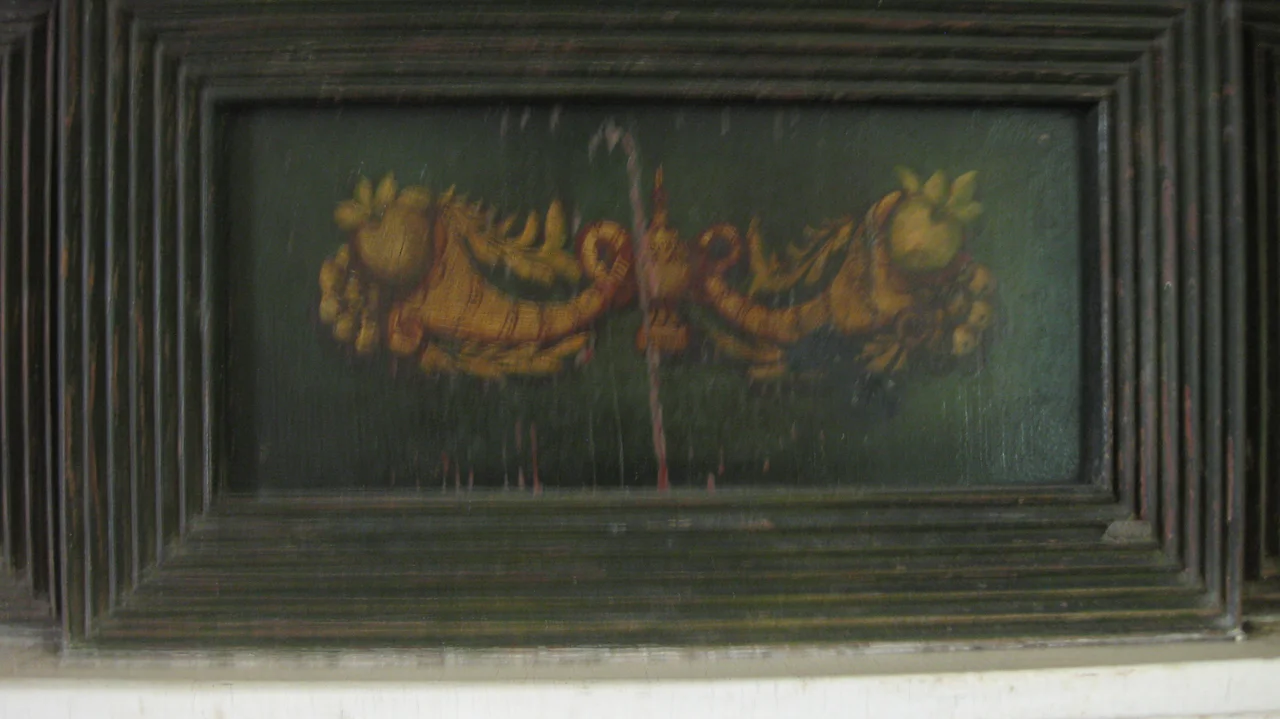
The main block is classic early Federal: a two-story central section, five bays across, flanked by single-bay one-story wings. The front door opens directly into the dining room, which would have served as both eating space and the formal hall. A six-paneled wooden door, hand-cut beams, and original mantels survive in places. Floor joists everywhere show termite damage in varying stages of slow decay. The porches that came and went over two centuries tell their own story: a highly decorated Italianate porch was added mid-nineteenth century, then replaced with a plainer one around 1900, then removed entirely for the 2014 move. Painted decorative motifs still adorn the dining room mantel. An English basement was demolished before the move; archaeological digs at the receiving site turned up little of note.
Saving the Bones, Losing the Hill
By the 1990s, developers had bought up most of the surrounding land. By the early 2000s, only the house and a single acre remained. Charles Gaddy, the 1973 owner who had promised preservation, died in 2005. The land transferred to a development group in 2009, and apartments were planned. The Junior League had once estimated restoration at forty-five thousand dollars; the total budget for the 2014 move came to roughly six hundred and thirty thousand dollars. Preservation North Carolina struck a deal. The house was lifted off its foundation, moved a half mile along Hillmer Drive, and set down near the Jones family cemetery in a quiet 1960s subdivision. Some neighbors fought the project all the way to Wake County superior court. The hill the house had occupied for two hundred years is now an apartment complex. The Federal house at 3108 Hillmer Drive still stands. It is no longer where Nathaniel Jones built it, but it still exists, which is more than most plantation houses can say.
From the Air
The Crabtree Jones House sits at 35.822°N, 78.624°W in north Raleigh, just north of the Crabtree Valley shopping district and west of the namesake creek. Raleigh-Durham International (KRDU) lies six miles northwest. From 2,000 feet AGL the surrounding 1960s suburban grid contrasts sharply with the heavily wooded ridge where the house originally stood half a mile east. Best viewed late afternoon when low sun illuminates the white clapboard walls.
Nearby Stories
- Sanford, North Carolina 7.6 km away
- Wilson, North Carolina 12 km away
- Cherry Hospital 13 km away
- Campbell University 19 km away
- North Carolina Tornado Outbreak of April 2014 21 km away
- Neuse River 23 km away
- Coal Glen Mine Disaster 26 km away
- Alamance County, North Carolina 27 km away