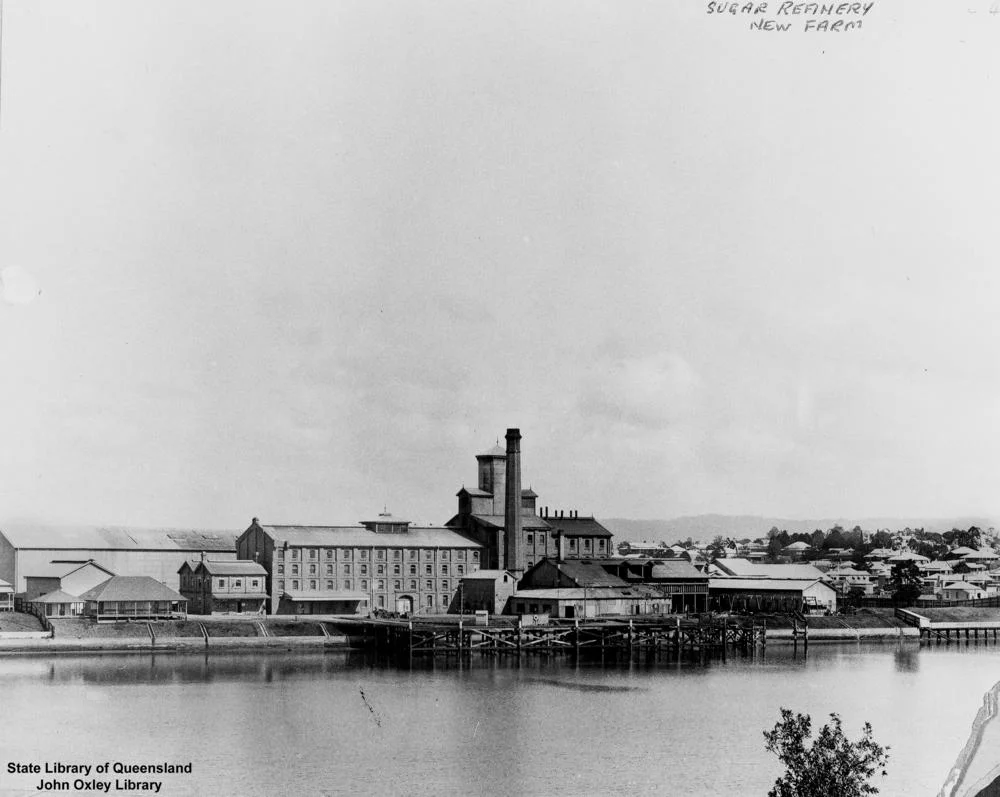

CSR Refinery, New Farm
Sugar built this place, and sugar shaped a whole stretch of the Brisbane River around it. The CSR Refinery rose at New Farm in 1892 and 1893, a long narrow building of dark face brick five storeys tall, set hard against the water with its own wharf in front. For more than a hundred years raw sugar came up the river by ship and left as something white and refined. The machinery is mostly silent now and people live behind those brick walls, but the great char tower still climbs above the rooftops, a landmark that has watched the river for over a century.
The Empire of Sweetness
By the 1890s one company had come to mean sugar in Australia. The Colonial Sugar Refining Company, founded in Sydney in 1855, was building a chain of refineries across the nation's capital cities, and Brisbane's was the fourth, after Sydney, Melbourne and Adelaide. CSR chose a site of nearly three acres on the New Farm peninsula, where deep water let large ships dock close to the city's markets. Local architects John Hall and Sons supervised the work. Construction was interrupted by the great Brisbane flood of 1893, the river rising over the very ground the refinery would depend on, but the complex was finished later that year. Its arrival, and CSR's lobbying for a branch railway, helped turn this reach of the river into Brisbane's industrial heart.
Inside the Brick Box
The main building was a study in industrial purpose. Load-bearing walls of face brick, laid in English bond around a frame of timber and cast iron, rose in repetitive bays divided by pilasters, each bay pierced by twelve-paned arched windows. Inside, the work of refining moved through named stages: the pan house and refined sugar store at the southern end, the cistern house and char house at the northern. Char, made from charred bone, filtered the colour out of the sugar, and it was stored in a hexagonal tower that still rises above the northern roof, crowned with a decorative finial. The form was severe and the ornament restrained, but the building had a confident vertical grace that marked it out along the riverbank.
A Working Community
A refinery is also the people who run it, and the New Farm site grew the small comforts of a working community over its long life. On the river's edge stood the Brown Room of 1901, a verandahed timber building used as a tea room for senior staff, later joined by a 1952 brick canteen block with polished hardwood floors and a kitchen at one end. Around the buildings grew Moreton Bay figs, poincianas, frangipanis and mango trees, softening the hard industrial edges. A white picket fence ran the length of the river frontage, lending the place an almost residential air. For the men and women who worked here, some across more than one generation, the refinery was not just a factory but a fixture of their family histories.
From Refinery to Riverside Living
Sugar refining at New Farm eventually ended, and the question became what to do with a vast and beloved industrial relic. The answer was Cutters Landing, a residential precinct that made the old refinery its centrepiece, converting the brick main building into loft-style apartments and turning the 1901 recreation room into a gym. The wharf and segments of the old railway line were woven into the public spaces. Today the CSR Refinery is one of the last nineteenth-century industrial sites left on the inner reaches of the Brisbane River, and among the last to keep its wharf. People sleep now where char once filtered sugar, and from the eastern bank of the river the dark brick and the tall tower still read, unmistakably, as a place where something was made.
From the Air
The former CSR Refinery stands on Lamington Street at New Farm, on the western bank of a bend in the Brisbane River, near 27.4657 degrees south, 153.052 degrees east. From the air, look for the New Farm peninsula east of the city centre, with the refinery's dark brick mass and hexagonal char tower beside the river, just north of New Farm Power Station and south of the Teneriffe woolstores. Brisbane Airport (YBBN) lies about 9 kilometres to the north-east; Archerfield (YBAF) is roughly 11 kilometres to the south-west. Best viewed from 1,500 to 2,500 feet in clear conditions, with the river bend and riverside industrial heritage as your guides.
Nearby Stories
- Redcliffe Peninsula 2.7 km away
- Tamborine National Park 12 km away
- Cressbrook Homestead 27 km away
- Main Range National Park 31 km away
- 2010-2011 Queensland Floods 38 km away
- Cape Byron 96 km away
- Cape Byron Light 126 km away
- HMS Porpoise (1799) 588 km away